Release day is close, the build is green, QA has signed off, and someone asks the question every team eventually hears too late: “Who’s writing the release notes?”
That’s usually when the scramble starts. Engineers skim commits. Product checks Jira. Support remembers three customer-facing fixes that never made it into the draft. Marketing wants a cleaner summary. By the time the notes go live, they’re either too technical to help users or so vague they don’t explain what changed.
Good application release notes don’t happen at the end of the release process. They come from a workflow that starts much earlier, while changes are still being built, reviewed, and deployed. When teams treat release notes as part of delivery instead of an afterthought, they publish faster, miss fewer details, and give users a much clearer picture of what shipped.
Table of Contents
- Why Well-Crafted Release Notes Are a Secret Weapon
- Sourcing Your Release Information Systematically
- Writing and Formatting Notes Users Will Actually Read
- Publishing Strategies for Different Channels and Audiences
- Automating Release Notes with CI/CD and Modern Tools
- Enterprise-Grade Notes for Rollbacks and Compliance
Why Well-Crafted Release Notes Are a Secret Weapon
Many still treat application release notes like packaging material. Necessary, but not important. That mindset creates weak notes because the writing starts after all the meaningful decisions have already happened.
The better view is simple. Release notes are part of product communication. They tell users what changed, why it matters, and what they should do next. Guidance on release-note structure has moved well beyond raw engineering logs and now recommends a user-facing format with a header, overview, issue summary, resolution, and impact section, with fuller explanations for major releases and short summaries for minor ones, as outlined in this guide to release note structure.
That shift matters because users don’t experience your product as a sprint board. They experience it as trust. If the app changes and they don’t understand why, confidence drops. If a feature ships and nobody notices, the release still happened, but the value didn’t land.
What strong notes actually do
Good release notes help in three ways:
- They set expectations: Users learn whether a change is cosmetic, operational, or something that requires action.
- They surface value: A feature announcement buried in a store description or support article won’t get the same attention as a timely release note.
- They reduce confusion: Support teams spend less time explaining whether an issue is fixed, changed, or still rolling out.
Practical rule: If a user can’t tell whether a release affects them within a few seconds, the note is written for the team, not the customer.
This is especially important in products with recurring updates. Frequent change without clear communication feels unstable. Frequent change with clear communication feels active and responsive. That difference influences adoption, customer confidence, and retention over time. Teams thinking about engagement should treat release communication as part of the same system as onboarding and habit formation, not as separate admin work.
What weak notes look like
Weak notes usually fail in one of three ways.
| Problem | What users see | What it causes |
|---|---|---|
| Too technical | Internal wording, ticket IDs, implementation details | Users ignore the update |
| Too vague | “Bug fixes and improvements” | Users learn nothing |
| Too late | Notes published well after the release | Users connect change to confusion, not to guidance |
Well-crafted release notes aren’t a side task. They’re one of the few product artifacts that sit directly between shipping and understanding. That’s why they’re a secret weapon. Teams often underinvest in them, which means a disciplined team can stand out quickly just by being clearer.
Sourcing Your Release Information Systematically
Bad release notes usually start with bad collection. If your inputs are scattered across GitHub, Jira, Slack, QA threads, and support tickets, the writing process becomes guesswork.
A solid workflow starts by pulling changes from development, version-control, and project-management systems, then sorting them by user impact so the important items appear first and breaking changes are clearly flagged. That structure is recommended in this release-note workflow template from monday.com, and it lines up with what experienced teams do in practice.
Build one input pipeline
Don’t ask a writer or PM to “figure out what shipped.” Build a release intake process that answers that question before the draft exists.
A practical pipeline usually pulls from:
-
Version control Commit history gives you the factual record of code movement. If your team uses Conventional Commits, extraction gets easier because
feat,fix,refactor, andbreakingalready carry intent. A team standard for commit messages pays off again when you start automating CI/CD with Conventional Commits. -
Project management Jira, Linear, Asana, or ClickUp often contain the plain-language description that Git lacks. Tickets also carry acceptance criteria, labels, priorities, and linked customer requests. That context helps you decide whether a change belongs in the release notes at all.
-
Support and success inputs Support knows which bugs hurt users. Customer success knows which account asked for a feature. If you ignore these channels, your notes will overrepresent backend work and underrepresent what customers care about.
-
QA and release management QA can confirm what made the release cut. That sounds obvious, but teams often write from “planned” changes instead of “shipped” changes.
Collecting release material is less about finding everything that changed and more about identifying what a user would notice, what an operator must know, and what a developer may need later.
Rank changes before writing
Once the raw list exists, sort it into impact tiers. Don’t start drafting from a flat backlog dump.
Here’s a simple triage model:
- Tier A: New features, major UX changes, breaking behavior, pricing or access changes, security-relevant fixes
- Tier B: Meaningful improvements to existing workflows, reliability fixes users can feel, important admin changes
- Tier C: Minor fixes, visual polish, low-visibility maintenance work
This ranking solves two common problems. First, it keeps high-impact items from getting buried under a pile of tiny fixes. Second, it makes approval easier because reviewers can focus their attention where risk is highest.
Create a release-note source of truth
The draft itself shouldn’t be the source of truth. Use a structured release record before writing begins.
Include fields like these:
- Version or build identifier
- Release date
- Change owner
- User-facing summary
- Audience
- Risk level
- Action required
- Rollback considerations
- Links to ticket, PR, and docs
That record can live in Notion, Airtable, Google Sheets, a markdown file in the repo, or a release database. The tool matters less than consistency. What matters is that every shipped item passes through one place before someone writes prose.
When teams do this well, writing becomes editing. When they skip it, writing becomes archaeology.
Writing and Formatting Notes Users Will Actually Read
A lot of application release notes fail because they preserve the shape of internal work. Users don’t care that a controller was refactored or that a migration script was cleaned up. They care that login works more reliably, a report is easier to export, or a frustrating bug is gone.
Industry guidance consistently recommends segmenting notes into categories like New, Improved, and Fixed, and it specifically points out that quantified outcomes such as “search results now load 40% faster” are easier to read than implementation details, as shown in these release note examples from Appcues.
Use a structure people can scan
That advice works because most users scan first and read second. A clear format reduces friction.
A practical layout looks like this:
| Element | What it should contain |
|---|---|
| Header | Product name, release number, date |
| Summary | One plain-language paragraph on what changed |
| New | Fresh capabilities or newly available workflows |
| Improved | Existing features that now work better |
| Fixed | Bugs resolved or issues addressed |
| Action required | Anything users or admins need to do |
| Technical appendix | Optional notes for developers, admins, or support |

Formatting matters as much as wording. Short sections, visible labels, and dated entries make release histories easier to skim. If your changelog spans many releases, give users a searchable archive rather than forcing them to scroll through a long blog feed.
Translate technical work into user value
The key skill is translation. The engineering truth has to stay intact, but the language has to shift from implementation to impact.
Here’s a before-and-after example:
Before
Refactored search index pipeline and optimized async query handler.
After
Improved
Search results now load 40% faster in common queries, which means less waiting when filtering large datasets.
The second version tells users what changed, where they’ll feel it, and why they should care. It doesn’t hide the technical work. It interprets it.
Another example:
- Weak: Fixed issue with token refresh edge case
- Better: Fixed a sign-in issue that could log some users out during long sessions
The strongest notes usually do three things in one sentence:
- state the visible change
- name the affected workflow
- explain the effect on the user
A practical template
You don’t need clever prose. You need repeatable wording that keeps quality high.
Use this pattern:
- Lead with the user-visible outcome
- Add just enough context
- Close with impact or action
Examples:
- New Shared dashboards can now be duplicated across workspaces, which makes it easier for admins to standardize reporting setups.
- Improved Export settings now persist between sessions, so teams don’t need to reselect the same options each time.
- Fixed An issue that prevented some image attachments from appearing in comment threads.
If you manage mobile or hybrid apps, it also helps to keep one style guide for both release notes and changelogs so your voice stays consistent across app stores, in-app notices, and internal documentation. A useful operational reference is this Capacitor changelog management guide.
Keep implementation details out of the main body unless they change setup, migration, or compatibility. Most users don’t need architecture. They need consequences.
One last rule. Never let “bug fixes and improvements” stand on its own. That phrase tells readers you shipped something but not whether it matters to them. If a fix is worth shipping, it’s worth naming clearly.
Publishing Strategies for Different Channels and Audiences
The same release shouldn’t read the same way everywhere. Internal developers, end users, support agents, and beta testers don’t need identical detail. If you push one generic note across all channels, each audience gets the wrong level of information.
For multi-audience products, a practical pattern is a layered format: start with a short plain-language summary, follow with user-facing details, then add an optional technical appendix for implementation notes, API or migration guidance, and troubleshooting. That approach is described in this ServiceNow discussion of release-note best practices.
One release, multiple readers
Here’s how those audiences differ in practice.
| Audience | What they need | What to avoid |
|---|---|---|
| End users | Clear benefits, visible changes, action items | Ticket IDs, implementation detail |
| Technical audience | Version details, migrations, API notes, known issues | Marketing phrasing without specifics |
| Internal teams | Support guidance, rollout timing, escalation context | Public-facing simplification that hides operational risk |
| Beta testers | What changed in this cohort, what feedback is needed | Full company-wide changelog noise |
A layered note lets you write once and publish many times. The summary becomes an in-app card or push message. The middle layer becomes the public changelog entry. The appendix can go into docs, a GitHub release, or an internal wiki.
Choose the right channel for the job
Some channels are better for speed. Others are better for detail.
- In-app notifications: Good for brief summaries tied to the moment a user encounters change.
- Changelog pages or blog posts: Better for durable history, search, and linking.
- Email digests: Useful for admins, champions, and customers who don’t log in daily.
- Internal chat or wiki: Best for support scripts, rollout status, and incident context.
- Developer docs or GitHub releases: Right place for API, SDK, or migration detail.
The mistake is copying the full note into every destination. Tailor the top layer to the channel, then link readers to the deeper layer if they want more.
If your team already manages documentation and release assets across several systems, it helps to standardize how those items move from draft to published state. A practical reference for that broader workflow is MeshBase’s guide to managing content publication, especially if release notes sit beside docs, updates, and knowledge-base content.
A user opening your app wants reassurance and relevance. A developer reading release history wants precision. A support lead wants both.
The most effective release-note programs treat publishing as distribution design, not copy-and-paste. Same release. Different packaging.
Automating Release Notes with CI/CD and Modern Tools
Manual release notes break down when shipping gets frequent. The draft falls behind the build, someone forgets to include a fix, and the published note no longer matches what’s live.
Automation fixes the repetitive parts. It doesn’t replace judgment.

What to automate and what to keep human
The best split is straightforward.
Automate:
- Change extraction from commits, merged pull requests, labels, and linked issues
- Draft assembly into your release-note template
- Version and date insertion
- Publishing steps to a changelog page, GitHub release, or CMS
- Notifications to internal teams after approval
Keep human review for:
- Priority and ordering
- User-facing wording
- Sensitive changes
- Breaking or rollback language
- Any claim about performance, compatibility, or required action
That division saves time without publishing robotic notes. Your pipeline gathers facts. A reviewer makes them useful.
A workable pipeline
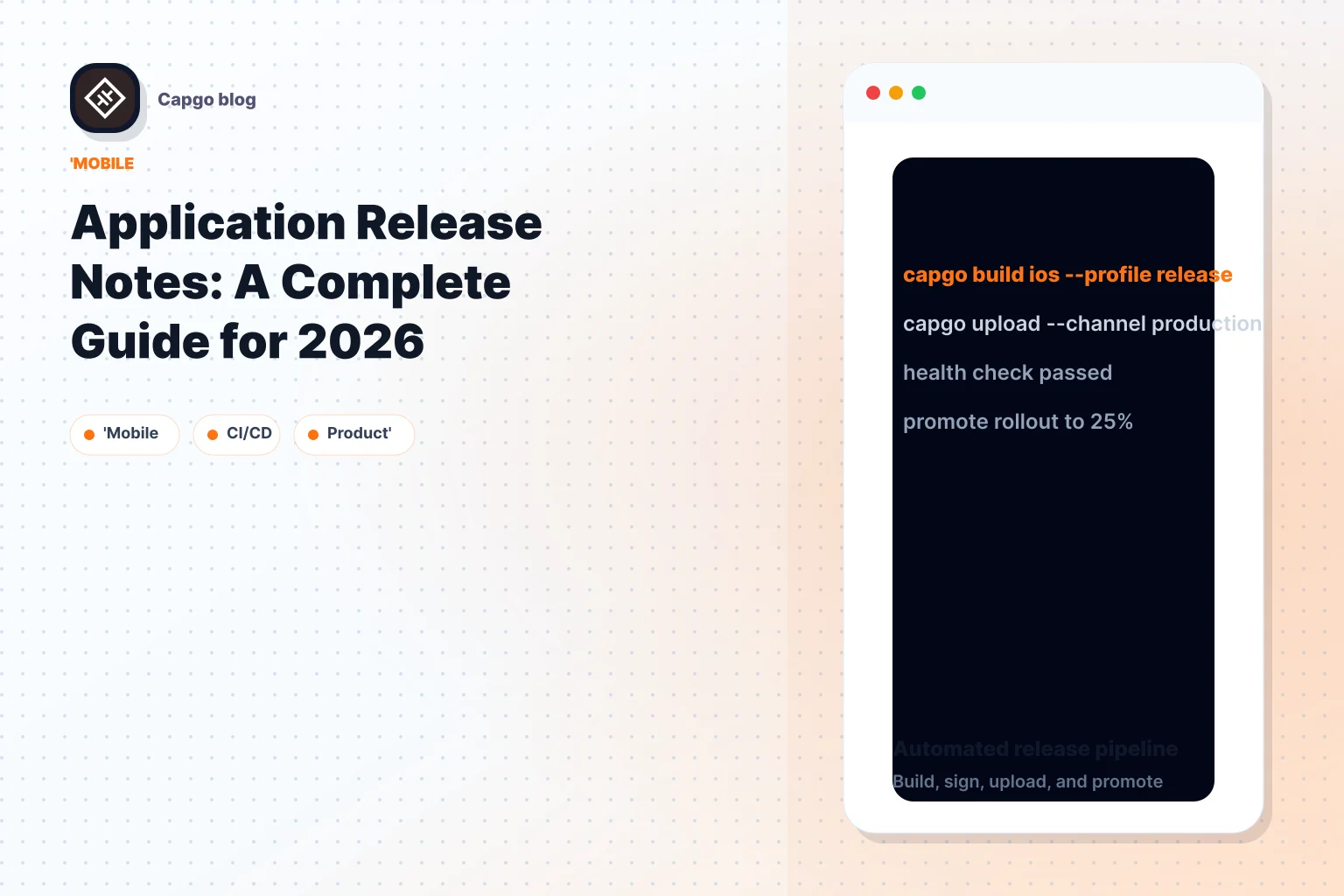
A practical automation flow in GitHub Actions, GitLab CI, or another CI/CD system usually looks like this:
- A release tag or merge to a release branch triggers the job.
- A script pulls merged PR titles, commit messages, and linked issue metadata.
- The pipeline groups items by labels such as feature, fix, and breaking-change.
- It generates a markdown draft with sections in your standard format.
- A reviewer edits the summary and any high-risk entries.
- Approval publishes the notes and attaches them to the release artifact.
You can build this with custom scripts, release tooling in your platform, or dedicated helpers. If you want ideas for the tooling layer, it’s worth taking a look at communities that explore innovative tools like Releasebot, especially for teams trying to reduce the manual cleanup after draft generation.
A team running Capacitor apps can also wire note generation into its deployment pipeline and approval flow. This GitHub Actions integration guide for Capgo shows one way to connect build automation with live update delivery.
Here’s a walkthrough of the automation flow in video form:
Live updates change the timing
Live update environments add a wrinkle. In a traditional store-based release, notes often align to a version pushed through app review. In a live update workflow, users may receive JavaScript, CSS, copy, config, or asset changes outside the store release cycle.
That means your release-note process needs to answer two separate questions:
- What shipped in the binary release?
- What changed in the live bundle after that?
If you support over-the-air delivery, keep a visible distinction between binary notes and post-release update notes. Otherwise support teams won’t know which changes are tied to a store version and which arrived later. One option in that space is Capgo, which publishes signed web bundles for Capacitor apps and keeps version history, logs, and rollback data tied to update delivery.
Automation works best when it reflects your actual release model. If your team ships continuously, your notes should be generated continuously too, with a review checkpoint before publication.
Enterprise-Grade Notes for Rollbacks and Compliance
Enterprise release notes carry more weight because they’re not just public updates. They can become audit artifacts, support evidence, incident references, and proof of operational control.
That changes how you write them. Brevity still matters, but traceability matters more.

Write for audits, not just announcements
A public note may say “Improved account recovery.” An enterprise release record should also preserve the version, release date, approver, related tickets, risk classification, affected systems, and any operational instructions.
That doesn’t mean putting everything in front of every reader. It means storing release notes as a versioned record with layers of detail. Public summary on top. Internal evidence underneath.
For teams in regulated sectors, a useful baseline is:
- Immutable release history
- Named owners and approvers
- Linked implementation records
- Clear status for shipped, rolled back, or superseded releases
- Separate handling for hotfixes and emergency changes
Rollback notes need their own format
Rollback communication often gets improvised in the middle of an incident. That’s risky. A rollback note should be a first-class release artifact.
Use a short structure:
| Field | Example content |
|---|---|
| Rolled-back release | Version or update identifier |
| Reason | User-facing issue, stability concern, compatibility problem |
| Scope | Who was affected |
| Action | What the team did |
| Current state | Reverted, paused, redeploying, monitoring |
| User guidance | Anything users or admins should do |
A rollback note should never read like an apology without information. It should explain the operational state clearly and avoid hiding the fact that a change was reverted. If your app supports live updates, rollback controls need to be tied closely to release history and deployment channels. In this context, a documented process for configuring rollback for Capacitor updates becomes part of release communication, not just incident response.
The worst rollback note says almost nothing. The second worst pretends the rollback didn’t happen.
Measure whether notes changed behavior
There’s one problem many teams still haven’t solved. They publish release notes, but they can’t show whether anyone acted on them.
Product analytics vendors report that release-note pages often function as a passive announcement channel, while teams struggle to connect them to adoption, support deflection, or feature discovery, as noted in this CalHEERS release-notes document. That gap matters more in enterprise settings because release communication often needs to justify its effort.
A practical approach is to define a small set of signals before publication:
- Feature discovery: Did users open or use the changed workflow after the note went live?
- Support impact: Did questions about the affected issue decrease?
- Admin behavior: Did targeted accounts complete the requested action?
- Incident clarity: During rollback or phased rollout, did support use the note as the reference point?
You won’t get perfect attribution. That’s fine. The goal is to stop treating release notes as a static document and start treating them as an operational lever.
If your team ships frequent updates to a Capacitor app, Capgo is one way to connect deployment, version history, rollback control, and release communication in the same workflow, especially when store releases and live updates need separate visibility.