Glad you asked.
I am not giving legal advice. I am sharing what’s practical and widely used across teams shipping Capacitor apps safely.
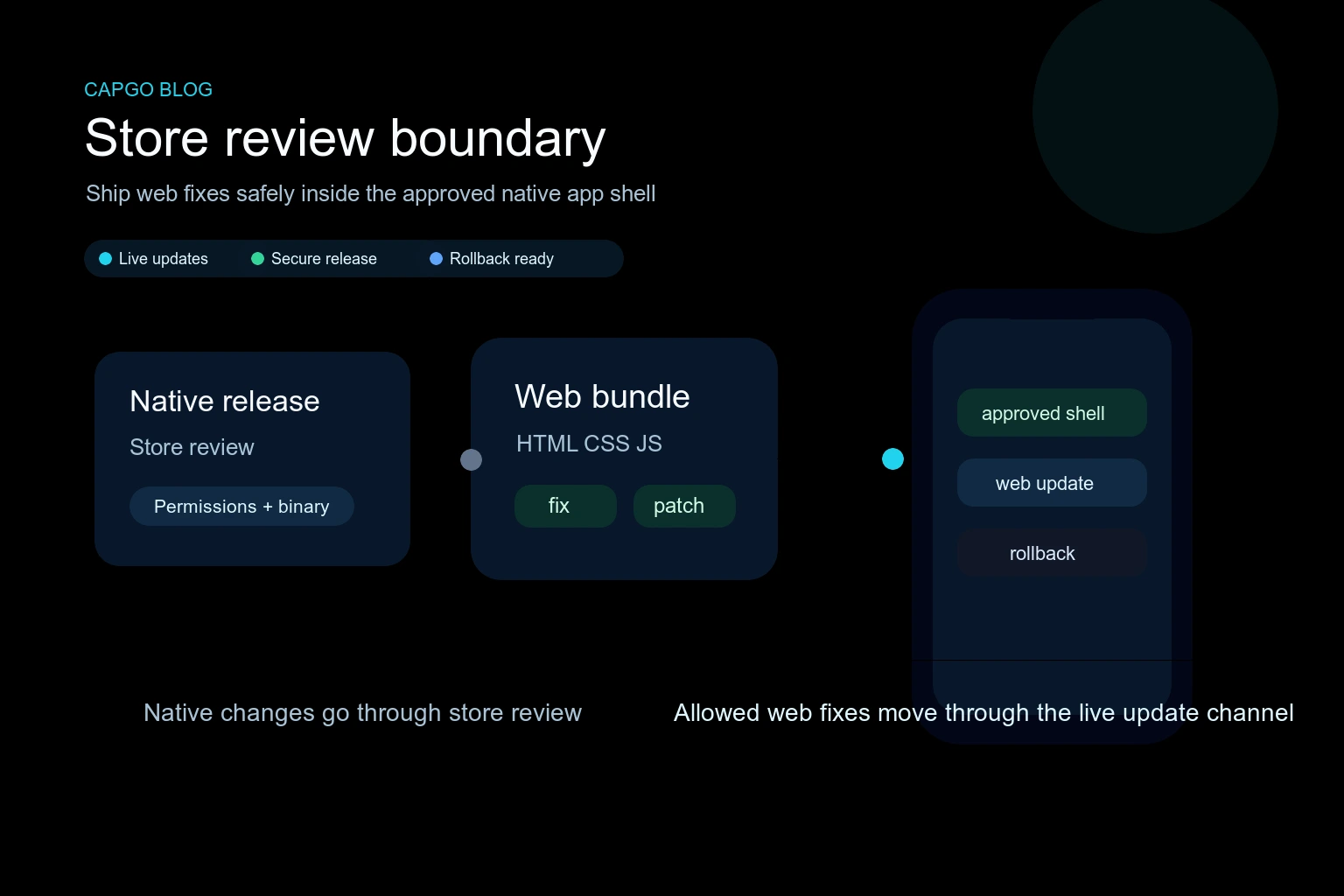
The important distinction is this:
- Native submission is still required for new native behavior and major capabilities.
- Live updates are for JavaScript/web fixes and adjustments inside your existing app scope.
Both iOS and Android can use this model, but you must treat it as a policy-safe workflow, not a loophole.
What Apple and Google allow in simple terms
You can treat Apple and Google as sharing a similar boundary:
- You can deliver code interpreted by the embedded web layer (HTML/CSS/JS) without resubmitting.
- You should not use that channel for major feature additions that change app purpose.
- You should not alter critical security or distribution controls through JS alone.
Apple’s official guidance around WebKit/JavaScript updates is the core of this model. Google is typically less restrictive for web-based updates, but the same principle applies: keep native changes in a native release.
What Capgo is good for
Capgo is for:
- hotfixing web bugs,
- safe UI copy / style / flow fixes,
- minor logic corrections in existing pages,
- fast experimentation for internal QA.
Capgo is not for:
- adding permissions or new native capabilities,
- shipping new core capabilities that should go through review,
- changing signing, encryption, or package identity behavior.
Recommended release strategy
Think in two tracks:
Track 1: native track (store review)
Use your normal Capacitor release process for:
- new plugin updates,
- app shell or manifest changes,
- permissions updates,
- platform-specific functionality changes.
These require:
bun run build
bunx cap sync
# then App Store / Google Play submission flow
Track 2: JS track (Capgo)
For safe, small runtime changes:
bun run build
bunx @capgo/cli deploy --channel staging
bunx @capgo/cli deploy --channel production
This gives you fast iteration without new binary uploads while keeping the binary itself stable.
How to avoid “oops, this needed a native release”
Before every Capgo rollout, run this quick gate:
- Does the change require a new native dependency or permission?
- Does it change the app’s advertised capabilities?
- Does it alter authentication/security boundaries?
- Can we describe it as a non-breaking JavaScript fix?
If the answer is yes to (1)-(3), submit a native release. If yes only to (4), send through Capgo.
What this means for compliance teams
- You keep app review bandwidth for meaningful changes.
- You preserve rollback control and fast patching.
- You reduce production risk by testing updates in channels before full rollout.
This is the same approach people use on large Capacitor programs in production: fast updates for JS-only fixes, native review only for real binaries.
If you want to go deeper, pair this with a strict environment strategy based on channels so QA never receives production mistakes. That is the Capgo-native way to keep staging, beta, and production clean.
Keep going from How to update Capacitor JS apps without repeat store review
If you are using How to update Capacitor JS apps without repeat store review to plan store approval and distribution, connect it with @capgo/capacitor-in-app-review for the implementation detail in @capgo/capacitor-in-app-review, Using @capgo/capacitor-in-app-review for the native capability in Using @capgo/capacitor-in-app-review, @capgo/capacitor-native-market for the implementation detail in @capgo/capacitor-native-market, Using @capgo/capacitor-native-market for the native capability in Using @capgo/capacitor-native-market, and Capacitor OTA Updates: App Store Approval Guide for the practical context in Capacitor OTA Updates: App Store Approval Guide.