Vous vous trouvez probablement dans l'une des deux situations actuellement. Soit votre équipe effectue encore une passe de test de régression manuelle avant chaque mise à jour, en cliquant sur login, commande, notifications de poussée, paramètres et récupération hors ligne pendant que tout le monde attend. Ou vous avez déjà écrit quelques tests, mais ils vous semblent fragiles, lents et déconnectés des risques de mise à jour réelles dans votre application CapacitorJS ou Electron.
C'est là où le test automatisé cesse d'être un terme QA abstrait et commence à devenir une infrastructure de mise à jour. Pour les équipes cross-plateformes, les enjeux sont encore plus élevés. Vous avez un web code qui avance rapidement, des ponts natifs qui peuvent se rompre de manière subtile et parfois un chemin live update qui change la vitesse à laquelle vous pouvez récupérer des erreurs. La question utile n'est pas seulement ce qu'est le test automatisé. C'est lesquels de vos applications doivent se prouver automatiquement à chaque changement, et lesquels nécessitent encore un regard humain.
Table des matières
- Qu'est-ce que le test automatisé et pourquoi ça compte
- Comprendre la pyramide de test automatisé
- Le Cas d'Affaires pour le Test Automatisé
- Choisir ce qu'il faut automatiser et ce qu'il faut tester manuellement
- Intégrer l'automatisation dans votre pipeline CI/CD
- Stratégies de test pour les applications Capacitor et Electron
- Évitons les pièges courants de l'automatisation
Qu'est-ce que le test automatique et pourquoi ça compte
Un modèle de publication familier ressemble à ceci. Le produit veut une correction aujourd'hui. L'ingénierie dit que la modification est petite. Ensuite, quelqu'un commence la liste de vérification manuelle et découvre que la « petite » modification a touché l'état d'authentification, une route WebView, des événements d'analytique et une seule flux de permission native. Au moment où l'équipe termine de cliquer sur tout, la moitié de la journée est passée et personne ne se fie pleinement au résultat.
Les équipes atteignent souvent un point où la validation des mises à jour prend plus de temps que la correction elle-même, ce qui conduit naturellement à la question de qu'est-ce que le test automatique: une façon de transformer les vérifications répétées en validation fiable, pilotée par code. Au lieu de compter sur quelqu'un pour confirmer manuellement les mêmes flux à chaque mise en production, les tests automatiques vérifient le comportement attendu chaque fois que les code changent. Cela aide les équipes à détecter les régressions plus tôt et à prendre des décisions de mise en production fondées sur des retours d'information cohérents. Cela devient particulièrement précieux pour les applications cross-plateformes où une seule modification partagée code peut avoir un impact sur les expériences web, mobile et bureau en même temps.
Le test automatique est la pratique de rédiger des tests qui exécutent des vérifications prédéfinies contre votre logiciel sans que quelqu'un répète manuellement les mêmes étapes à chaque mise en production. En termes simples, vous déplacez la vérification répétée hors d'une liste de vérification humaine et dans code. Ce code peut valider une fonction, un contrat API ou une transition d'écran ou une flux utilisateur complet.
La raison en est simple. Elle change la confiance dans les mises à jour de la mémoire à la confiance dans le système. Rapport de statistiques de test automatisé 2025 de Testlio, Plus de 70% des professionnels de test utilisent l'automatisation pour identifier les bogues plus rapidement, et 46% des équipes disent que l'automatisation a remplacé 50% ou plus de leurs tests manuelsCela correspond à l'opinion de la plupart des équipes d'ingénierie : les régressions manuelles ne s'adaptent pas bien lorsque les mises à jour deviennent fréquentes.
Pour les équipes de Capacitor et Electron, cette pression se manifeste plus tôt car un codebase unique sert souvent plusieurs environnements. Une seule modification dans le code partagé peut affecter le comportement iOS, Android et bureau différemment. Si votre équipe essaie également d'améliorer la rétention et la qualité des mises à jour, il est utile de connecter la discipline de test à des priorités plus larges de l'expérience utilisateur de l'application, car les bogues que les utilisateurs rencontrent après le lancement font partie de l'expérience du produit, et non d'un problème de QA.
Règle pratique : S'il faut à une personne répéter la même validation à chaque sprint, l'équipe devrait au moins demander si cette vérification appartient à l'automatisation.
Les équipes nouvelles dans ce domaine bénéficient généralement de ressources qui présentent les bases sans les noyer dans les débats sur les outils. Automatisation de la testabilité du logiciel Puis-je vous aider à aligner l'ingénierie et le produit sur la première vague de tests à écrire ?
Comprendre la pyramide de test automatisé
La meilleure façon de rendre l'automatisation coûteuse est de commencer par l'interface utilisateur et d'y rester. La pyramide de test existe pour éviter cette erreur.
Consider the process of building a car. You don’t test road safety only by driving the finished vehicle on a highway. You first verify the engine parts, then the way the engine connects to other systems, and only then do you test the full driving experience. Software works the same way.

Commencez avec la base
Commencez par la base En bas se trouvent. These validate small pieces of logic in isolation. In a Capacitor app, that might be token refresh logic, date formatting, feature flag evaluation, or state transitions in a store. In an Electron app, it could be window state handling or a utility that transforms local data before sync.
Les tests unitaires sont les moins coûteux à exécuter et les plus faciles à déboguer. Lorsqu'ils échouent, vous savez généralement exactement où chercher.
La couche intermédiaire est tests d'intégrationCes tests vérifient que les modules séparés fonctionnent correctement ensemble. Les exemples incluent votre interface utilisateur communiquant avec un client API, un niveau de persistance local restaurant l'état de l'application, ou un wrapper de pont natif retournant les valeurs attendues dans JavaScript.
Ensuite, vous avez tests UI ou tests finaux au sommet. Ces tests simulent le comportement de l'utilisateur à travers l'interface de l'application. Ils sont puissants car ils capturent les flux brisés que les tests de niveau inférieur manquent. Ils sont également plus lents, plus fragiles et plus coûteux à maintenir.
Une pile saine ressemble généralement à ceci :
| Couche | Meilleur pour | Exemples typiques | Principal compromis |
|---|---|---|---|
| Unité | Validation rapide de la logique | helpers, réducteurs, règles métier | portée étroite |
| Intégration | Interaction de module | API + état + persistance | more setup |
| UI/E2E | Voyages de l'utilisateur réel | connexion, achat, onboarding | plus lents, plus fragiles |
Pourquoi la partie supérieure de la pyramide reste petite
Les équipes investissent souvent trop dans les tests UI car ceux-ci ressemblent le plus à un comportement réel. Cette intuition est compréhensible, mais elle cause des souffrances plus tard. Les suites de tests UI se cassent à la suite de changements de sélection, de timing de chargement, d'animation et de dérive de l'environnement. Vous en avez toujours besoin, mais pas pour tout.
Vue d'ensemble de l'automatisation des tests de logiciels par Qt rend les avantages clairs de l'automatisation : elle est la plus forte pour vérifications répétitives et répétablesmême si les tests humains restent importants pour ne remplace pas la testification manuelleLes mêmes sources notent que l'automatisation peut réduire les cycles de test de jours à heures et améliorer la couverture, mais ne remplace pas les tests manuels.
Keep the top of the pyramid focused on business-critical flows. Don’t spend UI automation budget proving that every button can still be clicked if lower-level tests already cover the logic.
For mobile teams, this matters even more because the UI surface spans multiple devices and operating systems. A smaller, better-chosen E2E suite gives more signal than a massive suite nobody trusts.
Ce cas d'affaires n'est plus marginal.
Le même source note que l'automatisation peut réduire les cycles de test de jours à heures et améliorer la couverture, mais elle n'abaisse pas les cycles de test de jours à heures et améliore la couverture, mais elle ne remplace pas la testification manuelle
Cette affaire commerciale n'est plus marginale. Résumé du marché de test de logiciels de TestGrid estimé le marché de test logiciel plus large à $48,17 milliard en 2025 et projeté $93,94 milliard en 2030, tandis que le test d'automatisation seul était estimé à $29,29 milliard en 2025, en hausse de $25,4 milliard en 2024, avec un 15,3% CAGRL'aspect utile n'est pas la publicité. C'est que les équipes continuent d'investir car les tests automatisés résolvent des problèmes opérationnels qu'elles ressentent chaque semaine.

Où les équipes ressentent réellement le retour
Le premier retour se manifeste généralement dans le flux de publication, et non dans une note de qualité abstraite.
- Faster feedback : Les développeurs apprennent rapidement si une modification a endommagé un chemin connu.
- Moins de répétitions manuelles : Les QA et les ingénieurs cessent de réexécuter le même script de regression à chaque publication.
- Fewer late surprises : Les bugs sont détectés avant qu'ils ne soient déployés en production.
- Cleaner handoffs : Le produit, les QA et l'ingénierie peuvent discuter des échecs en utilisant les mêmes artefacts.
Existe également un angle moral que les équipes mentionnent rarement à haute voix. Les vérifications manuelles répétitives épuisent les bons ingénieurs. Une forte automatisation déplace l'effort vers la détection des vrais risques au lieu de reconstituer des scénarios anciens.
A moyen pratique pour penser à ROI
Ne commencez pas par un tableau de calcul rempli d'hypothèses. Commencez par le coût de ne pas automatiser.
Posez quelques questions directes :
- Comment souvent l'équipe reçoit-elle les mêmes résultats de tests de régression ?
- Quels blocs de flux sont libérés si ils échouent ?
- Quels flux bloquent la mise à jour si ils échouent ?
- Combien de temps d'ingénierie est consacré à vérifier ces flux manuellement ?
That framing usually makes the first targets obvious. Login, payment, sync, onboarding, update delivery, and settings persistence tend to matter more than low-risk brochure screens.
Un test utile pour le ROI : Si un échec retarderait la mise en production ou déclencherait un volume de support, automatiser la vérification dès que vous le justifiez.
Si une erreur retarderait la mise à jour ou déclencherait un volume de support, automatiser la vérification aussi tôt que vous le justifiez.
Choisir ce que tester automatiquement et ce qui tester manuellement
Les équipes échouent souvent pasqu'elles ont automatisé le mauvais travail avant le bon.
Le point de départ approprié est de classer les tests par répétition, importance commerciale et stabilité. Si le flux de travail change chaque semaine, l'automatisation deviendra un travail de routine. Si le flux de travail est stable et coûteux à vérifier manuellement, l'automatisation paie généralement pour elle-même.

Candidats à la bonne automatisation
Vue d'ensemble de GeeksforGeeks sur les tests d'automatisation est utile ici car elle évite le piège de considérer l'automatisation comme une seule chose. C'est son point fort pour tests de régression, répétitifs, basés sur des données et sensibles à la précisionet les tests automatisés devraient être autonomes et indépendants les échecs sont plus faciles à diagnostiquer.
Cela se traduit par un premier backlog pratique:
- Flux de la voie critique : se connecter, se déconnecter, achat, restauration de l'abonnement, récupération du compte.
- Vérifications de régression : la fonctionnalité qui a dysfonctionné précédemment et nécessite désormais une protection permanente.
- Validations basées sur des données : règles de formulaire, logique de tarification, formatage de localisation, droits de plan.
- Tests de contrat multiplateforme : Enveloppes JavaScript qui appellent les plugins natifs et normalisent les résultats.
Pour CapacitorJS et Electron, un modèle particulièrement précieux est d'automatiser la transition entre les couches d'application. Si votre JavaScript dépend de la caméra native, du système de fichiers, de la poussée ou du comportement de lien profond, écrivez des tests autour des contrats enveloppes au lieu de vous fier uniquement aux tests UI larges.
Travail qui devrait rester manuel
Certains contrôles nécessitent toujours une personne car ils dépendent de la jugement, et non seulement de la correction.
- Test d'exploration : Trouver des interactions étranges que la voie scriptée n'anticiperait pas.
- Révision de l'usabilité : Si un nouveau flux est confus, bruyant ou trop lent pour un utilisateur réel.
- Polish visuel : espacement, sentiment d'animation, ton de la copie et hiérarchie.
- Investigations uniques : problèmes qui ne sont pas stables enough pour justifier l'automatisation encore.
Une comparaison courte aide les équipes à décider plus vite :
| Préférez l'automatisation lorsque | Préférez le test manuel lorsque |
|---|---|
| les étapes se répètent souvent | le but est la découverte |
| le résultat attendu est explicite | le résultat dépend de la bonne appréciation |
| le flux bloque la mise en production | La fonctionnalité est encore en pleine évolution. |
| les données de test peuvent être contrôlées | le scénario est ad hoc |
Les équipes obtiennent plus de valeur de dix tests fiables sur des flux de travail à haut risque que de cent vérifications éparpillées que personne n'examine.
Lorsque vous avez le doute, automatisez ce que vous devez toujours savoir, et testez manuellement ce que vous devez encore apprendre.
Intégrer l'automatisation dans votre pipeline CI/CD
L'automatisation en soi est utile. C'est l'automatisation intégrée à la livraison qui change le comportement des équipes.
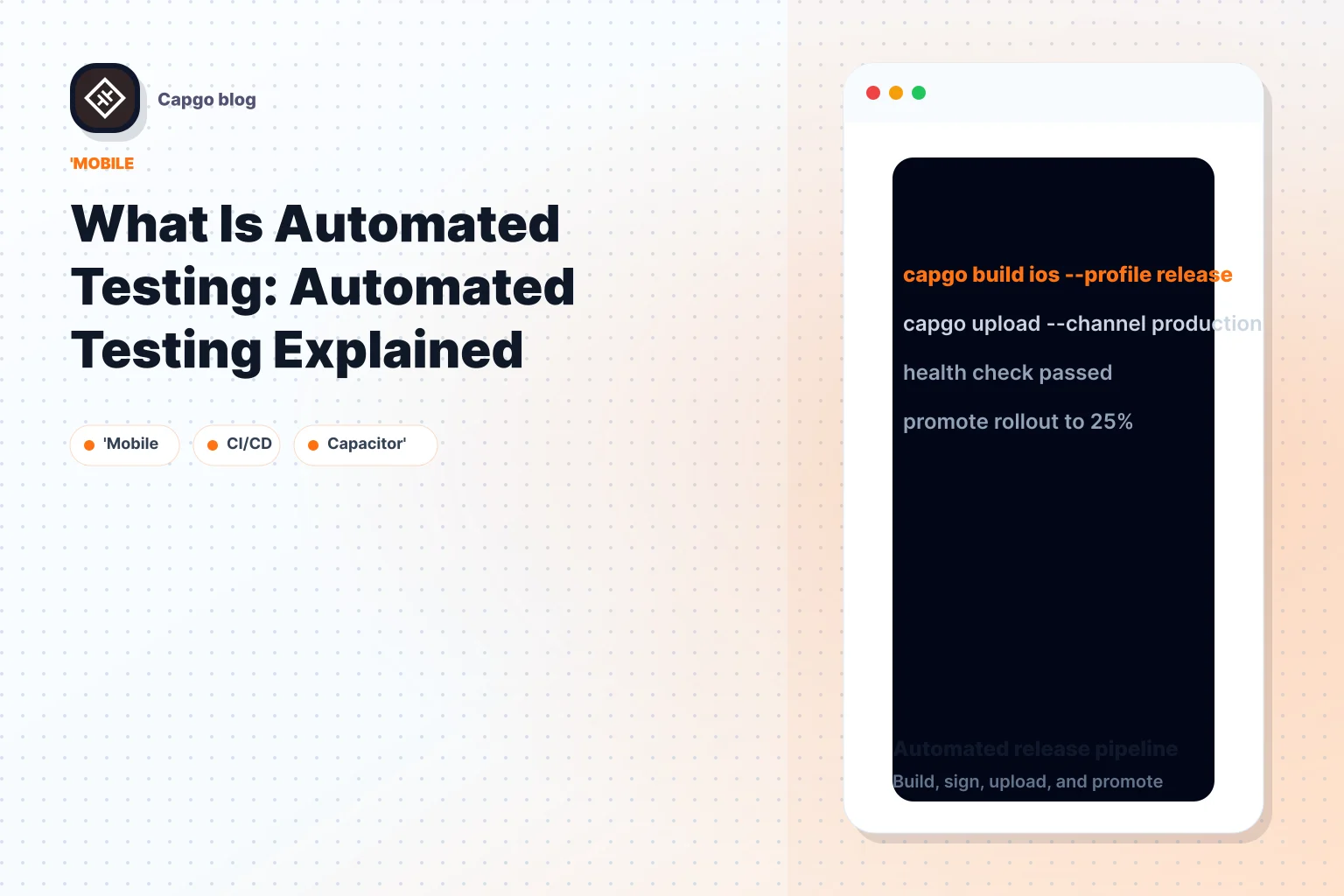
Si les tests ne s'exécutent que lorsque quelqu'un se souvient de les lancer, vous avez toujours un processus manuel avec des étapes supplémentaires. Le modèle de meilleure qualité est de déclencher les bonnes suites automatiquement sur les requêtes de tirage, les mises en commun, les exécutions nocturnes et les candidats à la mise en production. Pour les équipes Capacitor et Electron, cela signifie généralement combiner les GitHub Actions, GitLab CI, Jenkins ou un autre exécuteur de pipeline avec des tâches séparées pour les étapes de unités, d'intégration et de E2E.

Transformez les tests en barrière de mise en production
Le système devrait répondre à quelques questions automatiquement après chaque changement significatif :
- A-t-il construit code sans erreurs ?
- Les couches de tests rapides ont-elles réussi ?
- La mise en production a-t-elle reçu un artefact déployable ?
- Les flux à risque élevé fonctionnent-ils toujours dans un environnement proche de la production ?
La guide d'implémentation AFIT décrit l'automatisation comme un cycle de vie Planifier, Développer, Exécuter et Analyser, où l'exécution produit des données et l'analyse est utilisée pour identifier les anomalies et le ROI dans un cycle d'amélioration continue, comme détaillé dans le Guide d'implémentation de test logiciel AFIT automatiséC'est l'esprit à adopter. Un pipeline n'est pas juste un endroit pour exécuter des tests. C'est un système qui transforme les résultats des tests en décisions de mise en production.
Si vous construisez des flux de livraison autour d'actifs mobiles et web ensemble, une référence pratique sur le développement d'applications d'entreprise modernes est utile car elle relie l'architecture, la discipline de déploiement et la fiabilité opérationnelle dans la même conversation.
Un guide de configuration ciblé pour Capacitor automatisation du pipeline CI/CD peut également aider lorsque vos étapes de construction de l'application, de l'ensemble web, de la signature et du déploiement doivent s'aligner.
Voici un aperçu rapide du flux CI/CD en pratique :
Mesurez le lot comme un système
Une suite de tests qui ne signale que pass ou fail manque la moitié du tableau. Les équipes devraient également surveiller :
- Temps d'exécution : les lots lents sont ignorés.
- Modèles de réussite et d'échec : les échecs répétés peuvent indiquer des problèmes d'environnement, pas des bogues du produit.
- Taux de tests flous : La méfiance se développe plus vite que la faible couverture.
- Effort de maintenance : if every UI change breaks ten tests, the suite design needs work.
La bonne question n'est pas « Avons-nous de l'automatisation ? » C'est « Notre automatisation nous donne-t-elle un signal rapide et fiable au sein de la livraison ? »
Stratégies de test pour les applications Capacitor et Electron
Les applications cross-platform nécessitent une stratégie de test qui respecte la façon dont la pile est construite. Une application Capacitor n'est pas seulement une application web, et ce n'est pas seulement une application native non plus. Electron a le même partage, mais sur le bureau. Vous avez du JavaScript partagé, UI de framework, pont code, packaging et comportement spécifique au plateau qui se trouvent dans le même train de livraison.
Le conseil général sur le testing automatisé manque souvent la partie la plus difficile. Les bugs les plus risqués se trouvent généralement aux limites.
Divisez la pile par mode de panne
Une stratégie pratique est de séparer les tests en fonction de l'origine des échecs.
Pour la logique commerciale partagée, use unit tests with tools like Jest or Vitest. These are ideal for validation rules, permission decisions, sync conflict handling, feature flags, and local data transforms.
Pour l'interaction de moduleÉcrivez des tests d'intégration autour de votre couche API, adaptateur de stockage et interfaces de wrapper natif. Si votre application utilise @capacitor/preferencesdes notifications push, l'accès à la caméra ou un plugin natif personnalisé, testez le contrat de wrapper sur lequel votre interface utilisateur dépend. Dans Electron, faites la même chose autour de scripts de préchargement, de limites IPC et d'accès au système de fichiers.
Pour des flux utilisateurUtilisez Playwright ou Cypress pour les comportements centrés sur WebView. En pratique, de nombreux équipes obtiennent la meilleure valeur d'un ensemble E2E étroit qui couvre :
- chemins d'authentification : points d'entrée de connexion, session expirée, déconnexion, réinitialisation de mot de passe
- flux hors ligne et de récupération : état en cache, comportement de réessai, logique de reconnect
- écrans critiques de navigation : raccordement, paiement, paramètres de compte
- Fonctionnalités sensibles aux mises à jour : écrans les plus susceptibles de se rompre après une mise à jour frontale
Cet approche en couches compte car un test échoué devrait vous indiquer où chercher. Si chaque problème ne se manifeste que lors d'une exécution de bout en bout, la débogage devient lent.
Dans les applications multiplateformes, testez le contrat à chaque limite. Les limites web-vers-native et renderer-vers-processus-principal génèrent plus de risque de mise à jour que les composants ordinaires code.
How live updates change testing priorities
Les Live update plateformes modifient le modèle de risque. Si votre équipe peut déployer des modifications de JavaScript, CSS, de texte, de configuration et d'actifs en dehors du cycle de revue de l'App Store, alors les régressions de la couche web sont toujours sérieuses, mais elles ne sont pas opérationnellement identiques aux régressions liées aux applications natives.
Cela ne signifie pas que vous abaissiez les normes. Cela signifie que vous les rééquilibrez.
Native plugin changes, permission handling, binary configuration, and anything tied to store-submitted code deserve the heaviest pre-release scrutiny because rollback is slower and user impact lasts longer. Web-layer changes still need automated coverage, but teams can often move faster when they know they can patch an issue quickly after rollout.
Pour les équipes utilisant un système de live update tel que Capgo, it’s worth automating the update path itself. Test update detection, download behavior, install timing, fallback behavior, and rollback conditions the same way you’d test login or purchase. If your release mechanism is part of production risk, it belongs in the suite.
A une séparation raisonnable pour les équipes de Capacitor et Electron ressemble à ceci :
- Avant la soumission de l'application : une couverture approfondie des ponts natifs, des autorisations, du démarrage, de la compatibilité de mise à jour et des parcours de base
- Avant le lancement de la bibliothèque web : forte régression sur les flux UI partagés et le comportement de livraison d'actualisations
- Après le lancement : Vérifications de fumée ciblées dans des conditions similaires à la production, plus le suivi des journaux.
C'est un modèle plus pratique que de prétendre que chaque changement nécessite la même intensité de test.
Éviter les pièges courants de l'automatisation
La plus grande erreur d'automatisation coûteuse est de traiter l'ensemble comme un projet que vous terminez une fois. Les bonnes ensembles se comportent plus comme des bases de code. Ils ont besoin de propriété, de refactoring et de normes.
Le coût de maintenance est réel. Comme expliqué dans Cegeka's écrit sur les pièges de l'automatisation des testsQuand l'automatisation perd de sa valeur en raison de changements de l'interface utilisateur, de sélectionneurs fragiles et de logique de test obsolète, la flambabilité et le travail répétitif se créent.
Quelques modèles causent la plupart des soucis :
- Les sélectionneurs fragiles : Les tests liés aux détails du DOM instables se cassent pour les raisons incorrectes.
- Les scénarios couplés : Un test laisse derrière lui un état qui brise le suivant.
- Absence de stratégie de données de test : Les environnements dérivent, les utilisateurs générés deviennent invalides, et les erreurs deviennent difficiles à reproduire.
- Les échecs ignorés : Les équipes se répètent jusqu'à obtenir le vert et s'entraînent à ignorer les signaux.
- Couverture de l'interface utilisateur surdimensionnée : Trop de tests E2E larges, pas assez de vérifications de niveau inférieur.
L'automatisation n'aide que lorsque le lot reste à jour avec le produit. Les tests anciens ne sont pas neutres. Ils gaspillent activement le temps de mise en production.
The teams that succeed are disciplined about pruning. They delete low-value tests, stabilize high-value ones, and review failures quickly. They also write tests with the same standards they apply to production code: clear assertions, isolated setup, reusable helpers, and explicit ownership.
Si votre équipe Capacitor ou Electron souhaite une récupération plus rapide des régressions de la couche web Capgo est une option pour envoyer des mises à jour signées en direct aux utilisateurs sans attendre la revue de l'App Store. Cela change la façon dont les équipes pensent à la risque de mise en production, au retrait et à ce que leur lot automatique doit valider avant et après le déploiement.
Continuez de What Is Automated Testing : Automated Testing Explained
Si vous utilisez What Is Automated Testing : Automated Testing Explained pour planifier l'automatisation CI/CD, connectez-l’avec Capgo CI/CD pour le flux de travail du produit dans Capgo CI/CD Capgo Bâtiments natifs pour le flux de travail du produit dans Capgo Native Builds, les Capgo Intégrations pour le flux de travail du produit dans Capgo Intégrations, Intégration CI/CD pour les détails d'implémentation dans l'intégration CI/CD, et GitHub Actions Integration pour les détails d'implémentation dans GitHub Actions d'intégration.