You release a few times a year
If release health data and a fast-moving product do not matter to your team, Capawesome covers the basics: channels, gradual rollouts, and rollback after a crash. [1]
Both ship live updates and native builds for Capacitor. The difference is what happens after you ship: Capgo shows each release landing on real devices, explains why updates fail, checks native compatibility before upload, and pauses a bad rollout on its own. Built for teams and AI agents that ship every week.
Verdict Choose Capgo if you ship often and want real statistics from real devices, not network guesses. One plan includes live updates, native build minutes, Observe, and push notifications, and costs less than Capawesome plans that include builds, with the same or more users at every tier, billed monthly or yearly. Add audit logs on every plan and update checks served from 9 regions. Capawesome suits teams that release a few times a year and want fewer changes to their tooling.
14-day unlimited free trial. No credit card required
Last updated
Trusted by 9,400+ teams · 90M+ devices · 3,154+ GitHub stars
 Kick
20M+ installs
 Vaia
10M+ installs
 Suez
3.2M installs
 Nana
2.5M installs
 Snowqueen
1.8M installs
 StyleSeat
1M+ installs
 Huckleberry
1M+ installs
 SuperFrete
1M+ installs
 Pizza Hut
1M+ installs
 Shelf
950K installs
 Janitor
750K installs
 RemNote
500K+ installs
 Somtoday
500K+ installs
 Vella
400K+ installs
 Revel
250K+ installs
 IREC
150K+ installs
 360Player
100K+ installs
 Finax
100K+ installs
 OurLiving
80K+ installs
| Area | Capgo | Capawesome Cloud |
|---|---|---|
| Pricing | From $12/month billed yearly or $14 billed monthly. 14-day free trial, no credit card required. No free plan. | Live Updates plans from $9/month (1K MAU) to $249/month (250K MAU). Platform plans with native builds from $19/month to $499/month. 14-day free trial. [1] |
| OTA live updates | Ships JavaScript, HTML, CSS, and asset changes without waiting for store review, with delta downloads and end-to-end encryption. 1B+ updates per month. | Live updates with channels, gradual rollouts, RSA bundle signing, and automatic rollback. [3] |
| Native builds | Capgo Builder builds and signs iOS and Android binaries in the cloud, typically in 2–3 minutes, and can upload them to the stores. Build time is included in plans. | Cloud iOS and Android builds on Platform plans, from 200 to 5,000 build minutes per month, plus store publishing. [1] [2] |
| Framework support | Capacitor apps built with React, Vue, Angular, Svelte, Ionic, or any web framework. Live updates also work for Cordova and Electron. Not for React Native. | Capacitor, Ionic, and Cordova. [2] |
| Open source and self-hosting | Updater plugin and Capgo plugins are free under MPL-2.0. Backend source is on GitHub under AGPL-3.0. Run your own update server, or use licensed self-hosting on Enterprise. | Live Update plugin and CLI are open source under MIT. The cloud service is hosted by Capawesome; bundles can be served from your own servers or CDN while metadata stays in Capawesome Cloud. [4] [3] |
| Rollback and channels | Dynamic channels, device and channel overrides, progressive rollouts, automatic rollback when a bundle fails to start, and one-click revert to a previous bundle. | Channels for dev, staging, production, and customer tracks. Rollouts at 10%, 25%, 50%, or 100%, and automatic rollback to the last healthy bundle. [3] |
| Support | Discord and email with the engineers who build Capgo. Priority plugin fixes on any plan, and Premium Support for production deadlines. | Community chat on every plan. Email support from Professional (Live Updates) or Starter (Platform), and priority support on Business. [1] |
| Company status | Independent and bootstrapped, founded in 2021. 9,400+ teams, 4.7K+ apps, and 90M+ devices. SOC 2 Type II and ISO 27001 on the Enterprise plan. | Capawesome (Genz IT Solutions GmbH), based in Germany. Live updates launched in 2024. [5] [2] |
Competitor details are as of September 2026 and were checked against the vendor pages below. Plans and prices change, so confirm on the vendor site before you decide.
Capawesome counts update-check requests. Capgo devices report what actually happened: downloads, installs, failures, rollbacks, app launches, and crashes. That is how you get native app health, failure causes, a timeline for every device, and rollouts that pause themselves. These are real Capgo screens.
The moment a bundle goes live, Observe tracks installs, failed attempts, adoption, and success rate for that exact version and channel in 5-minute buckets.

Failed downloads, checksum mismatches, unzip errors, and rollbacks are grouped by cause, so you can tell a flaky network from a broken bundle.

Launch time, WebView load time, crashes, ANRs, and JavaScript errors reported by the Capgo updater, broken down by version, platform, and channel.

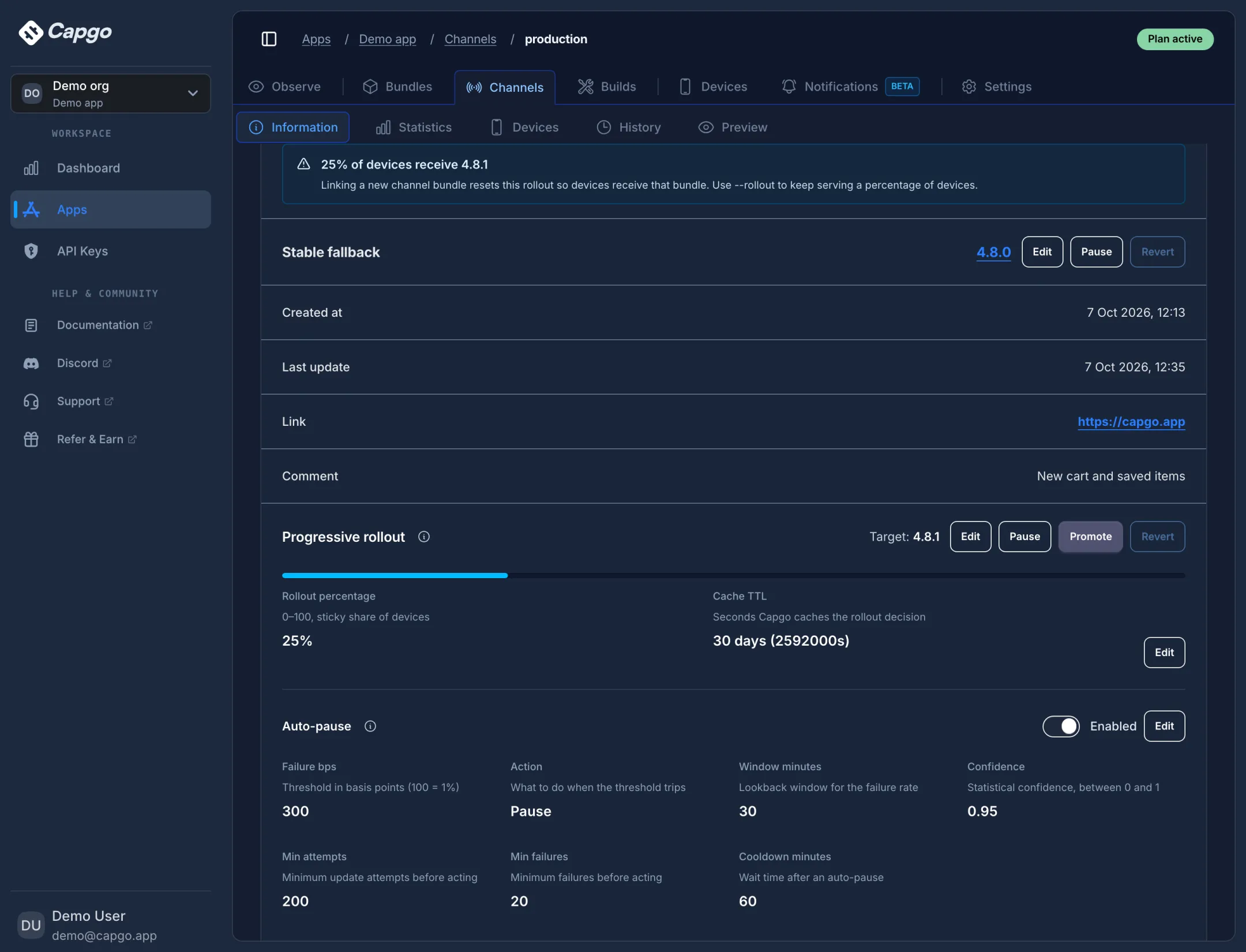
Serve a new bundle to a sticky percentage of devices while everyone else stays on a stable fallback. Auto-pause stops the rollout when the failure rate crosses your threshold.
When a channel serves a bundle whose native packages differ from what installed apps were built with, Observe flags it, names the blocking packages, and links the dependency diff.

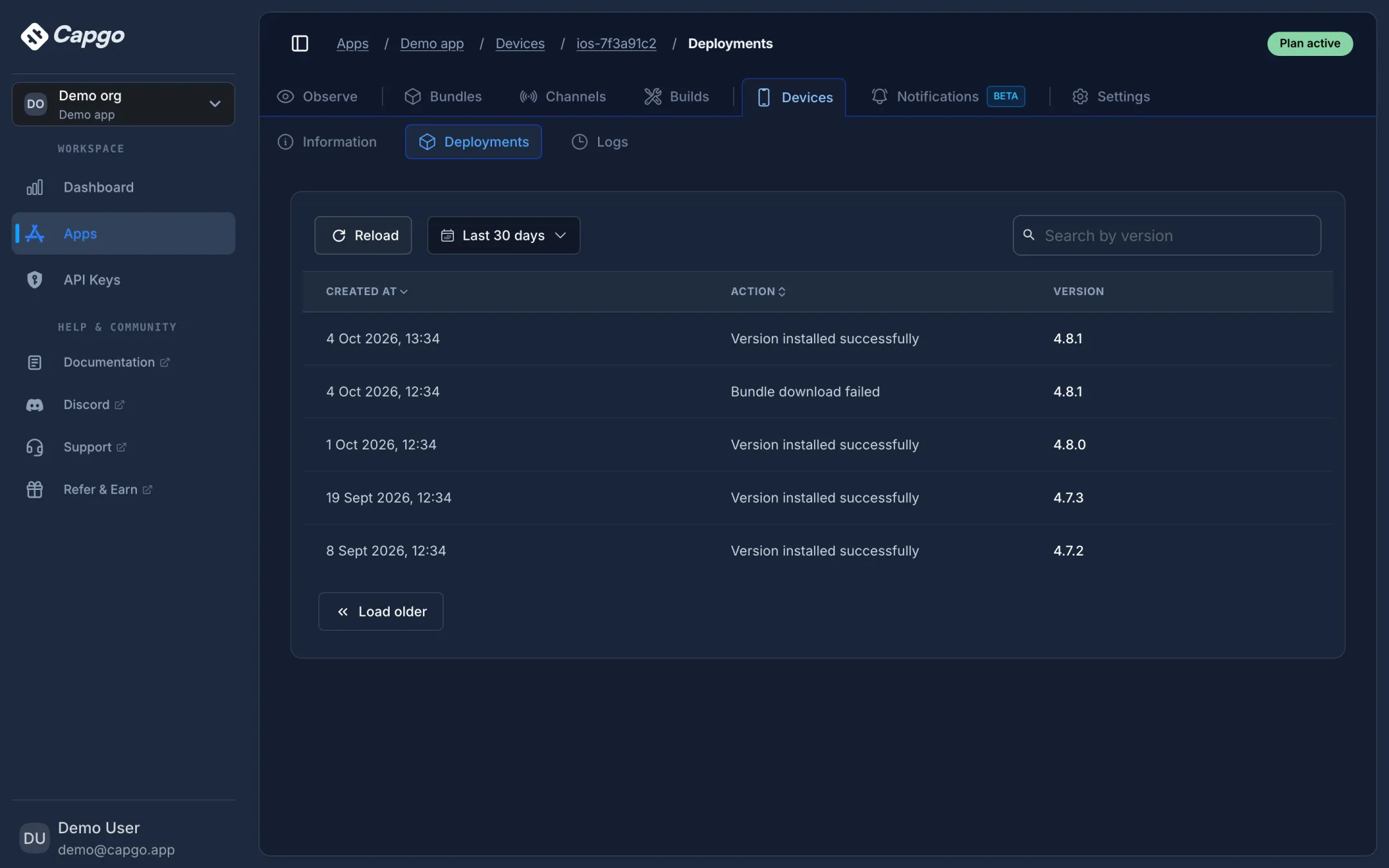
Look up any device by its ID or your own user ID to see the bundle it runs, its channel, and every install or failure it reported.
| Area | Capgo | Capawesome Cloud |
|---|---|---|
| Where the numbers come from | Events sent by the device: downloads, installs, failures, rollbacks, app launches, and crashes. | Network requests only. Their plugin calls two endpoints, the channel list and the latest bundle, and reports no device events. [10] [6] |
| What one plan includes | Live updates, native builds, Observe, and push notifications. One plan, sized by monthly active users. | Separate Live Updates, Platform, and SDK plans. [1] |
| Live release health | Installs, failed attempts, adoption, and success rate for the release that is live, in 5-minute buckets. | Active devices and adoption, inferred from update-check requests. [3] |
| Native app health | Launch time, WebView load time, crashes, ANRs, and JavaScript errors by version, platform, and channel. | Not available. The plugin sends no launch, crash, or error events. [10] |
| Why updates fail | Failures grouped by cause (network or device, bundle, rollback) with the affected versions and devices. | Request and response logs of update checks, with status codes. [6] |
| Per-device timeline | Every updater and app event for one device, with the error message attached. Search by device ID or your own user ID. | Update-check requests made by each device. [6] |
| Rollout safety | Any percentage, sticky per device. Auto-pause when the failure rate crosses your threshold, with a minimum sample size. | Rollout percentage changed by hand from the CLI or console. Devices roll back after a crash. [7] [3] |
| Native change detection | Native package changes detected automatically between bundles. The CLI warns on incompatible uploads, or blocks them with --fail-on-incompatible, and each channel flags the mismatch. | Native version ranges you set on each upload or channel. [8] |
| Audit logs | Included on every plan. | Business plan and above, from $249/month. [1] |
| Live updates + native builds | $14, $39, $99, or $249 a month billed monthly ($12, $33, $83, or $208 billed yearly) for 2K, 10K, 100K, or 1M users. Build minutes are always included. | $19, $49, $149, or $499 a month billed monthly (about $16, $41, $124, or $416 billed yearly) for 1K, 10K, 50K, or 250K users on Platform plans. [1] |
| Push notifications | Hosted push for iOS and Android in the same plan, plus silent update checks that speed up rollouts. | Not part of Capawesome Cloud. [2] |
| AI agents | Hosted MCP server, agent skills, setup guides for 12 coding agents, and plain-text pricing and docs for agents. | MCP server and agent skills. [9] |
| Update delivery | Update checks answered from 9 regions on 6 continents, about 50ms typical worldwide. | Global CDN for bundle downloads. [1] |
Capgo ships in the open, several times a week. Follow every change on GitHub →
No tool fits every team. These are the cases where we would point you to the other option.
If release health data and a fast-moving product do not matter to your team, Capawesome covers the basics: channels, gradual rollouts, and rollback after a crash. [1]
Point their CLI at a branch or tag and the Cloud Runner clones, builds, and ships the live update. With Capgo you build in your own CI and upload the bundle. [3]
Their store publishing covers TestFlight, Google Play, Huawei AppGallery, and Firebase App Distribution. [2]
If you're on Capawesome and considering Capgo, migration is straightforward. The Capacitor update plugin architecture is similar.
Uninstall @capawesome/capacitor-live-update, install @capgo/capacitor-updater, then run npx cap sync.
Set CapacitorUpdater options in capacitor.config.ts and call notifyAppReady() on launch. Channels live in the Capgo dashboard or API.
Replace the Capawesome deploy step in CI with npx @capgo/cli@latest bundle upload.
Named reviews from teams that ship Capacitor apps with Capgo.

The Capgo Capacitor Updater plugin completely transformed how we ship updates. What used to take days now takes just minutes.
Being able to push production OTA updates instantly without waiting for full App Store review cycles has been a massive operational advantage.
Getting set up took less than a day. Channel-based rollouts let me test on my own device before anything hits production users.
Start a 14-day free trial with no credit card. After the trial, plans start at $12/month billed yearly or $14 billed monthly.