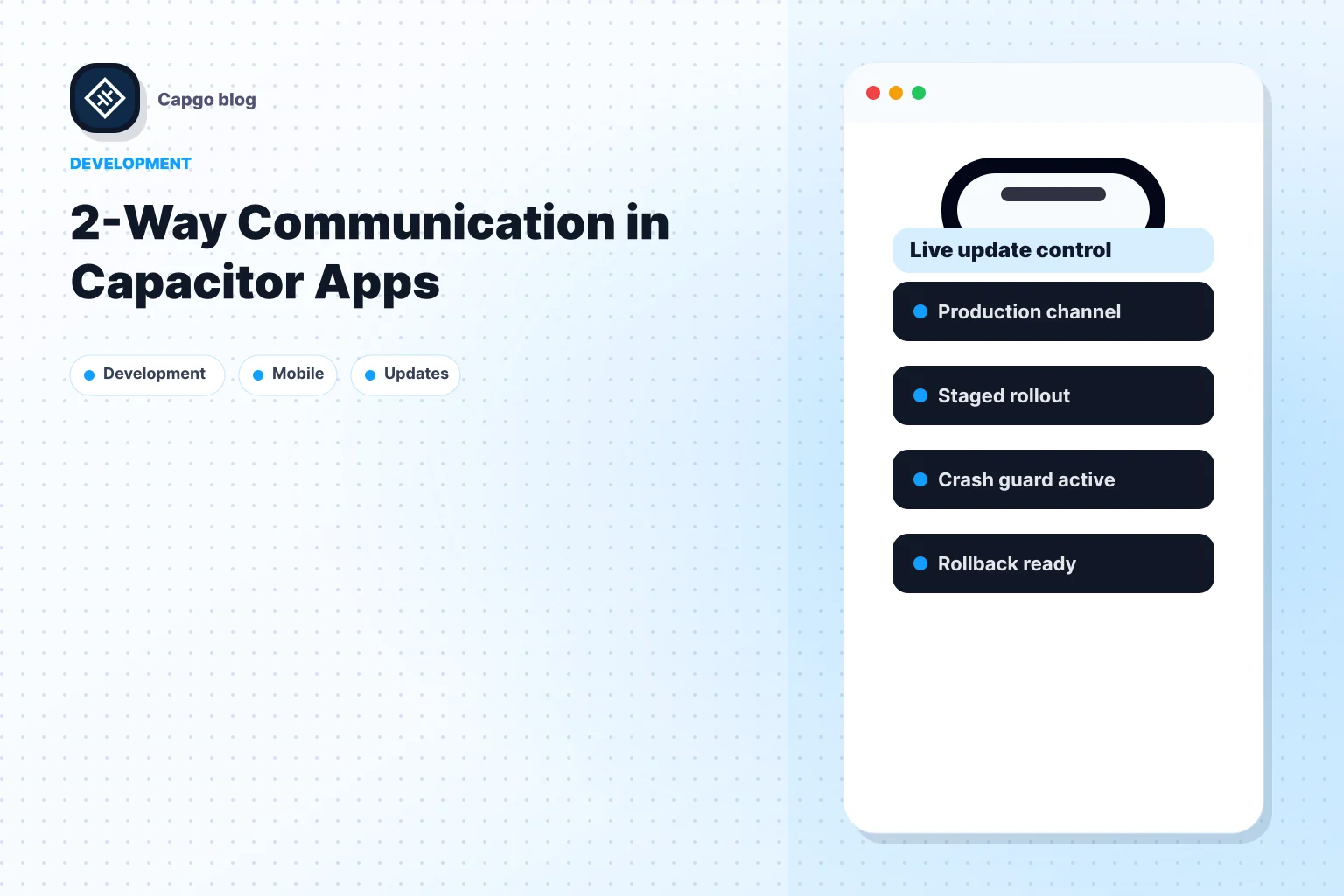
A pause stops a rollout from reaching more devices. A rollback moves affected devices toward a known-good version. Capgo supports both, so you can contain a problem first and decide what to do next.
Use these steps to choose the right action, check its effect, and reduce the chance of repeating the incident.
We read 6 public guides on staged rollouts and rollback published by Google Play, Amazon Appstore, Microsoft’s CodePush, Bitrise, Nearform, and Digia. Four of the 6 separate pausing from rolling back as distinct actions, while 2 skip rollback or treat pause as the only lever. None of the 6 explain how to verify recovery with analytics or device checks, and none describe a workflow for preventing repeat incidents. Getting the pause-versus-rollback choice right, then confirming it worked, closes a gap left open across public release guidance.
Table of Contents
- Step 1: Set up release controls in Capgo
- Step 2: Choose whether to pause or roll back
- Step 3: Pause further exposure while you investigate
- Step 4: Roll back when users need a stable version
- Step 5: Verify recovery with analytics and device checks
- Step 6: Prevent repeat incidents with safer release workflows
- FAQ
- Conclusion
Step 1: Set up release controls in Capgo
Before an incident, make sure your team knows which channel is delivering the release and which bundle is stable. A channel is a named lane that directs app devices to an update. A bundle is the updateable web code sent through that lane.
In Capgo, a progressive rollout can keep a stable bundle in place while sending a separate rollout target to a selected group. That gives you a control point before the new bundle reaches the wider user base. Review the progressive rollout controls before enabling one in production.
Write down the release owner and the signals that should stop expansion. For example, decide what your team will do if update failures rise, a key screen stops working, or support reports that users can’t finish a task. Set limits based on your app’s normal behavior rather than picking a threshold just because it sounds strict.
An OTA update changes the app’s updateable code over the air. It doesn’t replace the native app binary installed from an app store. The term over-the-air update describes this delivery approach. Keep this boundary in mind: if a fix needs a new native plugin or a change to the app’s native setup, a bundle rollback won’t supply it.
Before release, confirm the stable bundle is the one you expect. Check the channel name, target bundle, and rollout state. A typo in a channel name or a stale target can send responders toward the wrong control when minutes matter.
By now you should have a named release owner, a known-good bundle, and a written stop condition. That preparation turns the next decision into an operational choice, not a scramble through the dashboard.
Key Takeaway: A pause limits new exposure. A rollback changes the version users are directed to receive.
Step 2: Choose whether to pause or roll back
For the Capgo pause rollout vs rollback decision, ask one question first: are you trying to stop more devices from getting the target, or move devices off a target that’s already causing harm? A pause limits new exposure. A rollback clears the target and returns devices to the stable fallback on their next update check.
Choose pause when evidence is incomplete or the issue appears limited. You may have a handful of reports but not know whether the bug affects one device type, a particular user flow, or every updated device. Pausing gives the team room to inspect the signal without adding new devices to the rollout group.
Choose rollback when the target is clearly unsafe for users, or when the team has enough evidence that the known-good bundle is safer. A pause alone doesn’t remove the bad target from devices already in the rollout cohort. If those users need to return to stable, rollback is the action that changes their update path.
The Capgo channel CLI reference lists separate pause and rollback controls. Treat them as different actions, not two names for the same emergency stop.
| What you see | First action | What to check next |
|---|---|---|
| Early errors, unclear scope | Pause the rollout | Compare affected and unaffected devices |
| Known bug affecting the target cohort | Rollback the target | Confirm the stable bundle is active |
| Issue tied to native code or a service | Pause or contain the app change, then fix the affected layer | Check whether a native build or service repair is needed |
| Only a small group has the target, with no user impact confirmed | Pause while investigating | Resume only after the release owner approves |
A rollback won’t fix a backend outage, and it can’t add a missing native capability. First identify which layer failed. If the web bundle is at fault, choose between pausing and reverting based on how many users need relief.

Step 3: Pause further exposure while you investigate
Pause when you need to stop new devices from entering the rollout group but aren’t ready to revert the target for devices already in it. This is a containment step. It buys time to check the facts while keeping the issue from spreading to more users.
Open the production channel and verify that you’re acting on the affected rollout. Pause it with the dashboard, CLI, or API control your team uses. Then read the channel state back. Don’t rely only on a command completing successfully; confirm the rollout now shows as paused.
In Capgo’s progressive rollout model, devices already in the cohort can remain on the rollout target after a pause. New eligible devices receive the stable fallback on their next check. That distinction matters: pause stops new entry, but it doesn’t itself move the existing cohort back to stable.
Next, capture the release details before making another change. Record the target bundle, channel, time of pause, and the first known report. Keep device or session details your team is allowed to collect. A clear timeline helps you compare the rollout cohort with devices still on the stable bundle.
Check the issue through a repeatable path. If users report a failed login, test that exact journey on an affected device. If the app crashes on launch, check whether the crash aligns with the new bundle and native app version. Avoid treating every support report as proof that the update caused the problem.
Set an owner and a decision time for the investigation. A paused rollout can sit in limbo if no one owns the next move. The owner should either resume after evidence clears the release or choose rollback when the target remains unsafe.
Pro Tip: Tell support and the release team that the rollout is paused. Otherwise, one group may keep escalating reports while another assumes the rollout has already been reversed.
By now, new devices should no longer be entering the rollout cohort. Check the channel state and the behavior of a device that wasn’t in the cohort before moving to rollback or resume.
Step 4: Roll back when users need a stable version
Roll back when users already on the target need to move back toward a known-good bundle. This is the stronger response than pausing. It changes what the channel serves, so verify the selected stable build before you confirm the action.
In Capgo, open the affected channel and review its build history. Choose the version you want to restore, then confirm that it is the correct stable bundle for this app and channel. Capgo’s rollback documentation describes the dashboard path and notes that devices receive the selected build the next time they check for an update.
After rollback, don’t assume every device changed at once. A device needs to check for an update, and an offline user may not do that until later. Keep the incident open until you’ve checked the channel’s active version and tested the recovery path on a device in the affected cohort.
Use the built-in bundle only when that is the intended recovery target. It points devices back to the web build packaged inside the native app, which may differ from the last OTA bundle. Check compatibility and the user impact before choosing it as your recovery step.
Keep the bundle that caused the incident available for analysis unless your retention process says otherwise. The release ID and commit help engineers compare the change with the stable version. Preserve relevant logs before cleanup, especially if you need to understand why the issue escaped testing.
Rollback is not the right fix for every failure. If the root cause is a server-side dependency, repair that service. If the change depends on native code absent from installed binaries, prepare a native build and follow the app store release path for that change.

Step 5: Verify recovery with analytics and device checks
After a pause or rollback, verify what devices are doing rather than treating the control change as proof of recovery. Check the active channel state first. Then compare update adoption, errors, and device reports across the affected release and the stable version.
Capgo’s live update analytics can help you inspect adoption metrics, error rates, and device-level logs. Use those signals to answer specific questions: are new devices still receiving the target, are affected devices checking for the stable bundle, and did the reported failure stop after recovery?
Test the user path that failed. A successful download doesn’t prove the app works. Open the relevant screen, repeat the action that led to the report, and verify the app reaches the expected state. If the incident involves a critical flow, have someone other than the person who made the change confirm the result.
Compare like with like. A broad error count may rise for reasons unrelated to the release, such as a service issue or a change in traffic. Filter by bundle, channel, app version, and device where those fields are available. Look for a release-linked difference rather than blaming the newest update by default.
Also check users who haven’t updated. Their presence can make overall metrics look healthy while the affected cohort still sees the bug. Track the share of devices on the target against the share on stable, and keep support reports tied to the version users actually run.
Write down the recovery result and the remaining uncertainty. If errors fall but a few users still report the same issue, don’t close the incident until you understand whether they’re offline, on an older native shell, or still using the affected bundle.
Recovery is confirmed when the channel points to the intended version and the failing user path works on a device that could reproduce the issue. Metrics help you see the shape of the problem; a device check confirms what a person experiences.
Step 6: Prevent repeat incidents with safer release workflows
Make pause and rollback part of the release plan before publishing. A release owner should know who can stop exposure and who can approve a return to stable. That removes a common delay: waiting for a meeting while more devices enter the rollout.
Keep a stable fallback assigned while the rollout target is tested. Use a small, defined cohort first, then expand only when the agreed health signals stay within your limits. Capgo supports channel-based release control, so teams can separate testing from broad production delivery.
Put release checks in CI/CD, the automated process that runs tests and deploys a change. A pipeline can publish the bundle to the intended channel after tests pass. It should also fail safely if the channel is wrong or the release is not ready for promotion.
A continuous delivery workflow keeps software ready for release through an automated process. For an OTA workflow, keep the human approval point clear even when publishing is automated. Automation should make the chosen action repeatable, not make the decision for an unreviewed change.
With Capgo, a one-command deployment can publish a bundle to a channel. Keep the command in the same release process as your checks, and make the target channel visible in the deployment record. That helps the on-call engineer see exactly what shipped without guessing which lane received it.
Before enabling automatic safeguards, define what signal triggers them and what action they take. A pause can stop new exposure while keeping current cohort devices on the target. A rollback can direct devices toward stable. Those outcomes differ, so don’t configure one as if it were the other.
Use a test channel to rehearse the full response. Publish a harmless change, verify the pause control, and then test rollback to the prior bundle. Confirm the app behavior on a device after each action. A written runbook should include the channel, command or dashboard path, expected state, and the person who confirms success.
Release notes should identify the bundle and its purpose. Keep a link between the deployment record and the source change so engineers can narrow the search when an error appears. If your team hands off incidents across time zones, include the last action taken and the next decision owner.
If the incident points to a broader front-end implementation bottleneck, a web developer such as Amir Arezoo may be relevant for website development work. That is separate from Capgo’s rollout controls, which handle delivery and recovery for compatible app updates.
By now, your release path should include a stable fallback, an owner, a stop rule, and a tested recovery action. Keep the workflow short enough that the on-call engineer can use it under pressure.
FAQ
Does pausing a Capgo rollout roll back devices already updated?
No. Pausing stops new eligible devices from entering the rollout, but devices already in the cohort can remain on the target bundle. To move those users back toward stable, use rollback or another deliberate channel action. Check the channel state after either change, then confirm the result on a device that received the target.
When should I pause instead of rolling back?
Pause when the issue is still under investigation and you need to stop wider exposure. Roll back when the target is known to harm users or when affected devices need a stable bundle. The Capgo pause rollout vs rollback choice depends on whether the immediate need is containment or recovery for the existing cohort.
Will a rollback update every device right away?
No. A rollback changes the bundle the channel points to, but devices receive it when they next check for an update. A device that is offline may stay on its current bundle until it reconnects. Verify the channel target, then check affected devices and their update status before declaring the incident resolved.
Can an OTA rollback fix a native app problem?
No. An OTA rollback can restore an earlier updateable web bundle, but it can’t add or remove native code inside an installed app binary. If the issue comes from a native plugin or app-shell change, assess whether a new native build is needed. First identify which layer caused the failure.
What should I check after pausing or rolling back?
Confirm the channel’s state and active bundle, then check update adoption and errors by release. Test the user journey that failed on a device from the affected group. Also check devices that haven’t updated yet, since overall metrics can hide problems limited to one version or cohort.
Conclusion
Pause when you need to stop new exposure while you investigate. Roll back when users on the target need a stable version. Set up both controls in advance, then rehearse them on a test channel before your next production release.