Most MVP advice gets one thing wrong. An MVP isn’t a shrunken version of the product you hope to sell later. The best minimum viable product example usually does something narrower and more useful. It tests one risky assumption with the smallest experience a real user will still take seriously.
That distinction matters because small feature sets don’t automatically create learning. A stripped product can still be bloated if it tries to answer five questions at once. Eric Ries popularized the MVP as the smallest version of a product that enables maximum validated learning with the least effort, inside the lean startup build-measure-learn loop described in the Lean Startup overview. Earlier roots of the concept are commonly traced to Frank Robinson in 2001, then expanded by Steve Blank and later popularized by Ries, with IMVU often cited as a historical example of releasing early to learn from real users instead of waiting for polish, as summarized in this MVP history review.
The useful lens is simpler. For each example below, look at five things: the core problem, the minimal feature set, the implementation approach, the validation signal, and the lesson you can repeat. Some of the famous signup and adoption numbers around MVPs are helpful context, but they aren’t universal targets. What matters is whether the product proved the specific thing its team needed to learn.
Table of Contents
- 1. Dropbox
- 2. Slack
- 3. Twitter
- 4. Airbnb
- 5. Instagram
- 6. Stripe
- 7. Buffer
- 7 MVP Examples Comparison
- Turn These MVP Patterns Into Your Plan
1. Dropbox
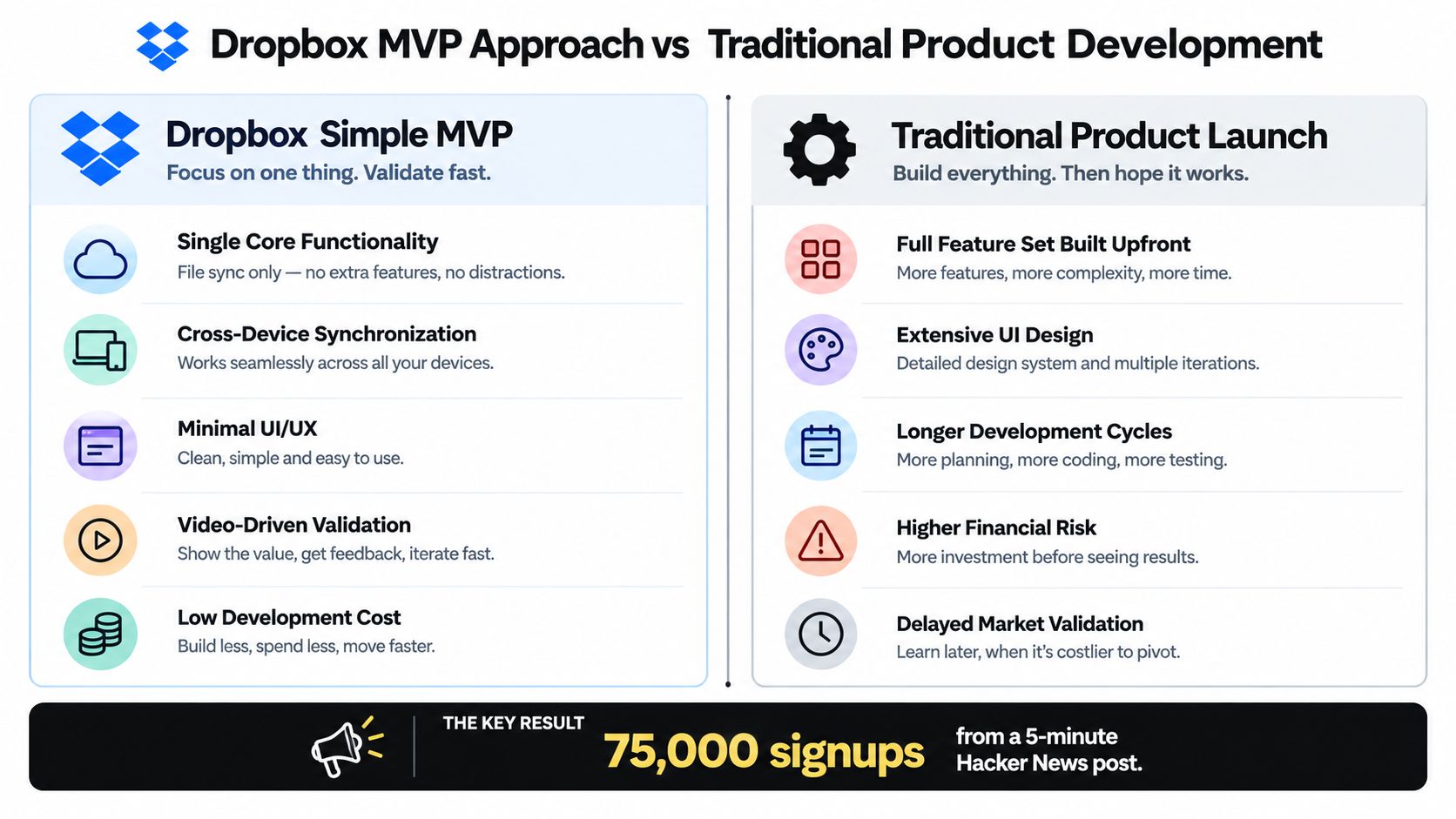
Dropbox is the classic example people cite, but the lesson isn’t “make a demo video.” It’s “prove the hard part before you build the expensive part.”
The hard part wasn’t storage. Plenty of people already understood storage. The hard part was whether file sync across devices felt compelling enough that users would change behavior for it. Dropbox focused on that one job and left almost everything else out.
A useful visual summary of that approach sits below.
The MVP pattern
This is a single-function focus pattern with demo-led validation.
Instead of building team admin controls, enterprise permissions, collaboration layers, or elaborate onboarding, Dropbox highlighted one moment of value. Put a file in one place. See it appear somewhere else. That’s enough for users to decide whether the idea matters.
Practical rule: If your product’s value is easiest to understand in motion, a demo can validate demand faster than a partially built app.
That makes Dropbox a strong minimum viable product example for products where the core promise is experiential. Sync, automation, handoff, and update delivery products often fit that mold.
What it left out and why that worked
The omission list matters more than the feature list:
- No broad platform story: The MVP didn’t need to prove every use case. It needed to prove that sync felt magical.
- No enterprise surface area: Admin controls, security workflows, and billing can wait until users care about the underlying behavior.
- No feature negotiation: Users couldn’t bury the team in adjacent requests before the core loop was validated.
If you’re building a live update workflow for a hybrid app, the equivalent is proving “we can push a critical fix cleanly” before adding audience segmentation, CI/CD, or governance layers. Teams working in that environment can compare this thinking to broader hybrid mobile application architecture.
A short product video still captures the point better than a long product spec.
2. Slack
Slack did not start by chasing broad distribution. It started by removing communication drag inside one team.
That origin matters because internal dogfooding is a specific MVP pattern, not a startup myth. The team built a product they had to rely on during real work, so weak points surfaced fast. Search either found the decision or it did not. Notifications either helped people respond or trained them to ignore the app. Channel structure either reduced chaos or recreated it.

Why this MVP worked
Slack is a good minimum viable product example because the team validated behavior before market scale. They were not testing whether people liked the idea of better communication. They were testing whether a team would switch daily coordination into this tool and keep it there.
That creates a tougher standard than early signups. Internal users generate constant product pressure because they depend on the workflow to do their jobs. In practice, that usually exposes three things quickly:
- message flow that breaks under real team habits
- search quality that matters after a few days of usage
- notification rules that can either create responsiveness or noise
For workplace software, that is a strong way to reach product clarity.
The repeatable pattern: internal dogfooding
This pattern works best when the builders closely resemble the first users. Slack fit that condition well. A product team building collaboration software can judge latency, context switching, missed messages, and retrieval pain from direct use.
The pattern is transferable, but not universal.
Use internal dogfooding first if you are building:
- team messaging
- developer tools
- support operations software
- release coordination systems
- internal dashboards
Be careful with it if your actual buyers operate differently from your team. A small product team is usually more tolerant of bugs, more technical, and faster to adapt than an enterprise department with approval layers and compliance requirements.
What Slack appears to have built first
The early product likely centered on a narrow operating loop. A team sends messages, organizes them in shared spaces, and retrieves information later.
That points to a practical MVP decision set:
- Keep the core loop short. Team communication had to be faster than email.
- Make history useful. Search needed to recover decisions, not just messages.
- Ship against live friction. Daily use gave the team a constant queue of concrete fixes.
The useful lesson is restraint. A collaboration MVP does not need a complete workplace suite. It needs one communication workflow that becomes the default place where a team checks, responds, and looks things up.
What it left out, on purpose
Slack did not need to prove every mode of workplace collaboration at the start. Leaving scope out was part of the advantage.
Likely omissions included:
- broad admin and governance controls for large organizations
- complex workflow automation
- deep external integrations across every tool a company used
- polished accommodations for teams with very different structures than the creators
Those gaps were acceptable early because the product was validating one thing first: whether persistent team messaging with searchable history became habit-forming.
The trade-off readers should copy carefully
Dogfooding gives speed. It also creates bias.
Internal teams know the shortcuts. They forgive rough edges because they can ask the builder what went wrong. They also share context that outside customers do not have. A team can convince itself the product works because the builders are unusually motivated to make it work.
So the practical sequence is simple. Use dogfooding to sharpen the core loop. Then put the product in front of outside teams as soon as the workflow is stable enough to survive without explanation.
For Capgo-relevant products, that often means building an internal release communication or update coordination flow first, then testing it with teams that have different approval paths and failure tolerance. If your product touches alerts, status updates, or release coordination, examples from cross-platform messaging app design are closer to the truth than generic SaaS advice.
3. Twitter
Twitter’s early MVP worked because the product promise was narrower than the market expected. Post a short public update. Read other short public updates. Repeat.
That sounds small. It was the advantage.
The pattern here is constraint-led design with a mobile-first edge. The character limit, rooted in SMS-era delivery, forced the team to define one behavior clearly enough that new users did not need a tutorial. Brevity shaped the content, the interface, and the pace of use. It also kept the first product loop easy to observe. Teams could watch whether people posted, returned, and reacted without sorting through a crowded feature set.
A lot of founders copy Twitter by copying the feed. The better lesson is to copy the rule.
What the rule did for the MVP
One hard product constraint gave Twitter three things early:
- Immediate comprehension: Users knew what counted as a valid contribution.
- Fast consumption: Short posts made the product scan-friendly on phones and desktop browsers.
- Cleaner validation: The team could measure whether concise public updates had standalone value before building heavier social mechanics.
That last point matters. An MVP should make the core behavior easy to test, not hide it under options. A research thesis on MVP and lean validation makes the same case for instrumentation tied to the build-measure-learn loop, as discussed in this lean validation thesis.
What Twitter postponed
Twitter did not need a full social platform on day one. It could delay the parts that improve scale before proving relevance.
Early omissions likely included product decisions such as:
- rich publishing controls for long-form creation
- heavy personalization systems
- broad monetization paths for creators and brands
- advanced moderation workflows built for large, global networks
Leaving those out protected the signal. The team was testing whether people wanted a lightweight public status layer at all.
How to apply the pattern
Constraint-led MVPs work well when your market is crowded and your product risks becoming a blurry bundle of features. Set one operating rule that creates a distinct usage habit.
For Capgo-relevant products, that can mean choosing a single update action and designing everything around it:
- send one urgent patch
- confirm install status
- collect one piece of release feedback
If the first version also tries to handle segmentation logic, approval chains, analytics dashboards, and multi-team governance, the learning loop gets muddy. If you’re shaping that loop, practical ways to gather feedback matter more than a larger control surface.
The trade-off shows up later. A strict constraint can limit expansion, and some users will push against it as needs broaden. That is usually a healthy problem. It means the team found a behavior strong enough to outgrow the original boundary.
4. Airbnb
Airbnb proved an MVP can be held together by people before it is held together by software.
Early on, the product pattern was manual operations in service of trust. The team needed to learn a narrow but difficult question: would guests book a stranger’s space if the listing felt credible enough? That pushed them toward hands-on host support, better photography, and direct communication instead of broad marketplace automation.

What they built first matters less than what they delayed. They did not need mature trust systems across thousands of listings. They needed enough confidence for a small number of stays to happen, then they could watch where the friction showed up.
A useful way to read Airbnb’s MVP is as a sequencing decision:
- Listing quality came before scalable supply acquisition.
- Direct host help came before self-serve onboarding.
- Human judgment came before standardized trust workflows.
That sequence gave the founders better raw input. They could see which hosts hesitated, which photos changed booking behavior, and which guest questions kept repeating. Manual work was doing research, operations, and quality control at the same time.
Why this pattern works
Concierge-style MVPs fit products where trust is the product problem.
Marketplaces, fintech onboarding, health workflows, and release systems all share this trait. Users are not just testing functionality. They are testing whether the process feels safe enough to adopt. In those cases, a manual back office often teaches more than an early automation layer.
I have seen teams automate approvals too early and miss the actual bottleneck. The software looked organized, but the decision path was still unclear.
What to borrow for your own MVP
Use Airbnb’s pattern if risk perception blocks adoption more than missing features do.
For a Capgo-relevant product, that can mean keeping release operations intentionally human at first:
- review update packages manually
- approve rollouts with a small group instead of policy logic
- talk directly with teams after failed installs or confusing release states
- improve visual assets before building larger admin surfaces
That last point is easy to underrate. Presentation affects trust. If an update includes images or branded UI, image optimization for updates can improve load behavior and reduce the sense that a release is improvised.
The trade-off is obvious. Manual systems create operational drag and cap volume. That is acceptable in an MVP if the team is learning which trust steps deserve productization later. Airbnb’s early advantage came from answering that question with real bookings, not from pretending the marketplace was already ready to scale.
5. Instagram
Instagram is a useful MVP example because the team treated focus as a product decision, not a staffing limitation.
Early on, the product did one job on one device context. It helped people take an ordinary phone photo, make it look better, publish it fast, and get an immediate social response. That is a repeatable MVP pattern: single-function focus combined with mobile-first execution.
The important choice was what they left out. No broad social graph strategy. No desktop-first experience. No attempt to serve every media type or creator workflow at launch. The team concentrated effort on a tight loop that could become habit: capture, edit, post, browse.
Why that narrow loop mattered
Consumer MVPs often fail because they ship too many half-finished actions. Instagram shipped one loop that felt complete.
That changed the validation question. The team was not asking, “Will users join another network?” It was asking, “Will users repeat this specific mobile behavior enough to form a habit?” That is a better MVP test because retention comes from repeated behavior, not feature count.
A polished loop also fit the constraints of the time. Phone cameras were improving, mobile use was rising, and posting speed mattered. Design quality was part of the core value, not decoration added later.
The pattern to borrow
Use this pattern when the product wins or loses inside a single repeated action.
A few signals usually point in that direction:
- users need very little explanation before trying the core action
- the product’s value depends on speed, interface quality, or flow
- one platform creates the majority of the early pain or opportunity
- adding adjacent features would dilute the main behavior instead of strengthening it
Instagram shows what disciplined omission looks like. Every feature that did not improve the posting loop could wait.
How to apply it to your MVP
For a Capgo-relevant product, this can mean choosing one release path and making it reliable before expanding scope.
Possible decisions:
- support one platform first if update pain is clearly worse on iOS or Android
- optimize the core publish and install flow before building broader team management
- keep rollback, status visibility, and version targeting clear for one common use case
- postpone lower-frequency admin features until teams trust the main release loop
I have seen product teams get better learning from one stable mobile workflow than from a wide release surface with uneven behavior. Breadth creates demos. Repetition creates evidence.
The trade-off is real. A narrow mobile-first MVP can miss the web, enterprise, or collaboration needs that show up later. That is acceptable if the first version is designed to answer one question well: does this workflow earn repeat use? Instagram worked because the answer came from behavior, not from a larger feature map.
6. Stripe
Stripe is a strong reminder that some MVPs should be built for implementers first, not buyers. Early on, the product had to answer a narrow question: will developers trust this enough to put payments into a live flow?
That changes what belongs in version one. The winning move was API-first delivery, with docs, test environments, and predictable behavior carrying more weight than a polished back office.
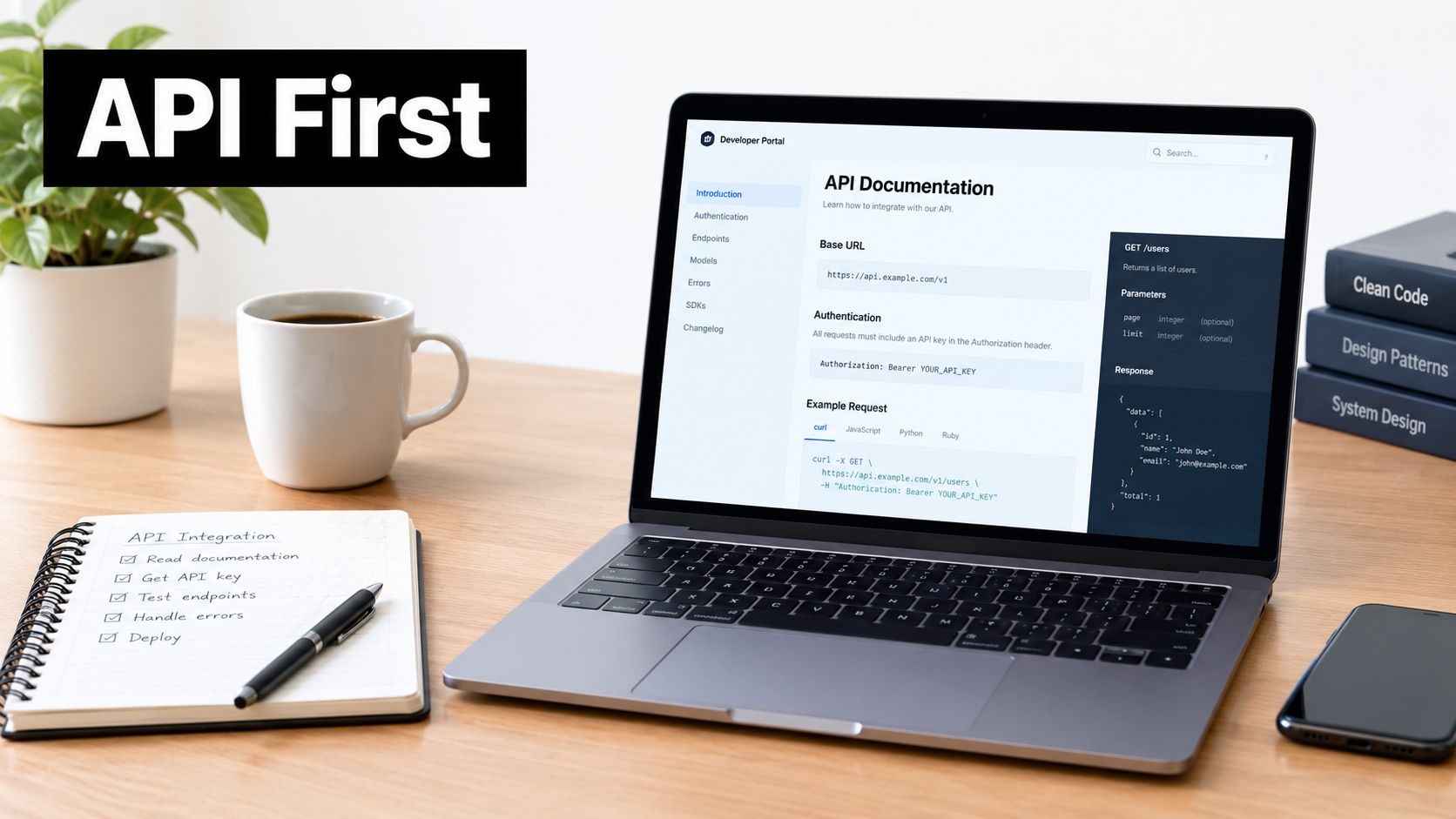
A lot of teams miss this trade-off. They spend early cycles on account structure, reporting views, permissions, and visual polish because those features look complete in demos. Stripe’s pattern points in a different direction. If adoption depends on engineers, the interface contract is the product.
Why this MVP worked
Stripe reduced the first promise to something testable. Can a developer read the docs, make a request, handle the response, and feel confident enough to keep going?
That is a better early test than broad market awareness for products that sit inside another team’s stack.
Three product choices usually define this pattern:
- clear, stable endpoints for one high-value job
- documentation with examples that shorten time to first successful call
- hands-on onboarding to catch naming, auth, and workflow gaps before scaling support
This is also where manual operations fit. Early API products often need humans behind the scenes. Support fills holes in the product, helps teams past integration friction, and shows exactly which parts should be automated next. That is still valid MVP work.
A useful framing from this overview of MVP testing choices is that different MVP formats answer different questions. Stripe’s format was well suited to testing workflow fit with developers and technical teams.
What Stripe left out on purpose
An API-first MVP does not need to solve every surrounding workflow.
Stripe could defer parts of the broader product surface while it proved the core integration path:
- deeper merchant admin tooling
- wider non-technical onboarding flows
- more elaborate analytics and reporting layers
- broader buyer-facing packaging
That omission is the lesson. Product teams often call something an MVP while still trying to satisfy operators, managers, finance, and developers in one release. Stripe’s pattern is narrower and more disciplined.
How to use this pattern
For Capgo-relevant products, this approach applies when the first value comes from being embedded in an existing delivery process. Release tooling, deployment control, billing hooks, and mobile automation often win or lose on implementation speed.
Practical MVP decisions might look like this:
- ship one reliable API for a single release action before building a full control plane
- treat request structure, auth, and error messages as core product work
- use manual onboarding with early teams to see where integration stalls
- delay broader admin surfaces until repeated usage shows which controls matter
Teams working on payment flows inside Capacitor apps will recognize the same requirement for good primitives in Stripe payment setup for Capacitor projects.
The cost is real. API-first products can spread quickly among technical users while staying hard to evaluate for less technical buyers. That is acceptable if the first version is meant to prove one thing clearly: developers can integrate it, trust it, and come back to it.
7. Buffer
Teams often overrate software and underrate sales evidence. Buffer worked the other way around. It proved that people wanted scheduled social posting before building the scheduling product itself.
That makes Buffer the strongest no-code validation example in this set, but the more useful lesson is the pattern behind it. This was constraint-led design applied to go-to-market. The team reduced the MVP to one question: will someone raise a hand for a tool that schedules Twitter posts?
Buffer answered that question with a landing page and a simple upgrade path. The software came later. What they built first was demand capture.
What Buffer actually validated
The promise was narrow enough to test without code: schedule your Twitter posts from one place.
That clarity mattered. A landing page works only when the benefit is easy to understand and the user can judge its value before touching the product. Buffer did not need to simulate a full dashboard, analytics suite, or multi-network publishing workflow to learn whether the problem was real.
What it left out was just as important:
- automated scheduling infrastructure
- full account management
- broader social network support
- reporting and team collaboration
- polished self-serve onboarding
Those omissions kept the test cheap and interpretable. If signups came in, the idea had demand. If they did not, the team had avoided weeks of unnecessary product work.
The repeatable pattern: no-code validation plus manual operations
This pattern fits products where the initial value can be described clearly and delivered manually for a small group of early users.
The sequence is practical:
- Write the narrowest credible promise.
- Put that promise on a landing page.
- Ask for a concrete commitment, such as signup, payment interest, or a request for access.
- Deliver the outcome manually for early users.
- Build software only around repeated manual work.
The trade-off is obvious. A waitlist shows interest, not sustained usage. Manual delivery fills that gap because it exposes user expectations, edge cases, and willingness to come back.
Why product teams still get this wrong
Teams usually fail here for one of two reasons. They test an idea that is too broad to explain, or they treat signups as proof of product-market fit.
Buffer avoided both mistakes by keeping the promise narrow and the learning goal modest. That is good MVP discipline. The first release does not need to answer every product question. It needs to answer the next expensive one before you fund a larger build.
The same caution shows up in newer AI product thinking, where teams test whether they can deliver a useful outcome before scaling the full system, as described in this discussion of what counts as viable in 2026.
Applying Buffer’s pattern to Capgo-style products
This pattern is useful when you are unsure whether teams want the workflow, not just the feature idea.
For a Capgo-relevant product, that might mean offering managed app update operations before building a full release platform. Run updates manually for a few design partners. Track who approves releases, where mobile deployments fail, what rollback controls they ask for, and how often they need visibility into version state.
That gives you a better first roadmap than guessing from feature requests. Build the parts that remove repeated manual effort first. Leave the broader control plane, reporting layers, and permission models for later, once the workflow appears often enough to justify them.
7 MVP Examples Comparison
| MVP Example | 🔄 Implementation complexity | ⚡ Resource & speed | 📊 Expected outcomes | Ideal use cases | ⭐ Key advantages • 💡 Tips |
|---|---|---|---|---|---|
| Dropbox - Simple File Sync MVP | Low feature scope but requires reliable backend sync engineering | Low development cost; very fast time-to-market; leverages a short demo video | Rapid PMF validation and viral signups (e.g., 75,000 signups from early post) | Products needing one core cross-device capability; validate with demo-driven messaging | ⭐ Clear, singular value proposition • 💡 Use concise demos to communicate value quickly |
| Slack - Internal Tool Turned Product MVP | Moderate, iterative internal dogfooding and feature refinement | Requires internal testers and longer iteration cycles; slower initial public launch | Strong product-market fit from real user feedback; faster monetization later | Team collaboration tools and B2B apps that benefit from dogfooding | ⭐ Deep user insight from dogfooding • 💡 Test internally first and iterate tightly |
| Twitter - Constraint-Driven MVP (140 Characters) | Low technical scope; high product design discipline to enforce a constraint | Minimal features enabled fast launch and mobile/SMS reach | Distinct positioning and rapid adoption via a clear constraint | Communication platforms where a defining constraint simplifies adoption | ⭐ Constraint becomes a product differentiator • 💡 Treat constraints as features, not limitations |
| Airbnb - Photo-Heavy, Manual MVP | Low tech complexity but high operational/manual effort by founders | Low engineering cost but very time-intensive for founders (manual listings, photos) | Validated marketplace demand and trust signals through curated listings | Marketplaces where supply must be manually validated or curated first | ⭐ High-quality presentation builds trust • 💡 Use manual processes to learn before automating |
| Instagram - Single Feature, Mobile-First MVP | Low feature breadth with high emphasis on mobile UX/design quality | Small team; mobile-first development; fast performance prioritized | Rapid viral growth and engagement (e.g., 25,000 downloads day one) | Consumer mobile apps centered on a single, delightful interaction | ⭐ Beautiful, focused core experience • 💡 Ship mobile-first and perfect one interaction |
| Stripe - API-First, Developer-Focused MVP | Moderate, focused backend/API work and security considerations | Requires developer-focused docs and integration work; higher engineering skill | Fast adoption among developers; product growth via integrations | Developer tools, APIs, and infra products where dev DX matters most | ⭐ Documentation-driven adoption • 💡 Invest in clear APIs and sandbox/test modes |
| Buffer - Landing Page + Manual Twitter MVP | Very low technical complexity; validation via manual workflow | Minimal dev resources; founder time is main cost; extremely fast to test | Demand validated with near-zero build cost; informs product roadmap | Early-stage ideas where user interest can be tested before building | ⭐ Validates demand cheaply • 💡 Start with a landing page + manual fulfillment, then automate |
Turn These MVP Patterns Into Your Plan
The most useful minimum viable product example isn’t the one with the biggest brand name. It’s the one that matches your uncertainty.
Start with the riskiest assumption. If you don’t know whether anybody wants the idea, use the Buffer pattern and test demand with a landing page, a signup flow, or manual outreach. If people clearly want the outcome but you don’t understand the workflow, use the Airbnb pattern and deliver the service manually until you can see where trust, quality, and communication break. If developers are your first audience, Stripe’s API-first pattern is usually better than a polished dashboard. If the product depends on a fast, habit-forming interaction, Instagram or Twitter offer the better model: one loop, one constraint, one clear behavior.
Then choose the smallest credible test. “Small” doesn’t mean cheap-looking. It means narrow enough to isolate learning. Dropbox proved the magic moment. Slack proved internal usefulness before broad launch. Those are very different MVPs, but both were disciplined because each tested one thing well.
Define a behavioral signal before launch. Not a vague hope like “users will love it.” Pick one action that shows the workflow matters. The Upwork mobile ATS MVP is useful here because it tied validation to behavior that mattered downstream. Clients using the app checked the ATS more frequently than web-only users, and new clients who used the app within seven days of signup were more likely to make their first hire than web-only clients, according to this Upwork MVP case discussion. That’s a better pattern than chasing installs or pageviews.
Finally, document what stays manual and what gets automated later. Many teams blur that line and end up overbuilding. Write it down instead. Manual approvals. Manual onboarding. Manual support follow-up. Then define the conditions that justify automation.
If you’re applying this to mobile release infrastructure, keep it narrow. Start with one update workflow, one target platform, and explicit success or failure signals. Only after that should you expand into channels, CI/CD, differential updates, rollback protection, or analytics. Capgo is one option in that stack when the problem you’re validating is controlled live updates for CapacitorJS or Electron apps, but the sequencing still matters more than the tool choice.
Capgo gives teams a practical way to run a focused MVP for app updates without waiting on full app store review cycles for every web-layer fix. If your first test is “can we ship one controlled update workflow reliably,” Capgo supports that with signed bundle delivery, rollback protection, channels, logs, and adoption metrics that make the learning visible.