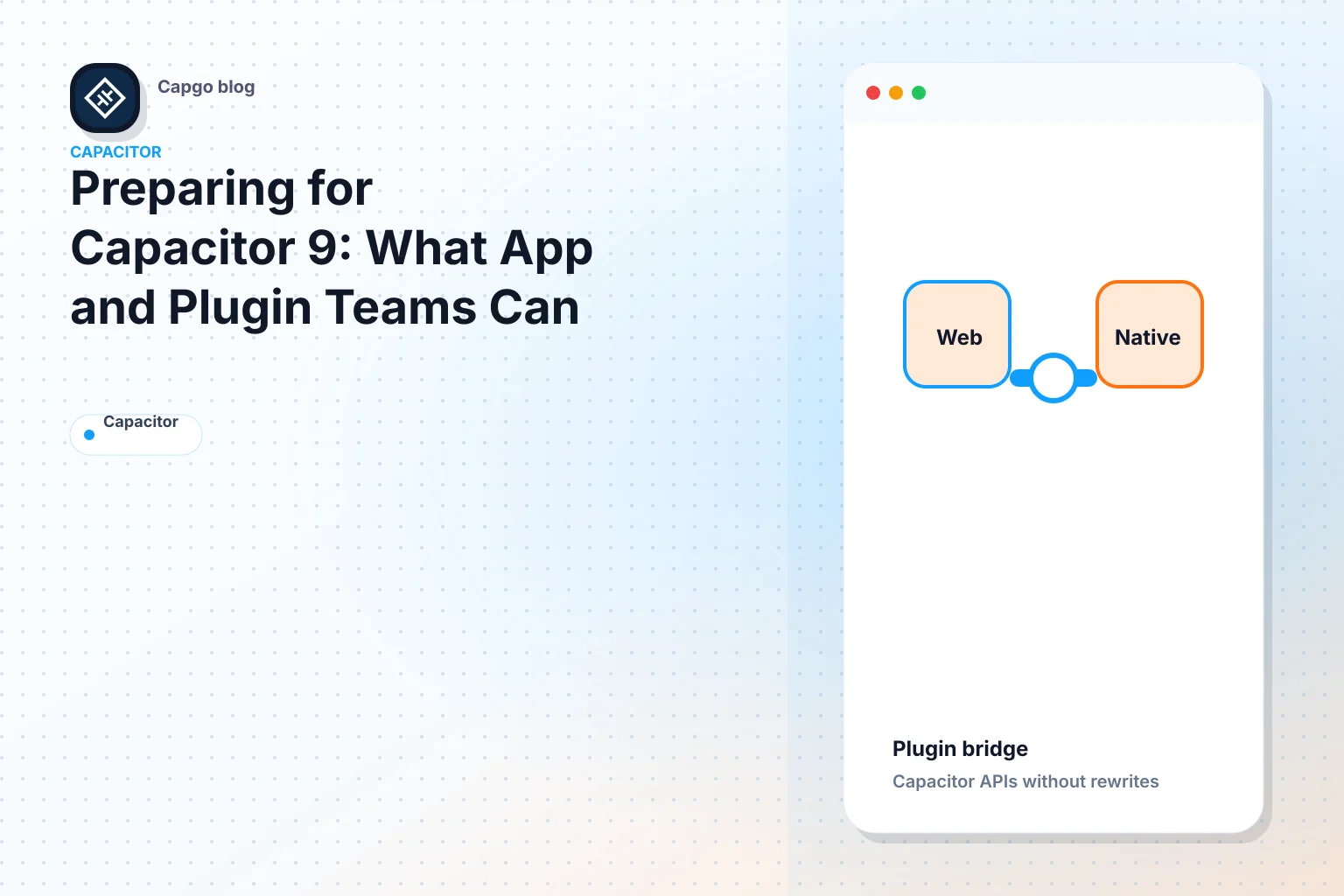
Capacitor 9 is available on the next dist-tag while it moves toward general availability. You do not have to upgrade your app the day the alpha lands, but the official Capacitor 9 update guide and plugin update guide already spell out toolchain floors and API removals that are worth addressing early.
This article is a preparation checklist: work you can do on Capacitor 8 (or on a branch) so the eventual bunx cap migrate pass is boring instead of painful. When you are ready to cut over, follow Ionic’s guides linked above line by line.
Toolchain and platform floors (apps)
Plan your CI, local machines, and store pipelines around these minimums:
| Area | Capacitor 9 requirement |
|---|---|
| Node.js | 24+ (latest LTS recommended; npm 11 ships with Node 24) |
| Xcode | 27+ |
| iOS deployment target | 16.0+ |
| Android Studio | 2026.1.1+ |
| Android Gradle Plugin (AGP) | 9.2.1 |
| Gradle wrapper | 9.5.1 |
If you are still on Capacitor 8.4 or earlier for iOS, you also need the UIScene lifecycle work from the Capacitor 8.5 update before Cap 9 — Xcode 27 expects it. Apps already on 8.5 can skip that extra step.
On iOS, Swift 6 (with Xcode 27) rejects @UIApplicationMain; when you upgrade, replace it with @main in AppDelegate.swift as described in the official guide.
Cordova at app sync time (not a plugin prep step)
In Capacitor 9, the Cordova compatibility layer is only wired into your app when cap sync detects an installed Cordova plugin. Android drops the extra Gradle modules when none are present; iOS stops adding CapacitorCordova to the Podfile or Package.swift when none are present.
That is an app-level behavior change after you upgrade. While you are still on Cap 8, you do not need to rip Cordova out of your template preemptively. Do audit whether any custom native code (yours or a forked plugin) imports Cordova symbols without an actual Cordova plugin in the project — those references will fail once optional Cordova wiring applies.
Android: gradle.properties and AGP 9 defaults
The AGP Upgrade Assistant often writes explicit gradle.properties flags so builds keep AGP 8 behavior. Capacitor 9 apps should remove those entries instead of carrying them forward: most are deprecated ahead of AGP 10, and some break Cap 9 builds (for example android.builtInKotlin=false disables Kotlin support that AGP 9 bundles, and android.sdk.defaultTargetSdkToCompileSdkIfUnset=false stops AGP from inferring targetSdkVersion).
When you migrate, also expect to:
- Bump
variables.gradleminimums (compile/target SDK 37,minSdkVersion26, updated AndroidX versions — see the official doc). - Remove explicit
targetSdkVersionfrom the appbuild.gradleso AGP 9 can infer it fromcompileSdkVersion. - Declare
variables.gradlesymbols at the top ofapp/build.gradle(Gradle 9.6 deprecates implicit lookup from the root project). - Swap default ProGuard file names, migrate
core-ktxtoandroidx.core:core1.19.0+, drop standalone Kotlin Gradle plugin usage, and removejcenter().
You can read diff hunks in the Updating to 9.0 Android section and apply the same cleanups on a branch before bumping Capacitor versions.
CLI: cap run --url
Capacitor 9 merges live-reload host/port/https flags into a single --url argument. Instead of:
bunx cap run android -l --host 192.168.1.181 --port 5173pass the URL your dev server prints:
bunx cap run android --url http://192.168.1.181:5173/Update scripts and README snippets now so muscle memory does not fight the new CLI after upgrade.
Official plugins: push and splash gotchas
Two user-facing changes show up often in production apps:
Push Notifications (iOS): The deprecated alert presentation option is removed. Use banner and/or list in your presentation options.
Splash Screen (Android): Default launchFadeOutDuration changes from 200 ms to 0. If you relied on the fade hiding first paint glitches, set launchFadeOutDuration: 200 explicitly in capacitor.config until you adjust your startup UI.
Scan the plugin sections in the 9.0 update guide for AndroidX and Google Play Services version bumps tied to official plugins you use.
Plugin maintainers: prep on Cap 8 without breaking Cap 8
If you ship Capacitor plugins consumed on Capacitor 8 and want Cap 9-ready code, focus on deprecated API removal, not on Cap-9-only packaging changes.
Safe to do while Cap 8 remains supported:
- Replace
@NativePluginwith@CapacitorPluginand migrate legacy permission / activity-result APIs to@PermissionCallback/@ActivityCallbackpatterns (see the plugin 9.0 guide table). - Remove
PluginCall.hasOption,Plugin.getConfigValue, oldCapConfigconstructors and getters,PluginCall.save()/isSaved(), and other Java removals listed under “Breaking changes in code.” - On iOS, stop using the
CAPBridgecompatibility class and deprecatedCAPBridgeProtocolhelpers; useApplicationDelegateProxy, typedPluginCallaccessors, and bridge properties from the migration table. - Run
bunx @capacitor/plugin-migration-v8-to-v9@lateston a branch and keep only the API edits that still compile against Cap 8 peer dependencies until you publish a major for Cap 9.
Do not remove the Cordova SPM product from your plugin’s Package.swift while you still support Capacitor 8. Cap 8 projects expect that dependency when your plugin is SPM-based; dropping it early breaks consumers still on 8. Treat optional Cordova / removing the unconditional Cordova product as a Capacitor 9-only release line (or a semver major explicitly documented as Cap 9+), after you stop supporting Cap 8 — as described in the plugin guide, not as prep work on the Cap 8 line.
The same rule of thumb applies to bumping capacitor-swift-pm to 9.0.0-alpha.x in Package.swift: that belongs on your Cap 9 major, not on a Cap-8-compatible release.
Capgo live updates and the native Cap 9 store build
Capgo delivers web bundle updates over the air; the native shell still comes from the App Store and Google Play. When you move your app to Capacitor 9:
- Ship at least one store build compiled against Capacitor 9 native projects (iOS and Android). That binary establishes the native baseline Capgo channels target.
- Only after that build is in users’ hands should you rely on OTA bundles tested against Cap 9 WebView and plugin behavior.
- Put production channels on the
metadatastrategy and upload the matching Cap 9 bundle to each channel with--auto-min-update-version. For that intentional native baseline upload, omit--fail-on-incompatible(native packages are supposed to change). Keep--fail-on-incompatibleand--auto-min-update-versionon everyday OTA uploads afterward. See Native + OTA channel workflow. - Keep channel and semver rules aligned so you never push a bundle that assumes Cap 9 APIs to devices still running an older native shell.
If you use Capgo Build or your own CI, refresh agents before the Cap 9 store release so the pipeline matches what users install: macOS runners need Node 24+ and Xcode 27+; Linux runners need Node 24+ and host Android tooling aligned with AGP 9.2.1 / Gradle 9.5.1 (Xcode is macOS-only).
Suggested order of operations
- Upgrade installed tooling on CI hosts and developer machines to the floors above (Node, Xcode, Android Studio, JDK). Do not bump the Cap 8 app’s AGP dependency, Gradle wrapper, or other Android project files to Cap 9 values until
bunx cap migrate— those project changes belong to the migration step. - Fix deprecated native APIs in app code and plugins (especially custom
AppDelegateURL handling and Android bridge usage). - Clean Android Gradle files and scripts (
gradle.properties, ProGuard defaults,--urlin dev scripts). - Audit Cordova usage at the app level; do not change plugin SPM Cordova products until Cap 9-only releases.
- When Cap 9 is GA (or when you accept
next), runbun add -d @capacitor/cli@next(or@latestafter release), thenbunx cap migrate, and follow Updating to 9.0. - Publish the Cap 9 native build to stores, then resume or expand Capgo OTA rollouts on the matching channel.
Capacitor 9 is mostly “pay down deprecations and align with modern Android and Apple toolchains.” Doing that work on Cap 8 keeps your upgrade diff small and your plugins compatible with the teams still shipping 8.x today.