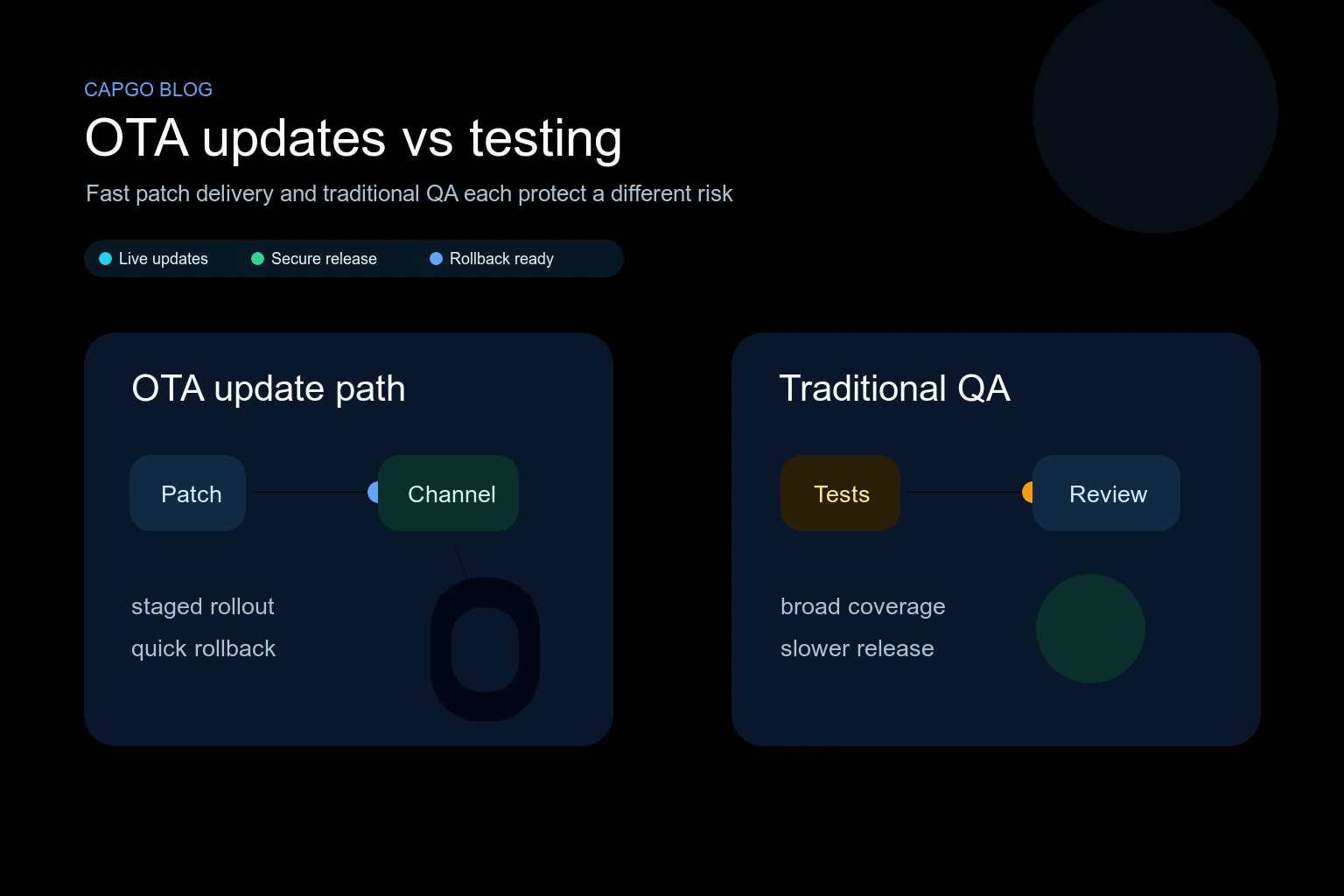
Want faster app updates without app store delays? Capacitor OTA updates let you deliver changes instantly, while traditional testing ensures thorough pre-release quality. Here’s a quick comparison:
- Capacitor OTA Updates: Push updates directly to users without app store approval. Ideal for quick fixes and feature rollouts.
- Traditional Testing: Follows structured phases like unit, integration, and system testing before release. Ensures reliability but takes longer.
Quick Comparison:
| Feature/Aspect | Capacitor OTA Updates | Traditional Testing Methods |
|---|---|---|
| Update Deployment | Instant over-the-air delivery | Requires app store submission |
| Testing Scope | Focused on specific changes | Full-system testing |
| User Experience | Automatic background updates | Users manually update apps |
| Risk Management | Instant rollback capabilities | Requires new submission for fixes |
Capacitor OTA updates, supported by tools like Capgo, provide flexibility and speed, while traditional methods ensure comprehensive quality. Both have their place depending on your app’s needs.
Appflow Deploy: Ship real-time updates to your Ionic app users

Capacitor OTA Updates Explained

OTA updates in Capacitor apps simplify app maintenance after release. Instead of requiring full app store submissions, developers can push updates directly to users.
What Makes OTA Updates Stand Out?
OTA updates focus on modifying the web layer (HTML, CSS, JavaScript) without altering native code. This method ensures compliance with app store rules while allowing quick updates.
Here’s a breakdown of key features:
| Feature | Description | Benefit |
|---|---|---|
| Instant Deployment | Push updates directly to devices | Skips app store approval delays |
| Selective Updates | Target updates to specific groups | Allows phased rollouts |
| Version Control | Manage and track update history | Keeps updates organized |
| Rollback Support | Revert to previous versions easily | Reduces risks from faulty updates |
These features provide developers with greater flexibility and control, especially when paired with tools like Capgo.
Capgo’s Role in OTA Updates

Capgo simplifies the process of managing OTA updates for Capacitor apps. Its platform prioritizes security with end-to-end encryption, ensuring update content remains protected.
By integrating with CI/CD pipelines, Capgo automates deployments. Developers can test updates with specific user groups, roll out changes gradually, and tailor updates based on user needs.
With Capgo’s tools for organization, version control, and rollback, teams can handle updates smoothly and with confidence.
sbb-itb-f9944d2
Standard Testing Methods Overview
Traditional testing involves structured phases and detailed documentation to ensure software performs reliably before release.
Core Testing Components
This approach includes four key phases: unit, integration, system, and acceptance testing. Each phase serves a specific purpose:
- Unit Testing: Focuses on individual code components.
- Integration Testing: Verifies interactions between components.
- System Testing: Assesses the overall application behavior.
- Acceptance Testing: Confirms the software meets user requirements.
A significant aspect of traditional testing is its reliance on comprehensive documentation. Key documentation types include:
| Documentation Type | Purpose | Key Elements |
|---|---|---|
| Test Plans | Outlines the testing strategy | Scope, timeline, resources |
| Test Cases | Describes specific test scenarios | Steps, expected results, prerequisites |
| Defect Reports | Tracks identified issues | Severity, reproduction steps, status |
| Test Results | Summarizes outcomes | Pass/fail metrics, coverage analysis |
Tools like TestRail and Jira are commonly used to manage these documents, though maintaining and executing them can be time-consuming.
Testing Methods: Strengths and Limits
Traditional testing is known for its thoroughness and accountability. Its structured approach ensures all functionalities are carefully examined, reducing the risk of critical issues making it to production.
However, this method has some drawbacks in fast-paced development environments:
- Sequential phases can lead to longer development cycles.
- Manual testing processes demand significant time and resources.
- Adapting to changes is challenging due to rigid workflows.
- Feedback loops between development and testing are slower.
Automation tools like Selenium and Appium can speed up certain tasks, but traditional testing remains slower compared to modern alternatives.
Ultimately, the success of traditional testing relies on proper execution and resource management. While its focus on thoroughness is valuable, the slower pace can be a hurdle, especially under tight deadlines or when faster, over-the-air (OTA) updates are needed. This contrast highlights the growing demand for more agile testing methods.
OTA Updates vs Standard Testing
Let’s take a closer look at how OTA (Over-The-Air) updates differ from traditional testing methods. OTA updates are deployed instantly via the web layer, while traditional testing involves phased, manual reviews.
Main Differences
| Feature/Aspect | Capacitor OTA Updates | Traditional Testing Methods |
|---|---|---|
| Resource Usage | Minimal manual effort, automated processes | Dedicated QA teams, manual testing |
| Testing Scope | Focused on specific changes | Full-system testing |
| Risk Management | Instant rollback capabilities | Requires a new submission for changes |
These differences directly shape how projects are executed and delivered.
Benefits and Drawbacks
The contrast between these approaches highlights how OTA updates can complement traditional testing by addressing its slower feedback cycles.
What OTA updates bring to the table:
- Instant deployment with immediate user feedback
- Automated processes that lighten resource demands
- Targeted updates for specific issues or features
- Real-time fixes and issue resolution
What traditional testing ensures:
- Thorough quality assurance across the system
- Well-documented testing procedures
- Validation for regulatory compliance
- Comprehensive system-wide testing
Platforms like Capgo demonstrate how secure OTA updates can integrate seamlessly with existing workflows. They allow developers to maintain app store compliance while deploying updates quickly.
Conclusion
OTA updates have changed the way developers address user needs and keep up with market demands. They allow apps to be updated and improved after release without the usual delays.
With tools like Capgo, developers can deploy updates instantly and securely, avoiding the slowdowns of app store approvals. This creates a balance where both OTA updates and traditional testing methods play important roles.
Keep going from Capacitor OTA Updates vs Traditional Testing Methods
If you are using Capacitor OTA Updates vs Traditional Testing Methods to plan native plugin work, connect it with Capgo Plugin Directory for the product workflow in Capgo Plugin Directory, Capacitor Plugins by Capgo for the implementation detail in Capacitor Plugins by Capgo, Adding or Updating Plugins for the implementation detail in Adding or Updating Plugins, Ionic Enterprise Plugin Alternatives for the product workflow in Ionic Enterprise Plugin Alternatives, and Capgo Native Builds for the product workflow in Capgo Native Builds.