Friday afternoon is when release managers earn their coffee. The build passed, the deploy job finished cleanly, and the dashboard says the new version is live. Then support pings the channel because users are still seeing the old behavior on mobile, or only a slice of users got the change because the actual release path sits behind app-store review, feature flags, or an OTA channel nobody outside engineering thinks about until it breaks.
That gap is the whole story. Deployment moves code, release controls user exposure, and mature release management has to govern both. The best models treat it as an end-to-end control system with six phases, and they measure health with the four DORA metrics, deployment frequency, lead time for changes, change failure rate, and mean time to recovery (MTTR), because those are the numbers that describe speed, stability, and recovery in one view (Arcad Software).
Table of Contents
- Why Most Release Management Guides Miss the Core Issue
- The Six Phases of a Mature Release Lifecycle
- Measuring Release Health with DORA Metrics
- Traditional vs Decoupled Release Management
- Best Practices for Branching, Gating, and Rollbacks
- Release Management for Capacitor and Electron Apps with OTA Updates
- Building a Release Readiness Checklist for Your Team
Why Most Release Management Guides Miss the Core Issue
The classic failure mode shows up on a Friday. The team merges the code, the build pipeline passes, deployment to production succeeds, and the change still does not reach users in any meaningful way. In web apps, that delay might come from cache behavior or a staged rollout. In mobile, it can be worse because the code is built, but exposure still waits on app-store review or an OTA path.
Deployment is not the same as release
That distinction matters because many guides still describe release as if it happens at the deployment step. Modern release management treats deployment as the technical movement of artifacts, while release is the decision about who sees what and when. A mature process uses planning, versioning, validation, controlled exposure, and retrospective learning, not just “ship it and hope.”
Practical rule: if your team can deploy without affecting every user, you are already doing release control whether you named it that way or not.
This matters even more in mobile and hybrid apps, where app-store review turns the release path into a bottleneck and runtime delivery becomes the main control layer. The practical question is no longer “Did the build go out?” It is “Which users are seeing the change, can we verify the effect, and can we stop exposure without another full redeploy?”
A useful mental model is to treat every release as a chain of decisions. Planning defines scope and risk, build and versioning create a controlled artifact, testing proves the artifact is acceptable, final validation decides whether it is safe to expose, deployment moves it into the target environment, and post-release analysis checks whether reality matched the plan. That structure is not bureaucracy for its own sake. It is how teams keep small mistakes from turning into widespread incidents.
When teams skip that model, they usually do not get faster. They just move risk downstream, where it is harder to diagnose and more expensive to unwind.
For mobile teams, the split between deployment and exposure is not theory. It changes the control points. A build can sit in a store queue while an OTA channel already lets you limit the blast radius, test a fix with a smaller audience, or pause a rollout if metrics start to drift. That is why the release management process has to track both artifact movement and user-facing change. The artifact may exist, but the release is not complete until the right users receive it through the channel you control, including the build types overview that determine how those artifacts move through the pipeline.
The Six Phases of a Mature Release Lifecycle
A mature release lifecycle is easier to run when each phase has a clear decision point. The point is not to make the process heavier. The point is to make failure visible earlier, when the blast radius is still small.
Planning and build work as a control system
Planning starts with scope definition, risk assessment, and stakeholder alignment. That sounds routine, but it’s where teams decide whether a change belongs in a standard release, an emergency path, or a longer stabilization cycle. The better the planning discipline, the fewer surprises show up during validation.
Build and versioning are where release artifacts become traceable. Configuration management, immutable artifacts, and version history matter here. The capgo.app article on build types is useful context for thinking about how different artifacts move through release pipelines, especially when you’re separating code packaging from user exposure (build types overview).
Testing validation deployment and learning
Testing and QA should do more than confirm that something runs. They need to verify regression paths, performance expectations, and obvious breakpoints before the change gets near users. Final validation is the go or no-go checkpoint, where change approval, rollback procedures, and sign-off happen together. If the team can’t describe the rollback path in plain language, the release isn’t ready.
Production deployment should support progressive exposure. Canary patterns, feature flags, and gradual rollouts reduce the chance that a bad change hits everyone at once. That is also why the release process is not over when the deploy job finishes. Post-release analysis needs monitoring, incident response, and retrospective review so the team can learn from what happened.
The model below is a good reminder that maturity is measured by control, not ceremony.

Skipping a phase rarely saves time. It usually means the failure arrives later, after more people have depended on the release and the rollback window has shrunk.
Measuring Release Health with DORA Metrics
Counting releases is a weak way to judge release quality. A team can ship often and still be clumsy, risky, and hard to recover. The four DORA metrics are more useful because they describe delivery speed and stability together, not just how much code moved.
What each metric tells you
Deployment frequency tells you how often the pipeline produces real change for users. In practice, it reflects batch size discipline. If releases are rare, teams are usually bundling too much work, waiting too long for approval, or carrying too much fear into the process.
Lead time for changes shows how long a change waits before it reaches production. Elite teams deploy on demand and keep lead time for changes to less than one day (Unleash). That threshold matters because a short path from commit to production reduces context loss and makes debugging far easier.
Change failure rate tells you how often releases degrade service. The elite benchmark is typically 0 to 15%. That number is not a trophy, it is a sign that the team is testing the right things and keeping blast radius small.
MTTR shows how fast service is restored after an incident. Elite teams recover in less than one hour. That matters because a strong rollback path and good observability are often more valuable than heroics during an outage.
Practical rule: track rollback frequency and post-release incidents alongside the DORA metrics, because a “successful deploy” that later creates incident churn is still a weak release.
Instrumentation beats memory
The strongest teams wire metric capture into the pipeline so the data arrives automatically instead of through hand-entered reports. That usually means the CI system, deployment platform, incident tool, and observability stack all need to share a release identifier. If they do not, the team ends up arguing about which release caused what.
Traditional output tracking tends to stop at “did it deploy.” That misses the key question, which is whether the release was safe, visible, and worth repeating. For teams that want a more operational view of runtime health and detection, the app health monitoring guidance from Capgo is a useful companion reference.
A release process that cannot measure recovery is only half built. Speed without restoration discipline just makes outages arrive faster.
Traditional vs Decoupled Release Management
Traditional release management assumes deployment and user exposure happen together. That worked when the release was a single event and the server state was the same thing as the user experience. It breaks down fast once you introduce feature flags, staged rollouts, and mobile distribution constraints.
Linear release flow versus runtime control
The old pattern is simple. Plan, build, test, deploy, then let everyone see the change. The advantage is clarity. The drawback is that one bad push can affect the whole audience, and rollback often means another redeploy.
Decoupled release management separates the act of shipping code from the act of exposing it. That gives teams a safer control surface. You can deploy dormant code, expose it to a small slice of users, verify impact, and then widen the rollout. The deployment is technical. The release is a product decision.
The comparison below captures the shift from batch-style delivery to runtime control.

Where each model still fits
Traditional batching still has a place. Regulated industries, major version changes, and large coordinated launches often need stronger change control and explicit approvals. The process is slower, but the coordination cost is acceptable when compliance or business risk is high.
Decoupled delivery wins when teams need fast iteration, safer experimentation, or mobile control paths that don’t depend on every user getting the same binary at the same time. That’s the critical issue in hybrid and mobile apps, where runtime delivery and policy gates often matter more than the store release itself. The practical question becomes how to expose changes to some users, verify behavior, and revert exposure without waiting for a new store cycle.
For a deeper comparison of store-bound updates and direct update channels, this overview is worth reading once your team is deciding how much release control should live in the app versus the platform (app store vs direct updates).
Best Practices for Branching, Gating, and Rollbacks
The controls that keep releases safe are usually boring when they work and painfully memorable when they don’t. Good branching, gating, and rollback design gives you enough structure to move quickly without letting every change become a fire drill.
Branching should match the size of the change
Trunk-based development fits continuous delivery because it keeps integration frequent and avoids the drift that comes from long-lived branches. Feature branches still make sense for larger changes that need isolation, but they should be short-lived and actively merged. Release branches are useful when a team needs stabilization without stopping mainline work.
The mistake is using branch strategy as a comfort blanket. A long branch can hide integration pain until the end, which is where it becomes expensive. Shorter paths surface merge conflicts earlier and make release risk easier to see.
Gates should stop bad change before users do
Automated quality checks need to catch the problems humans miss under pressure. That means test suites, security scans, and performance baselines should run before production exposure. Manual approval still matters for high-risk changes, but it should sit on top of machine validation, not replace it.
A useful control pattern is to separate standard releases from emergency ones. Emergency changes need faster governance paths, but they still need traceability. A mature release system can say who approved the change, what baseline it came from, and what rollback option was available if the release misbehaved.
Rollbacks need practice not wishful thinking
Rollback plans fail most often because they’re treated as paperwork. Blue-green deployments, reversible database changes, and feature flag kill switches are all stronger when they’ve been rehearsed under pressure. If the team has never tested the rollback path, it’s a theory, not a capability.
The underlying control model is captured well in the rollback strategy guidance for CI/CD workflows, which is worth keeping close when your team is tightening recovery procedures (rollback strategies for CI/CD workflows).

Practical rule: if a rollback requires a meeting, the rollback is too slow.
Release Management for Capacitor and Electron Apps with OTA Updates
The first time a hybrid app team gets burned by store latency, the lesson sticks. A JavaScript fix is ready, the native shell is fine, and the bug is clearly in the shipped bundle. The problem is that the app store is now part of the release path, so the team can’t patch the code and push it the same afternoon.
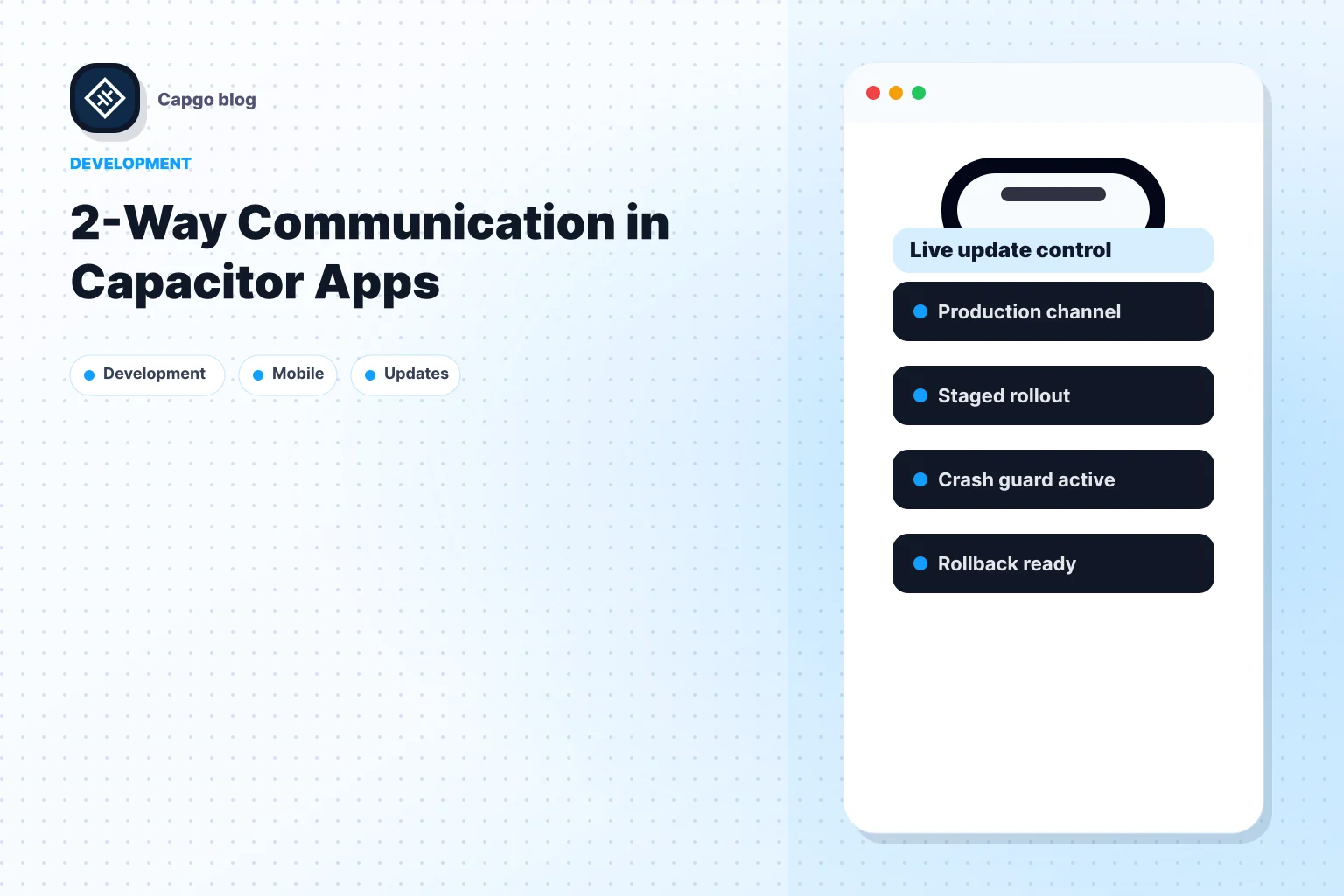
That is where OTA control changes the game. In Capacitor and Electron workflows, teams can ship JavaScript, CSS, copy, config, and asset fixes without waiting for a full app-store cycle. Capgo is one option in that category, it provides live updates, channel-based releases, rollback support, and differential updates for CapacitorJS and Electron apps. Its release flow is built around signed bundles, targeted channels, and observability at the device level, which makes the release decision much closer to the runtime than to the binary.
What changes when exposure is runtime-driven
Once deployment is decoupled from user exposure, release management becomes a policy problem as much as a shipping problem. A beta channel can receive the bundle first, a staging audience can validate the update, and a customer-specific stream can get the fix without touching everyone else. That structure works because the team can control who sees the update, not just whether the bundle exists.
Differential updates matter because they reduce the amount of data sent when only part of the bundle changes. That is a practical fit for mobile users on constrained networks and for frequent patch cycles where the payload is mostly unchanged. Signed web bundles matter for the same reason server-side signatures matter anywhere else, they keep the update path controlled.
What good OTA discipline looks like
Operational advantage lies in rollback protection. If a bad bundle starts causing crashes or broken UI flows, the system can suppress or replace exposure without a new store release. Support can look at per-device logs and version history, while engineering checks adoption and failure patterns by channel instead of guessing from anecdote.
The other discipline point is channel guardrails. Teams need hard rules so a staging build doesn’t leak into production. CI/CD integrations help here because the pipeline can upload bundles to the right stream automatically instead of relying on a manual operator to choose the correct target under pressure.
For implementation details on automating that flow, the Capgo guide on CI/CD integration is the most relevant reference to keep nearby (Capgo OTA updates CI/CD integration guide).
Building a Release Readiness Checklist for Your Team
A good release checklist is not a paperwork exercise. It is the minimum set of checks that keeps the team from discovering basic mistakes after users do. The strongest checklists combine pipeline automation, security controls, compliance traceability, and observability into one routine.
Pre-release checks that actually matter
Start with artifact integrity. Signed builds, access controls, and secret handling should be verified before the release moves any farther. Then check the release-specific approval path, especially if your team works in fintech, healthcare, or any other environment where change history matters.
Observability belongs in the checklist, not in the postmortem. The release should have a clear monitoring plan, defined alert thresholds, and enough tracing to isolate the first failing dependency. If the team can’t explain what will be watched after launch, it isn’t ready to launch.
A simple operating checklist
- Artifact readiness: confirm the bundle or binary is signed, versioned, and traceable to a controlled baseline.
- Approval path: verify who can approve standard, emergency, and high-risk releases.
- Rollback path: confirm the rollback method, the owner, and the expected recovery sequence.
- Monitoring setup: make sure tracing, anomaly detection, and alert routing are live before exposure.
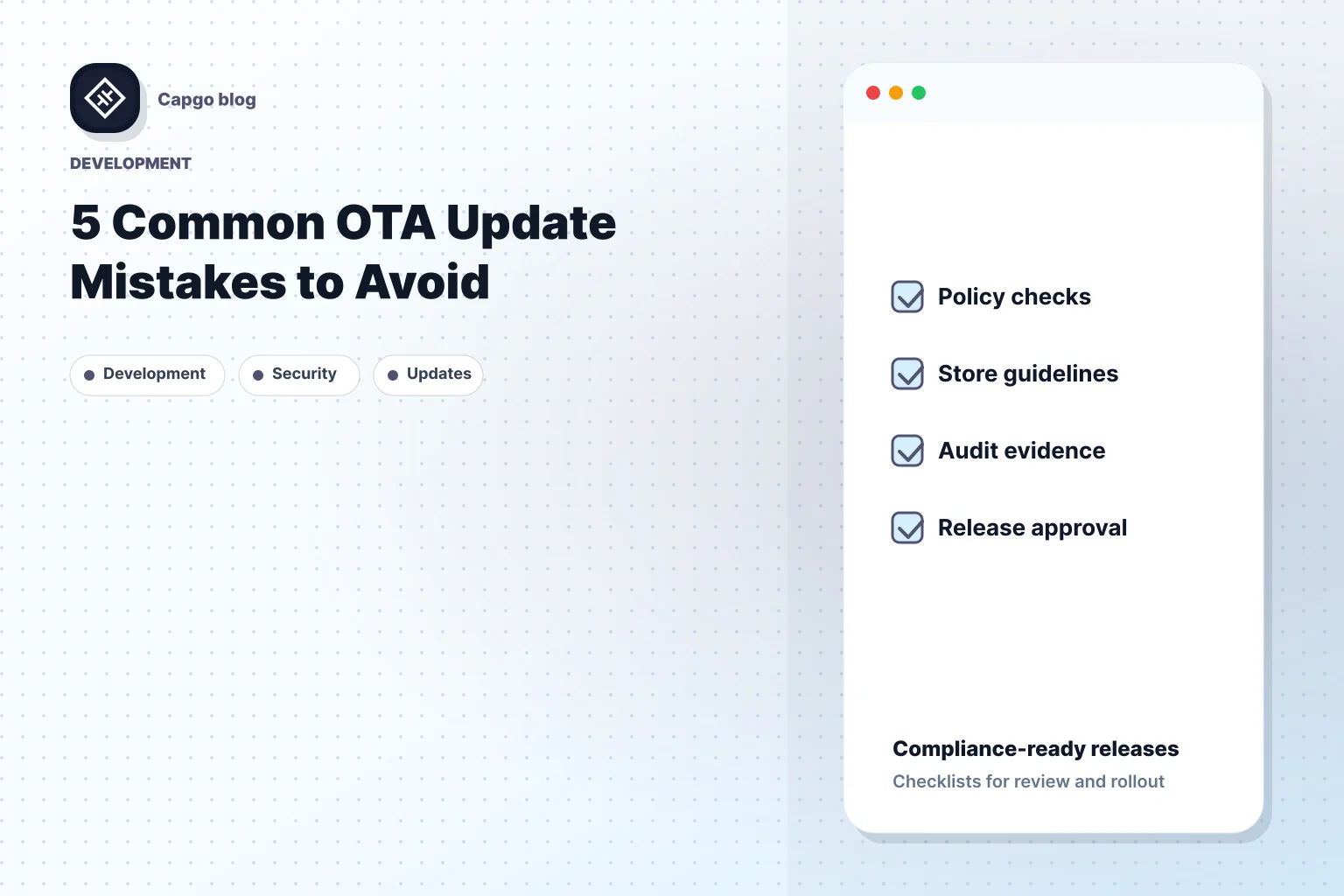
- Audit trail: keep the release record complete enough for compliance review and incident analysis.
The release management process gets better when this checklist is treated as a living control surface instead of a static document. Every incident, near miss, and smooth rollout should change the checklist a little. That’s how teams turn release management into continuous verification instead of a repeated gamble.
If your team is trying to shorten release cycles without losing control, Capgo gives you a practical way to ship OTA updates, manage channels, and roll back bad bundles without waiting on app-store review. Visit Capgo to see how its update flow fits Capacitor and Electron release management in real pipelines.