Elite software teams deploy code about 1,460 times per year, while low performers deploy about 1.5 times per year, according to DORA’s 2021 Accelerate State of DevOps report. That’s roughly a 973x difference in release frequency, and it changes how we should think about shipping software. Release velocity isn’t a vanity metric. It shows whether a team can turn an approved change into user value routinely, safely, and without waiting for every release to become a major event.
Mobile teams need a more precise definition. A Capacitor application can contain native code that requires App Store or Play review, alongside a web layer that can often change independently. If you measure only binary submissions, you’ll miss the updates users experience. The practical question is not how often your team builds an app. It’s how often customers receive a functional improvement, fix, content change, or configuration update.
Table of Contents
- What Release Velocity Actually Means for Software Teams
- The Core Metrics Behind Release Velocity
- Binary Cadence Versus Shipped Experience Frequency
- Practical Strategies to Accelerate Your Release Pipeline
- How Capgo Enables Faster Releases for Cross-Platform Apps
- Common Misconceptions About Shipping Faster
- Your Action Plan for Improving Release Velocity
What Release Velocity Actually Means for Software Teams
DORA defines deployment frequency as a core delivery metric, measuring how often teams deploy software to production or end users. Its benchmark places elite performers in the on-demand, multiple-deploys-per-day category, while low performers deploy fewer than once every six months, as documented in the 2022 Accelerate State of DevOps report. The exact benchmark matters less than the operating pattern behind it. High-performing teams make small releases a normal part of work instead of accumulating changes into risky batches.

Release velocity is the rate at which a team delivers functional, user-facing changes from committed code to a live experience. That journey includes review, testing, packaging, deployment, rollout, adoption, and recovery when something goes wrong. A fast build pipeline helps, but it doesn’t automatically produce a fast customer feedback loop.
Why mobile changes the calculation
Web teams can often deploy a JavaScript change directly to infrastructure and make it available immediately. Mobile teams face a different chain of dependencies. Native changes may require a new binary, store submission, review, approval, rollout, and user adoption. A team can finish a fix quickly and still wait for the user’s installed application to become capable of receiving it.
That distinction matters for Capacitor, Ionic, and Electron teams. Their applications often combine native capabilities with HTML, CSS, JavaScript, assets, and configuration. Treating every change as a binary release forces simple interface or logic updates through the slowest path.
Practical rule: Measure the time from code change to the user receiving the intended experience, not just the time from commit to build completion.
A useful operating model separates binary release cadence from shipped experience frequency. Binary cadence tells you how efficiently the team handles native packaging and store compliance. Shipped experience frequency tells you how often users receive meaningful changes. The distinction belongs alongside broader operational efficiency practices, because a pipeline can be technically busy while customers see little movement.
The goal isn’t to bypass platform rules or push arbitrary executable behavior. It’s to route eligible web-layer changes through a delivery mechanism suited to those changes, while keeping native functionality inside the normal store process.
The Core Metrics Behind Release Velocity
Deployment frequency starts the conversation, but it cannot describe release performance on its own. DORA defines it as how often deployments occur, or the time between them. Its current framework contains five core metrics, including Rework Rate, which tracks effort spent correcting earlier changes instead of delivering new value. Use the DORA metrics guide to keep definitions consistent across teams.
Track speed and stability together
These metrics work as a system:
- Deployment frequency measures how often changes reach production or end users.
- Lead time for changes measures the time from code commit to deployment.
- Change failure rate measures how often a deployment causes failure, rollback, or remediation.
- Mean time to recovery measures how quickly the team restores service after a production failure.
- Rework rate shows how much delivery capacity goes toward correcting earlier changes rather than shipping new value.
Mobile teams need to interpret lead time by delivery path. A JavaScript or asset change may be ready for users while a native change remains in the binary pipeline. Combining both paths in one dashboard can make a capable team appear slow and conceal the app store review bottleneck.
The historical DORA tiers provide useful vocabulary. Elite performers deploy on demand with multiple deploys per day. High performers range from once a month to once a week, medium performers range from once every six months to once a month, and low performers deploy fewer than once every six months, according to the DORA 2022 report. These tiers describe delivery capability. They are not targets to pursue without considering risk, team size, or the difference between binary releases and live web-layer updates.
Use a dashboard that exposes trade-offs
A release-frequency chart without failure and recovery data can reward risky batching. A failure-rate chart without lead time can hide a team that avoids shipping. Cross-platform teams should separate native binary releases from web-layer updates and also track update adoption, rollback events, and rework.
| Performance Tier | Deployment Frequency | Lead Time for Changes | Change Failure Rate | Mean Time to Recovery |
|---|---|---|---|---|
| Elite | On demand, multiple deploys per day | Track with deployment flow | Track as a stability guardrail | Track recovery speed |
| High | Once a month to once a week | Track with deployment flow | Track as a stability guardrail | Track recovery speed |
| Medium | Once every six months to once a month | Track with deployment flow | Track as a stability guardrail | Track recovery speed |
| Low | Fewer than once every six months | Track with deployment flow | Track as a stability guardrail | Track recovery speed |
Do not create a benchmark for a metric you have not measured. Establish a baseline, segment native and web-layer changes, and check whether faster delivery also brings smaller batches, manageable failures, and quicker recovery. For teams building a broader view of engineering output, this developer productivity guide offers a complementary reference.
Binary Cadence Versus Shipped Experience Frequency
A binary release is an application package submitted through a store or distributed through an approved desktop channel. Shipped experience frequency is how often users receive the changes that affect what they see and do. Those measures overlap, but they aren’t interchangeable.
A monthly binary cadence can coexist with frequent web-layer delivery. A Capacitor team might reserve binary releases for native plugins, permissions, OS integrations, and updater changes, while sending eligible JavaScript, CSS, copy, configuration, and asset updates through a controlled live-update path. The binary number describes packaging work. The experience number describes product iteration.

Why one mobile number isn’t enough
App store review introduces latency that backend teams don’t face in the same way. The mobile release velocity analysis from Digia describes store review as introducing 24 to 48 hours of latency and argues that mobile teams should track binary release cadence separately from shipped experience frequency. User adoption creates another delay. Even after approval, users may not install the new binary immediately.
That creates a common measurement failure. A team may submit binaries frequently, yet most customers continue running an older version. If the product team measures only submissions, it can claim progress that users haven’t experienced.
Route each change through the right path
Use the binary pipeline for changes that need native packaging. Use feature flags, remote configuration, content delivery, and signed web-layer updates for changes that don’t. The goal isn’t to force every update through an over-the-air mechanism. The goal is to stop making the store the default gate for changes that don’t require a new binary.
Usage-frequency segmentation for app updates can help teams distinguish who receives an update, when they receive it, and whether the update reaches active users. That data makes shipped experience frequency more useful than a simple release calendar.
Practical Strategies to Accelerate Your Release Pipeline
Release velocity improves when teams remove waiting, repeated manual work, and unnecessary coupling. Start by measuring where each release spends time. Manual signing, native dependency installation, serial tests, approval handoffs, and full-bundle transfers require different fixes, so treat them as separate bottlenecks.
Automate the mechanical work
A reliable CI/CD pipeline builds from a known commit, installs pinned dependencies, runs tests, produces signed artifacts, and publishes them without repeating local steps. Parallelize independent test suites and cache native dependencies where the build system supports it. Keep staging and production configuration structurally consistent, because an environment mismatch can block a release late in the process.
Automation changes ownership more than it changes the clock. Without it, one developer coordinates signing, builds, approvals, and publication. With it, the pipeline performs repeatable work while the developer reviews the result and handles exceptions.
Differential updates address a separate source of waste. If only part of a web bundle changes, sending changed files instead of the full package reduces transfer work and makes live delivery more practical on constrained connections. The artifact then reflects the actual change surface rather than packaging every unchanged asset again.
Reduce risk without creating a QA queue
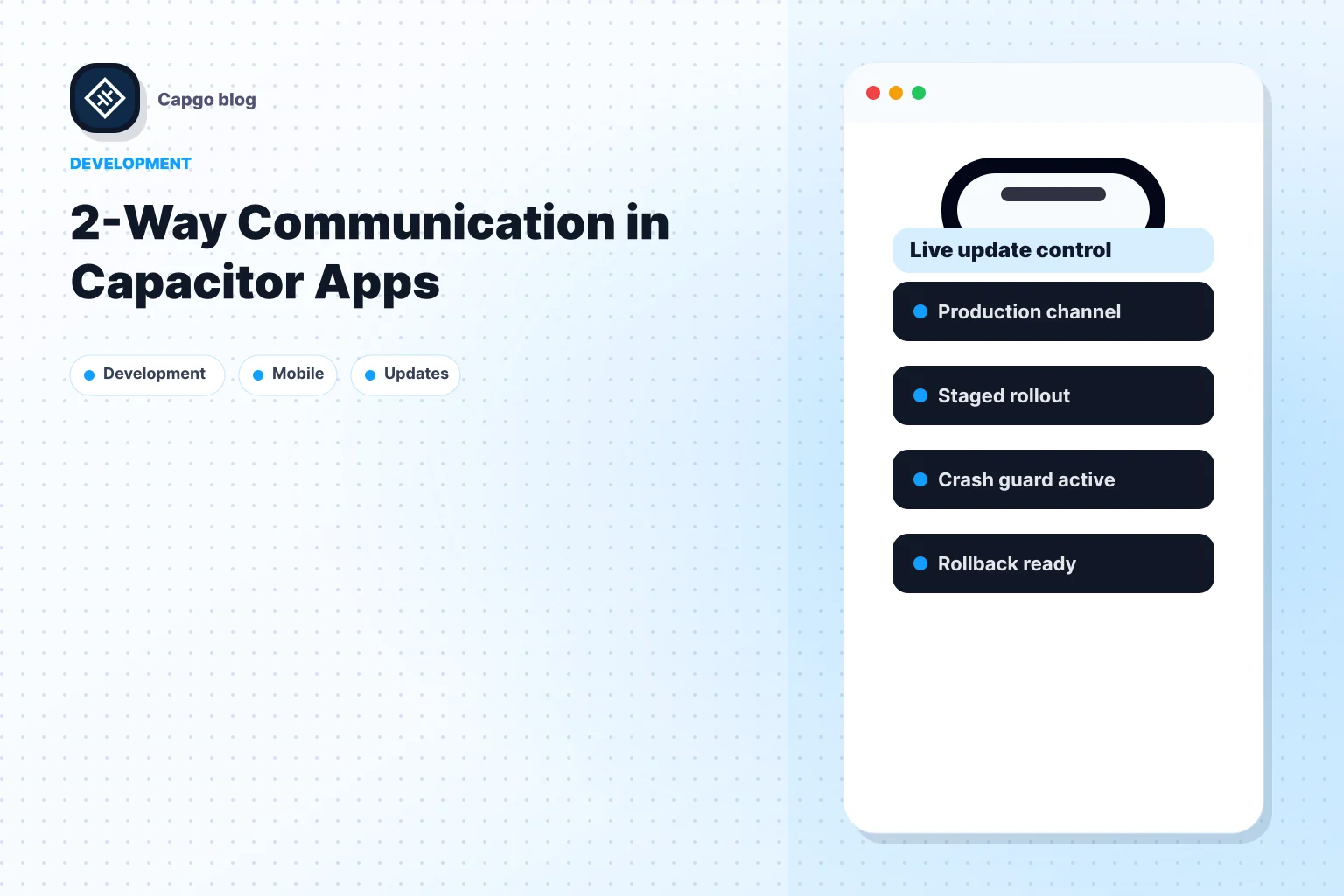
Channel-based rollouts separate internal testing, early access, and general availability. Staging can receive an update first, beta can expose it to selected users, and production can follow after telemetry shows acceptable behavior. This keeps validation tied to a smaller, observable audience instead of accumulating a large batch for one late approval.
Feature flags add control inside the application. Developers can merge code without activating the full experience, then enable it for a defined audience while monitoring errors and behavior. That supports shorter-lived branches and lets teams disable a problematic experience without rebuilding the native binary.
For guidance on test coverage and performance validation, consult the PageSpeed Plus testing strategy article before automating deployment gates.

A practical pipeline can follow this sequence:
- Commit and validate: Run linting, unit tests, bundle checks, and security checks for every relevant change.
- Publish to a controlled channel: Send the artifact to staging or beta with a clear version history and audience rule.
- Observe and promote: Review adoption, failures, and user reports before promoting the same artifact to production.
- Recover deliberately: Keep the prior known-good version available so rollback does not require another store submission.
Watch the workflow in action:
The deployment automation guide provides implementation context for turning these practices into repeatable delivery. For Capacitor teams, the practical distinction remains important: native changes still require a binary release, while eligible web-layer changes can follow a controlled live-update path and reach users without waiting for store review.
How Capgo Enables Faster Releases for Cross-Platform Apps
A Capacitor team can use Capgo as a live-update path for eligible web-layer changes. A developer fixes a JavaScript bug, builds the web bundle, and publishes a signed update through the Capgo CLI. The updater can deliver the bundle to targeted devices, apply it on the next launch, and retain rollback protection if the update fails.

That workflow changes the unit of delivery. A native capability still follows the binary path, but a web-layer correction doesn’t need to wait for a new store package when it falls within the platform and store-policy boundaries. Capgo supports signed web bundles, differential updates, channels, CI/CD integration, per-device logs, adoption and failure metrics, version history, and automatic rollback protection, according to the publisher’s product information.
Channels turn release control into a team workflow
Channels map naturally to how cross-platform teams work:
- Staging gives internal testers an isolated update stream.
- Beta supports early adopters and controlled validation.
- Production serves the general audience after the team is satisfied with the evidence.
Each channel can move on its own cadence. That means a developer can publish a fix for internal validation without exposing it broadly, then promote the tested bundle instead of rebuilding it for every audience.
Rollback is just as important as publishing. If a critical issue appears, reverting to a previous bundle gives the team a recovery path while the underlying fix is investigated. That safety net doesn’t remove the need for testing or observability. It reduces the cost of a mistake and makes smaller releases more practical.
Compare the two release paths
A traditional Capacitor cycle often looks like this:
- Change web and native code.
- Build the binary.
- Submit it for review.
- Wait for approval and rollout.
- Wait for users to adopt it.
A live-update cycle for an eligible web-layer change looks different:
- Change the web layer.
- Build and sign the bundle.
- Publish it to a controlled channel.
- Observe adoption and failures.
- Promote or roll back.
Teams can connect this workflow to automated pipelines using the Capgo GitHub Actions integration guide. The important result isn’t a promised release count. It’s the ability to separate native release work from web-layer iteration and measure both.
Common Misconceptions About Shipping Faster
Faster releases don’t automatically mean lower quality. Smaller changes usually give engineers a narrower debugging surface. When a release contains one focused change, the team can connect a regression to a smaller set of causes and roll back a more precise unit. That advantage disappears when teams use high frequency to justify weak tests, unclear ownership, or poor telemetry.
The second misconception is that deployment frequency defines velocity by itself. DORA treats delivery as a group of metrics, including lead time, change failure rate, and mean time to recovery. A team that deploys constantly but spends its time repairing incidents hasn’t built healthy velocity. It has accelerated the movement of unfinished risk.
Speed without recovery is only a faster route to a longer outage.
Mobile teams often say store review makes improvement impossible. Store review limits binary delivery, but it doesn’t define every user-facing change. The useful distinction is whether a change belongs in native code or in the web layer. Feature flags, remote configuration, content updates, and eligible signed bundles can shorten the path for the latter without pretending that native changes don’t need review.
Live updates also raise legitimate policy and security questions. Teams must understand Apple and Google rules, restrict delivery to permitted content and behavior, sign and authenticate bundles, protect channels, and maintain a clear rollback path. A live-update system shouldn’t become a hidden way to ship prohibited executable behavior.
The final misconception is that observability can wait until after the team gets faster. It can’t. Per-device logs, version history, update adoption, failure signals, and rollback controls tell you whether users received the intended release. Without that evidence, a high update count says little about product value or operational health.
Your Action Plan for Improving Release Velocity
Start with measurement, then remove the biggest source of waiting. Separate native binary releases from web-layer updates in your dashboard, record lead time for each path, and track failures and recovery alongside frequency. This prevents the team from optimizing a single number while the customer experience remains slow.
First sprint quick wins
- Automate the trigger: Run validation and build jobs from the repository rather than from a developer’s laptop.
- Standardize versioning: Use a consistent versioning scheme so teams can identify what changed and which artifact users received.
- Create a staging channel: Give internal testers a controlled path that doesn’t require broad distribution.
- Record recovery steps: Document who can pause, promote, or roll back an update.
- Review the batch size: Split large changes before they enter the release pipeline.
The next investment is architectural. Identify which changes require a binary and which can travel through the web layer. Add differential bundling where it fits, introduce progressive channels, and connect delivery events to an observability system. A dashboard should answer who received the update, whether it failed, and how quickly the team restored a safe version.
Longer term, product and engineering leaders need to reward shipped experience frequency, not just version-number activity. Smaller releases create tighter feedback loops, but only when teams protect stability, keep rollback routine, and treat recovery as part of delivery rather than an exceptional event.
Use this checklist in the current sprint:
- Separate binary cadence from shipped experience frequency.
- Automate the build, test, signing, and publication path.
- Establish staging and beta channels before expanding production delivery.
- Add adoption, failure, and rollback visibility.
- Review DORA metrics together instead of chasing deployment frequency alone.
Release velocity compounds because every completed feedback loop informs the next change. Removing one bottleneck improves the following cycle too, especially when the team can ship smaller changes, observe them quickly, and recover without rebuilding the entire application.
Capgo provides Capacitor and Electron teams with a controlled live-update path for signed web-layer bundles, differential delivery, channels, observability, and rollback protection. If App Store review is slowing eligible fixes and experience changes, visit Capgo to evaluate how it can fit into your release pipeline.