The best live updates system for a mobile app depends on your stack. There is no single OTA product that fits Capacitor, Expo, React Native, and Flutter equally well. Pick the platform that matches your runtime, then judge it on rollback, channels, security, CI/CD, and long-term vendor status.
Verdict
For Capacitor, Ionic, Cordova, and Electron web-layer apps, Capgo is the best live updates system in 2026.
For Expo and React Native apps that use expo-updates, choose Expo EAS Update. For Flutter apps, choose Shorebird. Treat Ionic Appflow and Microsoft CodePush / App Center as migration cases, not new platform choices.
What a live updates system must do
A production live updates system is more than an upload endpoint. It must:
- Ship JS, Dart, HTML, CSS, or asset changes without a full store binary review when the change stays inside store policy.
- Keep native binary compatibility under control.
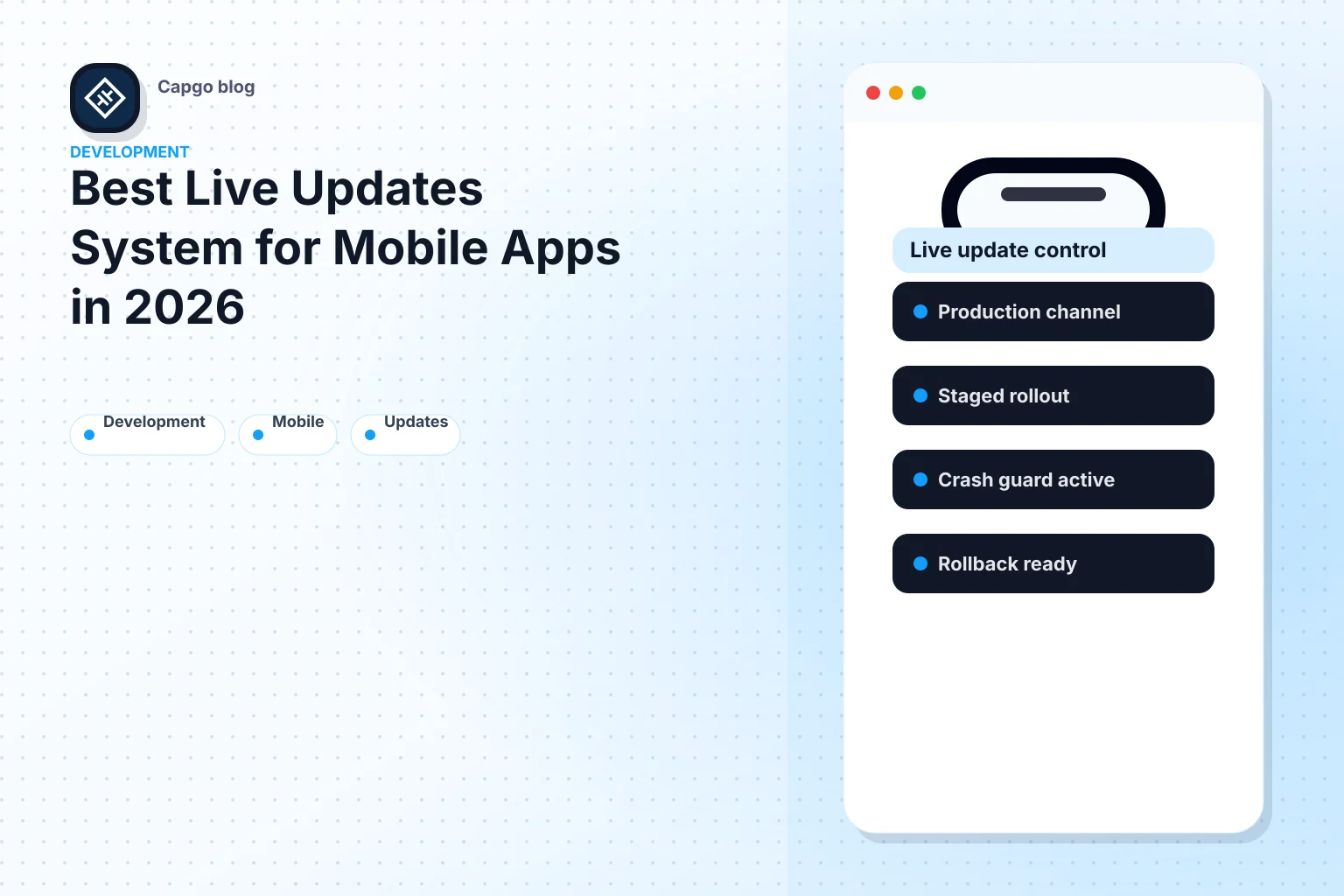
- Support channels, staged rollout, and rollback.
- Encrypt or sign update payloads.
- Show device adoption, failures, and rollback events.
- Fit into CI/CD without manual dashboard clicking for every release.
If a tool only uploads a bundle and has no rollback story, it is not ready for production fleets.
Best live updates system by mobile stack
| Stack | Best live updates system | Why |
|---|---|---|
| Capacitor / Ionic / Cordova / Electron web layer | Capgo | Built for Capacitor OTA, with channels, rollback, delta updates, end-to-end encryption, device logs, native builds, and self-hosting options |
Expo / React Native with expo-updates |
Expo EAS Update | Native Expo workflow with runtime versions, insights, and republish |
| Flutter | Shorebird | Dart code push with rollback, patch signing, and Flutter-focused CI |
| Capawesome ecosystem already in use | Capawesome Cloud | Live updates plus builds and publishing inside that vendor stack |
| Lightweight Capacitor OTA only | OtaKit | Open-source core and simple update delivery without a full release platform |
| Existing Appflow customers | Migrate before Dec 31, 2027 | New Appflow commercial sales are discontinued |
| Legacy CodePush / App Center | Capgo or EAS Update by stack | Hosted App Center CodePush is retired |
Full comparison
| System | Best for | Update payload | Rollback | Channels / staged rollout | Encryption / signing | Self-hosting | Native builds | Status |
|---|---|---|---|---|---|---|---|---|
| Capgo | Capacitor, Ionic, Cordova, Electron | JS, CSS, HTML, assets | Yes | Yes | End-to-end encryption | Yes | Yes | Active |
| Expo EAS Update | Expo / React Native | JS and non-native assets via expo-updates |
Republish previous update | Yes | Expo/EAS update model | Documented self-hosted path | Via EAS Build | Active |
| Shorebird | Flutter | Dart code patches | Yes | Yes | Patch signing | Product-managed cloud workflow | Flutter release/patch CLI flow | Active |
| Capawesome Cloud | Capawesome users | Web-layer bundles for Capacitor/Ionic/Cordova | Yes | Yes | Code signing | Partial (bundles self-hosted, metadata in cloud) | Yes | Active |
| OtaKit | Minimal Capacitor OTA | Web-layer bundles | Yes | Yes | Optional E2EE | Yes | No | Active |
| Ionic Appflow | Existing customers only | Live updates for supported projects | Yes | Yes | Update signing | No | Yes | Legacy through Dec 31, 2027 |
| Microsoft CodePush / App Center | Legacy migrations | Historical CodePush bundles | Legacy | Legacy | Signing in old model | Archived standalone repo | App Center Build retired | Retired |
1. Capgo
Capgo is the strongest choice when your mobile app is Capacitor-based and you need production release operations, not only OTA uploads.
Use Capgo when you need:
- Instant web-layer updates without waiting for store review.
- End-to-end encrypted updates.
- Delta updates for smaller downloads.
- Channels, staged rollout, and one-click rollback.
- Device logs and update success tracking.
- Native builds in the same platform.
- Self-hosting or enterprise controls.
Capgo plans start from $12/month on yearly billing, with credit-based overages when you grow past included usage. See Capgo pricing.
Capgo is not the right default for Flutter or Expo-native apps. Those stacks need Shorebird or EAS Update.
2. Expo EAS Update
EAS Update is the best live updates system for Expo and many React Native apps that already run on expo-updates.
It fits when:
- Your project is Expo-managed or already uses the Expo updates client.
- You want runtime-version compatibility checks.
- You need update insights and the ability to republish a previous update.
- Native binaries still go through EAS Build or your own CI.
It is the wrong fit for Capacitor. Capacitor apps do not use the Expo update runtime, so Capgo or another Capacitor updater is the direct path.
3. Shorebird
Shorebird is the best live updates system for Flutter. It patches Dart code over the air after a Shorebird-built release is in the stores.
It fits when:
- Your app is Flutter and you need hotfixes without a full store binary cycle.
- You want rollback and patch signing.
- You accept that native code, Flutter engine upgrades, and native plugin changes still need a store release.
Shorebird does not replace Capgo for Capacitor. Capgo does not replace Shorebird for Flutter. The runtimes are different.
4. Capawesome Cloud
Capawesome Cloud is a solid modern option if your team already standardized on Capawesome products. It offers live updates, delta updates, rollback, audit logs, web builds, native builds, and store publishing in that ecosystem.
Choose it when vendor continuity inside Capawesome matters more than Capgo’s Capacitor-focused open updater lineage, E2EE model, and self-hosting options.
5. OtaKit
OtaKit is useful when you only want a lightweight Capacitor OTA tool: open-source core, channels, rollback, analytics, and optional encryption.
Skip it when you also need native builds, broader plugin coverage, enterprise controls, or a full release operations platform. In that case Capgo is the better system.
6. Ionic Appflow
Do not start a new mobile live-update architecture on Appflow in 2026. Ionic discontinued new commercial sales. Existing customers keep access through December 31, 2027.
If you are still on Appflow, plan migration now. Capacitor teams can start with Migrate from Ionic Appflow to Capgo.
7. Microsoft CodePush / App Center
Visual Studio App Center retired core features on March 31, 2025. Microsoft published a standalone CodePush server, but that repository was archived on May 20, 2025.
CodePush still appears in search results, so it belongs in this comparison, but it is not a current hosted live updates system. Migrate by stack:
- Capacitor / Ionic / Cordova: Capgo
- Expo / React Native: EAS Update
- Flutter: Shorebird
How to choose in 10 minutes
Answer these questions in order:
- What is the app runtime? Capacitor, Expo/React Native, or Flutter.
- Do you need only OTA, or OTA plus native builds and release ops?
- Do you need end-to-end encryption, self-hosting, or enterprise audit controls?
- Is your current vendor retiring? Appflow and CodePush force a migration deadline.
- Can your CI publish updates without manual steps?
Then map the answer:
| Your situation | Best system |
|---|---|
| Capacitor production team | Capgo |
| Capacitor, OTA-only, minimal tool | OtaKit |
| Already on Capawesome Cloud | Capawesome Cloud |
| Expo / React Native | Expo EAS Update |
| Flutter | Shorebird |
| Leaving Appflow | Capgo for Capacitor stacks |
| Leaving CodePush | Capgo, EAS Update, or Shorebird by stack |
Store compliance still matters
Live updates do not mean “change anything after review.” Apple and Google allow updating web assets or interpreted code when the update stays inside the reviewed app experience and does not change the binary in prohibited ways.
Practical rules:
- Keep native API, permission, and binary changes on the store path.
- Use channels and staged rollout before a full fleet push.
- Ship encrypted or signed bundles.
- Keep a rollback path ready before you publish.
- Document what your OTA layer can and cannot change.
For Capacitor teams, start with Capgo for app-store-safe OTA updates and the OTA compliance guide.
FAQ
What is the best live updates system for mobile apps in 2026?
It depends on the stack. Capgo is best for Capacitor, Ionic, Cordova, and Electron web-layer apps. Expo EAS Update is best for Expo and React Native apps using expo-updates. Shorebird is best for Flutter.
Can one live updates system cover every mobile framework?
No. Capacitor updates web bundles. Expo updates JS bundles through expo-updates. Shorebird patches Flutter Dart code. Choosing by runtime is more important than choosing by marketing feature list.
Is Capgo better than CodePush?
For Capacitor, Ionic, and Cordova apps, yes. Hosted CodePush through App Center is retired. Capgo is an active production platform with rollback, channels, encryption, logs, and native builds.
Should Appflow users move before 2027?
Yes. Existing Appflow access runs through December 31, 2027. Migration planning should start earlier so credentials, CI, channels, and rollback drills are ready.
Do live updates replace App Store and Google Play releases?
No. Live updates accelerate compatible web or Dart changes. Native binary changes still need store submissions.
Keep going
If you are choosing a live updates system, continue with Best Live Update Tools for Capacitor Apps in 2026, Best CodePush Alternatives for Capacitor, Ionic and Cordova Apps, Capgo Live Updates, Capgo Native Builds, and Capgo pricing.