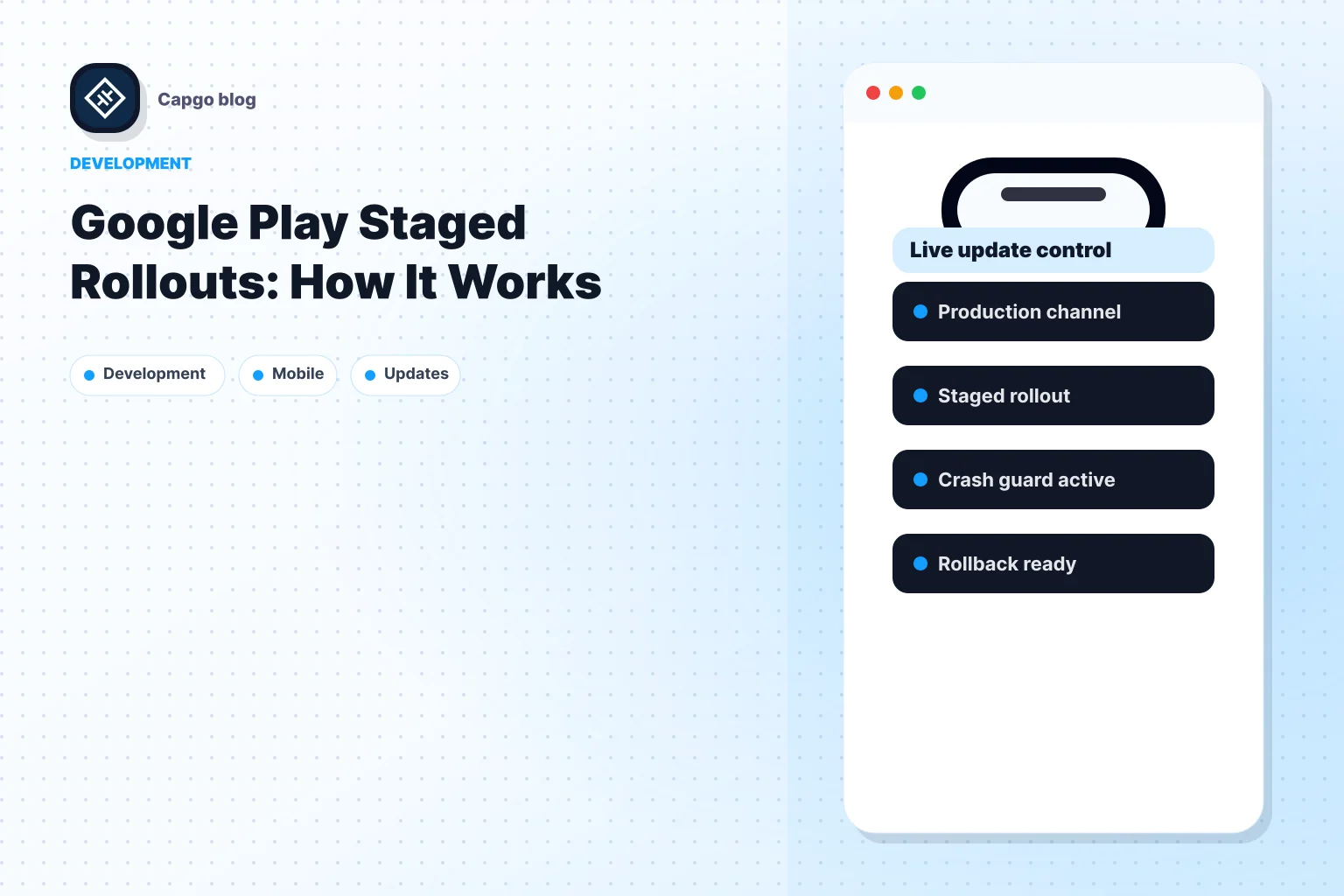
Google Play staged rollouts release a new Android App Bundle to a percentage of users on a track before you reach 100%. Use them on Production, Open testing, and Closed testing to limit blast radius while you watch crashes and ratings. Internal testing is for fast checks with up to 100 testers and is not the same as a production percentage rollout. For Capacitor apps, pair store rollouts with Capgo channels and progressive rollouts when you need percentage-based delivery of live web updates between store releases.
Play Console tracks in 2026
Google documents four release surfaces:
| Track in Play Console | Who receives builds | Staged rollout percentage |
|---|---|---|
| Internal testing | Up to 100 invited testers | No staged percentage rollout (full track delivery to testers) |
| Closed testing | Email lists or Google Groups you choose | Yes |
| Open testing | Anyone who joins from your store listing | Yes |
| Production | Eligible users in selected countries | Yes (country targeting available on production) |
Source: Prepare and roll out a release and Set up an open, closed, or internal test.
Typical flow: Internal testing for smoke tests, Closed testing for trusted beta groups, Open testing for wider feedback, then Production with a staged percentage.
How a Play staged rollout works
Google’s Release app updates with staged rollouts guide describes the loop:
- Open Production, Open testing, or Closed testing in Play Console.
- Create or edit a release and upload an Android App Bundle whose
versionCodeis higher than the release already on that track. Play serves the highest compatibleversionCodeacross every track a user is eligible for, so a newer Production build can override a lower testing-track build for the same user. - Set a rollout percentage (between 1% and 100%).
- Start the rollout.
- Monitor Android vitals, crashes, and reviews.
- Increase the percentage, halt, or resume the rollout from the Releases tab (Manage rollout).
- Promote to 100% when metrics look healthy.
Important constraints from Google’s documentation:
- Rollout users are chosen by Google; you cannot hand-pick individuals in the console UI.
- Finish or discard conflicting draft releases on a track before starting another rollout; Google documents creating a new staged rollout before the previous release reaches 100%.
- You cannot force users to install immediately; they update when Play delivers the release.
- Production staged rollouts can target specific countries or regions; testing tracks follow the track’s tester rules.
The Google Play Developer API maps track IDs (production, beta for open testing, qa for internal testing, plus named closed tracks) if you automate releases.
What to watch during the rollout
| Signal | Where to look |
|---|---|
| Crash rate (after users install) | Play Console Android vitals |
| ANRs (after users install) | Play Console Android vitals |
| Pre-launch checks (before wide rollout) | Play Console pre-launch report on test devices |
| User reviews | Store listing feedback for the version |
| Backend errors | Your API dashboards correlated with version headers |
Wait long enough between percentage jumps to gather signal. Google’s help center suggests monitoring before you expand; many teams hold at least a day on early percentages for production.
If a native bug ships, halt the Play rollout and publish a fixed bundle with a higher versionCode. Play does not auto-rollback binaries for you.
Capgo channels and percentage rollouts (live updates)
Store rollouts change the native shell users download from Play. Capgo handles live web bundle updates inside an already installed Capacitor app.
- Channels map devices to update streams (
production,beta, custom names). You can force specific device IDs to a channel when debugging. - Progressive rollouts keep a stable fallback bundle on the channel while a rollout target reaches a configured percentage of devices. Increase, decrease, pause, complete, or roll back without shipping a new Play build for web-layer fixes.
Use Play staged rollouts when you change native code, permissions, or targetSdkVersion. Use Capgo percentage rollouts when the fix lives in HTML, CSS, or JavaScript and your compliance review allows OTA delivery.
Suggested combined strategy
- Ship native changes through Internal testing, then Closed or Open testing, then a Production staged rollout.
- Point production devices to a stable Capgo channel for day-to-day web fixes.
- Run a progressive rollout on a channel when you want canary web bundles with an automatic stable fallback.
- Halt the Play rollout if vitals regress; roll back the Capgo progressive rollout if web metrics regress.
Rules and requirements reminder
- Each new bundle needs a higher
versionCodethan builds users can already receive on any overlapping track. - Apps using Play App Signing must upload signed AABs per Google Play App Signing.
- Complete outstanding staged releases or discard drafts before starting conflicting releases on the same track (Prepare and roll out a release).
FAQ
Does Internal testing use percentages?
No. Internal testing distributes the release to your tester list (up to 100 people). Use Closed, Open, or Production for percentage-based staged rollouts.
How do testers install Internal or Closed builds?
Internal testing uses an email list (up to 100 testers). Closed testing supports email lists, Google Groups, or Play Console organization management. Open testing is the only track that surfaces a public opt-in program on your store listing. Testers on internal or closed tracks usually need the Play Store URL you share; they will not find the build by searching unless you use open testing or production.
When should Capacitor teams use Capgo instead of raising the Play rollout?
When the change is confined to web assets and passes your store compliance checklist. Native plugin upgrades, manifest changes, and permission changes still need a new Play release.
Keep going from Google Play Staged Rollouts: How It Works
If you are using Google Play Staged Rollouts: How It Works to plan store approval and distribution, connect it with @capgo/capacitor-in-app-review for the implementation detail in @capgo/capacitor-in-app-review, Using @capgo/capacitor-in-app-review for the native capability in Using @capgo/capacitor-in-app-review, @capgo/capacitor-native-market for the implementation detail in @capgo/capacitor-native-market, Using @capgo/capacitor-native-market for the native capability in Using @capgo/capacitor-native-market, and Capacitor OTA Updates: App Store Approval Guide for the practical context in Capacitor OTA Updates: App Store Approval Guide.