The shortlist for Capacitor CI/CD has shrunk. Microsoft App Center’s build and distribute services retired on March 31, 2025. Ionic Appflow is in a multi-year wind-down. GitHub Actions, GitLab CI, Bitrise, and Codemagic are still here, and they are still good at the jobs they were designed for.
The mistake is treating this as a bake-off where you pick one platform and move the entire pipeline onto it. Most Capacitor teams already have CI. What they lack is the three jobs generalist CI still does poorly: signed native builds, live updates, and getting the app onto a real phone.
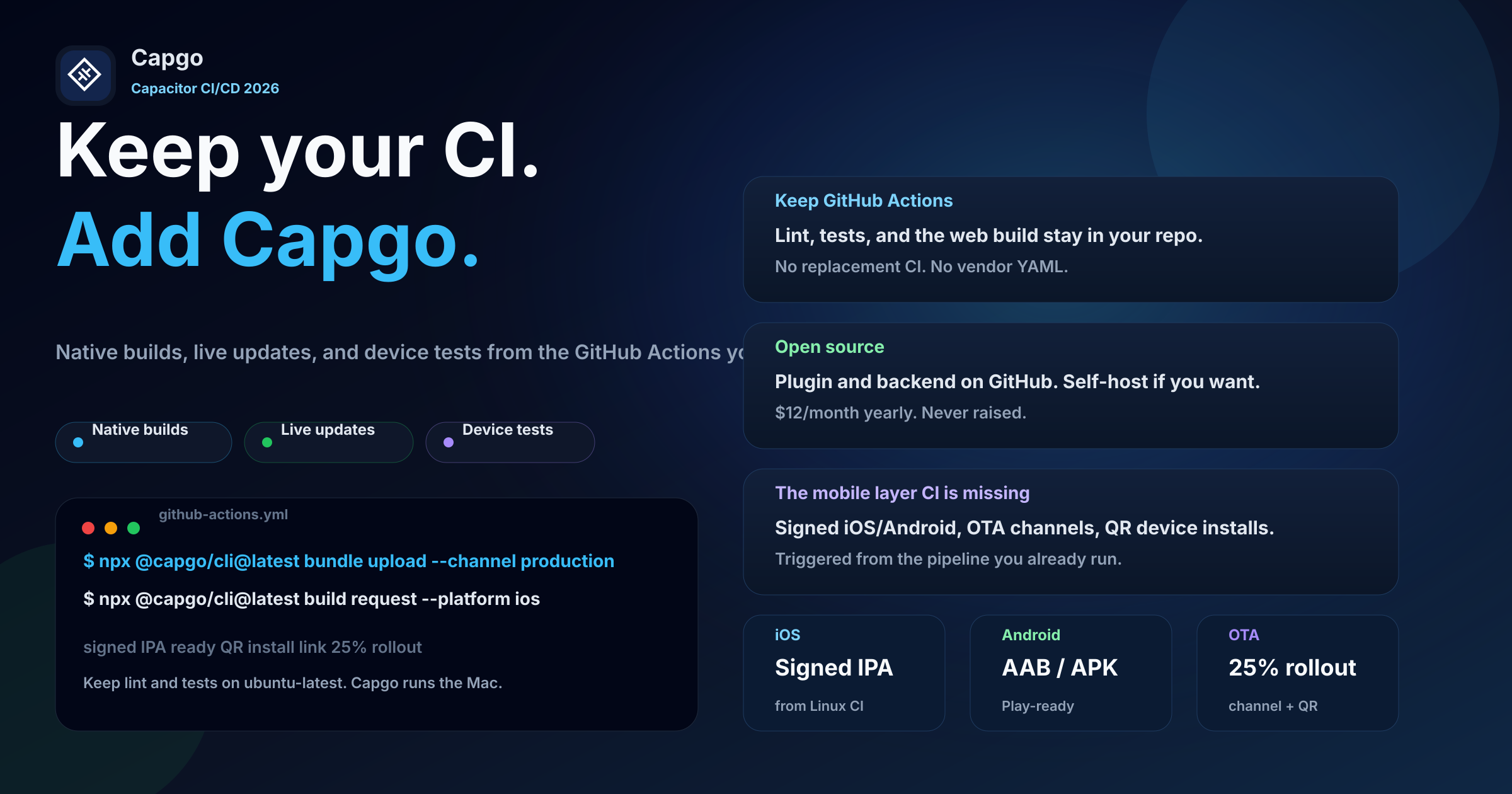
Capgo is built for those three jobs, and it is designed to run inside the CI you already trust. Keep GitHub Actions or GitLab CI for lint, type-check, unit tests, and the web build. Call Capgo when the pipeline needs an iOS or Android binary, an over-the-air bundle, or a preview a tester can install.
The 2026 landscape
Two names still show up in search results even though they are no longer a 2026 purchase.
- Microsoft App Center retired on March 31, 2025. Build and distribute stopped. Analytics and Diagnostics were extended through March 31, 2027. CodePush is no longer a Microsoft-hosted service. If you still have an App Center pipeline, read Migrating from App Center to Capgo.
- Ionic Appflow stopped new commercial sales on February 11, 2025. Existing customers keep access through December 31, 2027. It still works, but anything you start now has to migrate before 2028. See Alternative to Ionic Appflow.
That leaves the platforms teams actually run:
- GitHub Actions and GitLab CI: general-purpose CI. Excellent on Linux. Expensive and unfinished on native mobile.
- Bitrise and Codemagic: mobile CI specialists. Strong signing and store submit. No managed Capacitor live updates.
- Capgo: Capacitor-native live updates, cloud native builds, and installable device previews, called from the CI you already have.
- Capawesome Cloud: Capacitor-native live updates and native builds sold as a replacement CI. You connect git and leave GitHub Actions. Closed backend, full vendor lock-in, and a pricing history that has already moved more than once.
The useful question in 2026 is not “which CI should replace GitHub Actions?” It is “what should GitHub Actions call when a Capacitor app needs a binary, an OTA bundle, or a phone install?”
What generalist CI still does poorly
GitHub Actions and GitLab CI are fine kitchens. They are not a native build farm, an OTA network, or a QA device lab.
Native builds
iOS still needs Xcode, certificates, provisioning profiles, and a Mac. Android still needs a keystore and a Play upload key. Hosted macOS minutes on GitHub Actions cost far more than Linux minutes. After GitHub’s January 2026 rate cut, a standard macOS minute is still about ten times a standard Linux minute (GitHub Actions billing).
That is why so many Capacitor teams already split the pipeline: Linux for PR checks, something else for the signed binary. Capgo Native Builds is that something else. The job stays on ubuntu-latest. Capgo runs the Mac.
Live updates
CI can compile a web bundle. It cannot deliver that bundle to devices that already have the app installed, with channels, rollback, encryption, and device logs. Live updates are a product, not a YAML step. Capacitor teams that skip OTA wait for App Store and Play review for JavaScript fixes that never needed a new binary.
Capgo Live Updates sit next to CI. The pipeline builds the web app, then uploads the bundle. Users get the change without a store round-trip, as long as the native shell did not change.
Mobile app testing
Unit tests on Linux do not prove the app on a phone. TestFlight processing, internal Play tracks, and “can you install this IPA I just emailed you?” are the slow part of review. Capgo PR previews put each pull request on a channel. Testers switch channels in the app they already have. Native build jobs can also emit a QR install link for the APK or IPA.
That is not a device farm. If you need emulator matrices or Firebase Test Lab, keep those jobs in CI. Capgo covers the gap CI rarely solves: a human with a phone, looking at the right build, in under a minute.
Feature matrix
| Feature | Capgo | Your CI (GitHub Actions, GitLab) | Bitrise / Codemagic | Capawesome Cloud | Ionic Appflow |
|---|---|---|---|---|---|
| Capacitor support | First-class | DIY | Generic mobile CI | First-class | First-class (legacy) |
| Native iOS and Android builds | Yes, from a Linux CI job | DIY on macOS runners | Yes | Yes, inside their CI | Yes |
| Managed signing | Yes | Secrets only | Yes | Yes | Yes |
| Managed live updates | Yes | DIY | No | Yes | Yes |
| PR / device testing | Channels, QR installs, Capgo app | Not built in | Distribute a binary | Git-connected builds | Store tracks |
| Store publishing | Yes | DIY via Fastlane | Yes | Yes | Yes |
| Replaces your CI? | No, it plugs in | It is your CI | Usually yes | Yes | Yes |
| Open source | Plugin and backend | N/A | No | Plugin/CLI; closed backend | No |
| Self-host | Yes | Yes | No | Partial (bundles only) | No |
| Long-term status | Active | Active | Active | Active | EOL 2027-12-31 |
Three things stand out. Capgo, Capawesome Cloud, and Appflow bundle managed live updates with native builds, and Appflow is winding down. Only Capgo is designed to keep GitHub Actions or GitLab CI instead of replacing them. Capawesome Cloud is the other Capacitor-native option, but it is a replacement CI with a closed backend. Bitrise and Codemagic can own the native binary, but you still assemble OTA and device previews yourself.
The platforms in detail
Capgo
Capgo is the Capacitor release layer that generalist CI is missing.
- Live updates: encrypted web-bundle OTA, channels, rollback, delta updates, and device logs.
- Native builds: signed iOS and Android binaries in the cloud, including store submit. The CI runner can stay on Linux. Capgo is already on Xcode 26 for App Store Connect’s April 2026 requirement.
- Device testing: PR preview channels, QR links on native artifacts, and the Capgo mobile app for checking a bundle on a real device.
You do not move lint and unit tests off GitHub Actions. You add two CLI calls after the web build succeeds:
- name: Live update
  run: npx @capgo/cli@latest bundle upload --channel production

- name: Native build
  run: npx @capgo/cli@latest build request com.example.app --platform ios --build-mode release
Paid plans start at $12/month billed yearly and include live updates plus native build time (about 15 builds/month, with extra minutes billed through credits). That entry price has not been raised since launch. See pricing, CI/CD with Capgo Build, and the GitHub Actions build guide.
The updater plugin is open source (MPL-2.0) and the backend is open source (AGPL-3.0). You can audit them, fork them, or self-host. Paid Capgo Cloud is optional infrastructure, not a trap.
Capawesome Cloud
Capawesome Cloud CI — Native Builds plus Live Updates, now sold as Capawesome Platform — is the other Capacitor-native option that bundles OTA with cloud iOS and Android builds. The product pitch is the opposite of Capgo: replace GitHub Actions and GitLab instead of plugging into them.
Their Native Builds launch post is explicit. No third-party CI/CD. Connect GitHub, GitLab, Bitbucket, or Azure DevOps. Put the pipeline in capawesome.config.json. Run it inside Capawesome Cloud. You can trigger a build from a CLI, but the intended workflow is vendor-hosted CI. Git integration, signing, build minutes, live updates, and store submit all sit behind one closed backend. The plugin and CLI are open source. The backend is not. Self-hosting is partial at best: you can host bundles; metadata stays in Capawesome Cloud.
That is full vendor lock-in. Leaving later means moving the updater, the build config, the git connection, and the release metadata. Capgo keeps those pieces in your repo and your CI, and its open-source updater and backend are the exit.
Pricing history is the other split. Capgo’s paid entry has been $12/month billed yearly since launch. It has never been raised. Capawesome has already changed the commercial shape more than once:
- Native Builds launch: from $9/month for 1,000 live updates and 200 build minutes. Business was $299/month.
- May 2026 Platform relaunch: Live Updates moved off MAU onto per-update counting, then back to MAU after customers complained. The full Platform SKU (builds, live updates, and publishing) starts at $19/month. Business is $499/month.
- Current public pricing still splits Live Updates (from $9/month) from the full Platform (from $19/month).
A cheaper sticker that keeps moving is not the same as a fair price that stays put. If you want Capacitor live updates and native builds without giving up your CI, Capgo is the fit. If you already standardized on Capawesome plugins and want their git-connected CI, read Capgo vs Capawesome Cloud and the migration guide.
| Compared | Capgo | Capawesome Cloud |
|---|---|---|
| CI model | Add-on to GitHub Actions / GitLab | Replacement CI (capawesome.config.json) |
| Open source | Plugin and backend | Plugin/CLI; closed backend |
| Self-host | Yes | Bundles only; metadata stays in their cloud |
| Paid entry | $12/month yearly, never raised | $9 live-updates / $19 platform after multiple reshuffles |
| Business list price | Usage-based credits | $299 at Native Builds launch, $499 after Platform relaunch |
Sources: Capawesome Native Builds announcement, Capawesome Platform announcement, Capawesome pricing.
GitHub Actions
GitHub Actions is the default CI for most Capacitor repos, and it should stay that way for PR checks. Linux jobs are cheap. The workflow lives next to the code. Caching, matrix builds, and required status checks are solved problems.
What it is not: a mobile DevOps platform. You write the YAML. You wire Fastlane or Capgo for signing. You host your own OTA, or you do not have OTA. macOS minutes dominate the bill once iOS builds run on every pull request.
The hybrid that works: GitHub Actions for lint, tests, and npm run build. Capgo for bundle upload, native builds, and previews. That split is cheaper and faster than forcing the entire mobile pipeline onto hosted Macs. Setup guides: GitHub Actions live updates and automatic build and release.
GitLab CI
Same shape as GitHub Actions. Strong Linux CI, optional Mac runners, no managed Capacitor live updates, no installable PR channel. If the repo already lives on GitLab, keep it. Call Capgo from .gitlab-ci.yml the same way. See GitLab setup and automatic Android builds on GitLab.
Bitrise
Bitrise is a mobile CI platform with a large step library, managed signing, and store publishing. You can build a Capacitor app with npm steps plus native iOS and Android steps. It is a reasonable choice when the team wants a dedicated mobile runner fleet and does not need OTA.
What is missing is the Capacitor-shaped release loop: live updates, PR channels, and a CLI that your existing GitHub workflow can call without moving the whole pipeline. Pricing also sits at the high end of mobile CI. Use Bitrise if you are already standardized on it for native apps. Add Capgo if you still need OTA and device previews; do not assume Bitrise replaced that layer.
Codemagic
Codemagic started as a Flutter builder and now documents Ionic and Capacitor YAML workflows, with managed Android keystores, App Store Connect API keys, and publishing to TestFlight and Play. Signing is a strength.
It has the same hole as Bitrise: no managed live updates. You would still upload OTA bundles somewhere else. If the only gap in your GitHub Actions setup is “I do not want to maintain Fastlane on a Mac,” Codemagic can close that gap. Capgo closes that gap and the OTA and preview gaps in one CLI. Codemagic walkthroughs on this site: iOS with Codemagic.
Ionic Appflow
Appflow is the all-in-one Ionic product: native builds, signing, live updates, and store publishing. It is also a replacement CI, not a plugin for GitHub Actions. Ionic announced the commercial wind-down on February 11, 2025. Existing customers keep access through December 31, 2027.
If you are already on Appflow, plan the exit now rather than in late 2027. The like-for-like move is Capgo for live updates and native builds, while you keep (or return to) GitHub Actions for PR automation. Migration: from Appflow to Capgo.
Microsoft App Center
Not a 2026 option. Builds and distribution ended March 31, 2025. CodePush as a hosted service is gone. Teams that never finished the migration still search for it. The Capacitor path is Capgo for OTA plus Capgo Build or your CI for binaries. Start with App Center migration and CodePush alternatives.
Xcode Cloud
Apple’s CI is fine for iOS-only native apps already in App Store Connect. It does not build Android, does not ship Capacitor live updates, and does not give you PR channels for web-bundle QA. Treat it as an Apple-side extra, not a Capacitor platform.
How Capgo plugs into your pipeline
The winning 2026 setup looks like this:
- On every pull request, GitHub Actions or GitLab CI installs dependencies, runs tests, and builds the web app on Linux.
- If the change is web-only, Capgo uploads a bundle to a PR channel. Reviewers open the existing app, switch channel, and test. No TestFlight wait. See Turn every pull request into an installable preview.
- If native code, plugins, or permissions changed, the same workflow requests a Capgo native build and shares a QR install link.
- On main or a version tag, Capgo ships a production live update, or a signed binary to TestFlight and Play, depending on what actually changed.
A compact GitHub Actions sketch:
name: Capacitor CI
on:
  pull_request:
  push:
    branches: [main]
    tags: ['v*']

jobs:
  web:
    runs-on: ubuntu-latest
    steps:
      - uses: actions/checkout@v6
      - uses: actions/setup-node@v6
        with:
          node-version: '24'
          cache: 'npm'
      - run: npm ci
      - run: npm test
      - run: npm run build
      - name: Upload live update
        if: github.event_name == 'push' && github.ref == 'refs/heads/main'
        run: npx @capgo/cli@latest bundle upload --channel production
        env:
          CAPGO_TOKEN: ${{ secrets.CAPGO_TOKEN }}
      - name: Native build on tag-style releases
        if: startsWith(github.ref, 'refs/tags/v')
        run: npx @capgo/cli@latest build request com.example.app --platform ios --build-mode release
        env:
          CAPGO_TOKEN: ${{ secrets.CAPGO_TOKEN }}
          BUILD_CERTIFICATE_BASE64: ${{ secrets.BUILD_CERTIFICATE_BASE64 }}
          P12_PASSWORD: ${{ secrets.P12_PASSWORD }}
          CAPGO_IOS_PROVISIONING_MAP_BASE64: ${{ secrets.CAPGO_IOS_PROVISIONING_MAP_BASE64 }}
          APPLE_KEY_ID: ${{ secrets.APPLE_KEY_ID }}
          APPLE_ISSUER_ID: ${{ secrets.APPLE_ISSUER_ID }}
          APPLE_KEY_CONTENT: ${{ secrets.APPLE_KEY_CONTENT }}
          APP_STORE_CONNECT_TEAM_ID: ${{ secrets.APP_STORE_CONNECT_TEAM_ID }}
The sketch is iOS-only. Android needs ANDROID_KEYSTORE_FILE, KEYSTORE_KEY_ALIAS, KEYSTORE_KEY_PASSWORD, KEYSTORE_STORE_PASSWORD, and PLAY_CONFIG_JSON. Do not copy the iOS env block and change only --platform. Use the matrix in the GitHub Actions build guide. Signing secrets stay in GitHub and are passed as environment variables on the build request. Capgo does not need to become your source of truth for git. Full examples live in the builder GitHub Actions docs and CI/CD integration.
Choosing the right setup
There is no universal winner. These situations cover most Capacitor teams.
You already use GitHub Actions or GitLab CI. Keep them. Add Capgo for live updates, native builds, and PR previews. This is the default 2026 answer.
You are looking at Capawesome Cloud. They want the git connection, the YAML replacement, and the release metadata. That is convenient until you want to leave. Capgo keeps your CI, is fully open source, and has not raised the $12 entry price. See Capgo vs Capawesome Cloud.
You are still on Appflow. You have until December 31, 2027. Waiting concentrates the migration. Move live updates and native builds to Capgo, and put PR automation back on GitHub Actions if Appflow was also your CI.
You are coming off App Center. The build pipeline is gone, and CodePush is not a hosted product. Replace both pieces with Capgo rather than rebuilding OTA on GitHub Actions from scratch.
macOS minutes are taking over the GitHub bill. Do not move lint and unit tests off GitHub. Move native builds to Capgo so iOS no longer runs on hosted Macs in Actions. Keep the PR status checks where they are.
You are starting a Capacitor app in 2026. Skip Appflow and App Center. Start with GitHub Actions for CI. Add Capgo on day one for OTA, cloud builds, and device previews. You can add Bitrise or Codemagic later if you have a specific runner or step-library reason. Most teams never need that extra platform. Skip Capawesome Cloud unless you already want their plugin catalog enough to accept a replacement CI.
FAQ
What is the best CI/CD platform for Capacitor apps?
Keep the CI you already use for lint, unit tests, and web builds. Add Capgo for signed native iOS and Android builds, live updates, and installable device tests. Bitrise and Codemagic can replace native builds if you do not need live updates. Capawesome Cloud covers OTA and native builds, but as a replacement CI with a closed backend. Appflow remains available to existing customers through December 31, 2027, but it is not a greenfield choice.
Should I replace GitHub Actions with a mobile CI platform?
Usually no. GitHub Actions and GitLab CI are strong at pull-request checks on Linux. The expensive part is macOS native builds, signing, live updates, and getting a build onto a phone. Capgo is designed to be called from that existing pipeline instead of replacing it.
Do Bitrise and Codemagic include live updates for Capacitor?
No. Both are strong at native builds, signing, and store publishing. You still need a separate live-update product to ship JavaScript, CSS, and HTML without a store review. Capgo covers native builds and live updates in the same workflow.
How does Capgo test a mobile app from CI?
Capgo turns pull requests into installable previews on dedicated channels, shares native build artifacts as QR install links, and lets QA switch channels in the app that is already on the device. That is faster than waiting for TestFlight. It is not a device-farm replacement for emulator matrices.
Is Ionic Appflow still a valid choice in 2026?
Only if you are already a customer. Ionic closed new commercial sales on February 11, 2025, and existing Appflow access continues through December 31, 2027. New Capacitor projects should keep their CI and add Capgo rather than start on a platform with a shutdown date.
How does Capawesome Cloud CI compare to Capgo?
Capawesome Cloud is an all-in-one Capacitor CI: connect git, leave GitHub Actions, and run native builds plus live updates inside their cloud. That is vendor lock-in. Capgo is open source (plugin and backend), plugs into the CI you already have, and has kept the same $12/month paid entry since launch. Capawesome has already reshuffled pricing more than once, including Native Builds from $9/month at launch and a May 2026 Platform SKU from $19/month with Business at $499/month, up from $299.
Conclusion
The 2026 Capacitor shortlist is smaller than it looks: two retired or retiring all-in-one platforms, two mobile CI generalists with no OTA, one git-connected Capacitor CI that replaces your pipeline, and one general-purpose runner you already have. The team that ships fastest is not the team that rebuilds CI on a new vendor. It is the team that keeps GitHub Actions or GitLab CI, then adds a Capacitor layer for the jobs that CI still does badly.
That layer is Capgo: native builds, live updates, and device testing, triggered from the pipeline you already run. Open source. Fair pricing that has not been raised. Not a closed replacement CI.
Create a Capgo account, then follow CI/CD integration or Capgo Build from GitHub Actions. If you want the product view first, start with Native Builds, Live Updates, and PR previews.