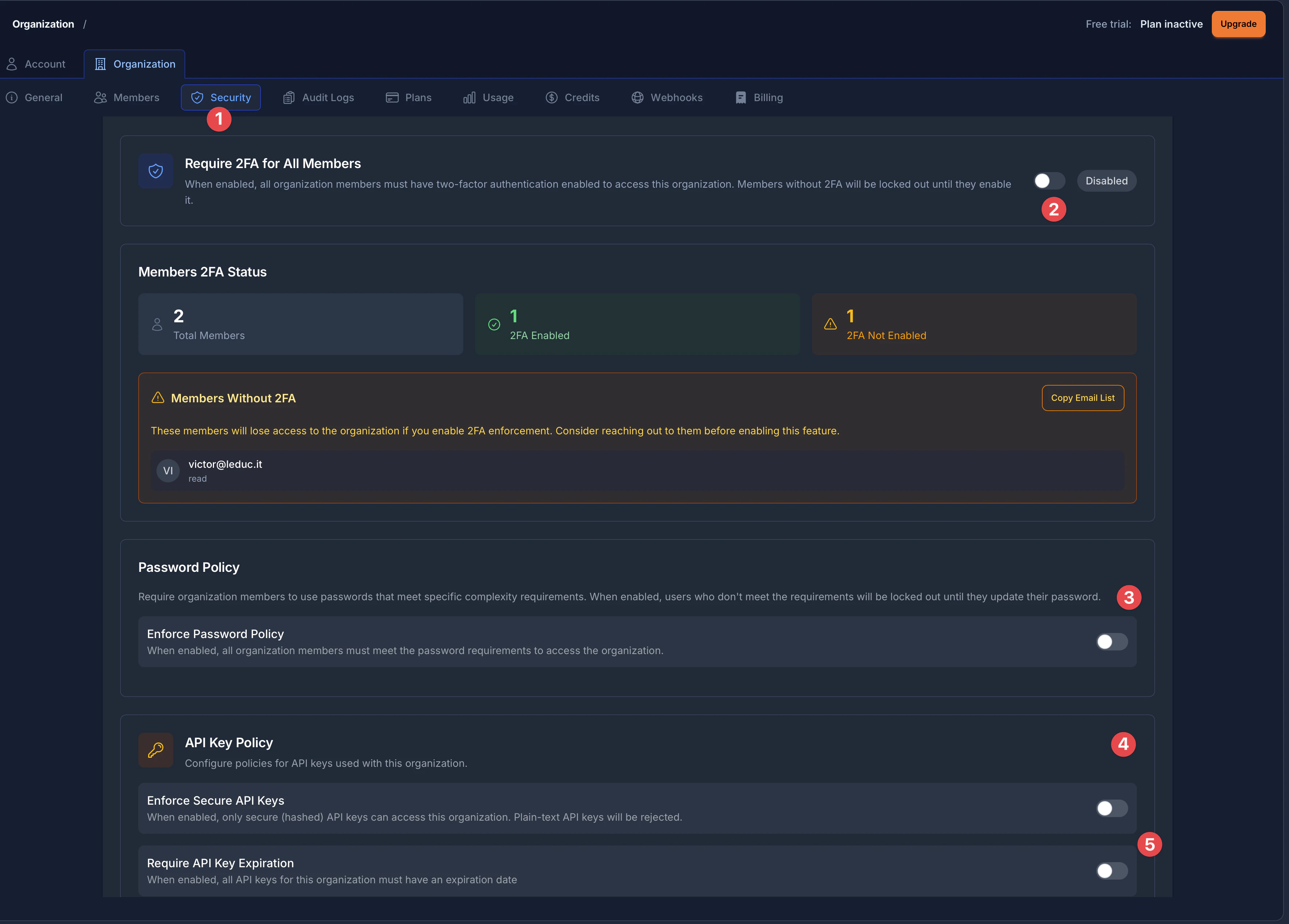
Organization Security
此内容尚不支持你的语言。
Capgo provides comprehensive security controls that allow organization administrators to enforce security policies across all members. These features help you meet compliance requirements, protect sensitive data, and maintain a strong security posture.
Overview
Section titled “Overview”The Organization Security settings allow super admins to configure:
- Two-Factor Authentication (2FA) Enforcement - Require all members to enable 2FA
- Password Policy - Set password complexity requirements
- API Key Security - Enforce secure API keys and expiration policies
Accessing Security Settings
Section titled “Accessing Security Settings”- Navigate to your organization settings by clicking on your profile
- Select Organization Settings
- Click on Security in the sidebar
Two-Factor Authentication (2FA) Enforcement
Section titled “Two-Factor Authentication (2FA) Enforcement”2FA enforcement requires all organization members to have two-factor authentication enabled on their accounts. This adds a critical layer of security by requiring both a password and a verification code.
What Happens When 2FA is Enforced
Section titled “What Happens When 2FA is Enforced”- Members without 2FA are immediately blocked from accessing organization apps
- Both the web dashboard and CLI enforce this requirement
- New members must enable 2FA before they can access organization resources
- The system tracks which members have 2FA enabled in real-time
Enabling 2FA Enforcement
Section titled “Enabling 2FA Enforcement”Before enabling, you can see exactly which members will be impacted:
- Go to Organization Settings > Security
- Review the Members 2FA Status section showing:
- Total members in your organization
- Members with 2FA enabled (compliant)
- Members without 2FA (will be blocked)
- Toggle Require 2FA for all members
- If members will be impacted, you’ll see a warning with:
- List of affected members and their roles
- Option to copy their email addresses (to notify them)
- Confirm to enable enforcement
CLI Support for 2FA Enforcement
Section titled “CLI Support for 2FA Enforcement”You can also manage 2FA enforcement via the CLI:
# Enable 2FA enforcementnpx @capgo/cli organisation set YOUR_ORG_ID --enforce-2fa
# Disable 2FA enforcementnpx @capgo/cli organisation set YOUR_ORG_ID --no-enforce-2fa
# Check member 2FA statusnpx @capgo/cli organisation members YOUR_ORG_IDFor detailed information about 2FA enforcement, see the 2FA Enforcement guide.
Password Policy
Section titled “Password Policy”Password policies allow you to enforce password complexity requirements for all organization members. When a member’s password doesn’t meet the policy requirements, they must update their password before accessing organization resources.
Available Password Requirements
Section titled “Available Password Requirements”| Setting | Description | Range |
|---|---|---|
| Minimum Length | Minimum number of characters required | 6-128 characters |
| Require Uppercase | Password must contain at least one uppercase letter (A-Z) | On/Off |
| Require Number | Password must contain at least one digit (0-9) | On/Off |
| Require Special Character | Password must contain at least one special character (!@#$%^&*, etc.) | On/Off |
Enabling Password Policy
Section titled “Enabling Password Policy”- Go to Organization Settings > Security
- Find the Password Policy section
- Toggle Enforce password policy to enable
- Configure your requirements:
- Set the minimum password length (default: 10)
- Enable/disable uppercase letter requirement
- Enable/disable number requirement
- Enable/disable special character requirement
- Changes are saved automatically
Member Compliance Tracking
Section titled “Member Compliance Tracking”When a password policy is active, you can monitor compliance:
- Total Members: Number of members in your organization
- Compliant: Members whose passwords meet the policy requirements
- Non-Compliant: Members who need to update their passwords
Non-compliant members are listed with their email addresses. You can copy the email list to notify them about the policy and required password changes.
Best Practices for Password Policies
Section titled “Best Practices for Password Policies”- Start with reasonable requirements: A minimum of 10-12 characters with mixed case and numbers provides good security without being overly restrictive
- Communicate changes: Notify your team before enabling new password requirements
- Allow transition time: Give members time to update their passwords
- Consider password managers: Recommend that team members use password managers to generate and store strong passwords
API Key Security
Section titled “API Key Security”Capgo provides two security controls for API keys: enforcing secure (hashed) API keys and requiring expiration dates.
Enforce Secure API Keys
Section titled “Enforce Secure API Keys”When enabled, this setting requires all API keys in your organization to be created using the secure/hashed format. Hashed API keys are more secure because:
- The actual key value is never stored on our servers
- Only you (and your systems) have access to the full key
- Even if our database were compromised, your keys couldn’t be used
Enabling Secure API Keys
Section titled “Enabling Secure API Keys”- Go to Organization Settings > Security
- Find the API Key Policy section
- Toggle Enforce secure API keys
- Existing keys are not affected; the policy applies to new key creation
API Key Expiration Policy
Section titled “API Key Expiration Policy”You can require all API keys to have an expiration date, limiting their validity period. This is a security best practice that:
- Limits the window of exposure if a key is compromised
- Ensures regular key rotation
- Helps meet compliance requirements for credential management
Configuring Expiration Policy
Section titled “Configuring Expiration Policy”- Go to Organization Settings > Security
- Find the API Key Policy section
- Toggle Require API key expiration
- Set the Maximum expiration days (1-365 days)
- This limits how far in the future expiration dates can be set
- Example: Setting 90 days means keys can expire at most 90 days from creation
Recommended API Key Policies
Section titled “Recommended API Key Policies”| Use Case | Secure Keys | Expiration | Max Days |
|---|---|---|---|
| Development | Recommended | Optional | 30-90 |
| CI/CD Pipelines | Required | Required | 90-180 |
| Production | Required | Required | 30-90 |
| Enterprise/Compliance | Required | Required | 30-60 |
Compliance and Auditing
Section titled “Compliance and Auditing”Organization security features help you meet various compliance requirements:
| Standard | Relevant Features |
|---|---|
| SOC 2 | 2FA enforcement, password policies, API key controls |
| ISO 27001 | All security features help demonstrate access control |
| HIPAA | Strong authentication and access management |
| GDPR | Data protection through access controls |
| PCI DSS | Multi-factor authentication, strong passwords |
Monitoring Compliance Status
Section titled “Monitoring Compliance Status”The Security dashboard provides real-time visibility into:
- How many members have 2FA enabled
- Password policy compliance across your organization
- API key security adoption
Use the “Copy email list” feature to easily export lists of non-compliant members for targeted communication.
Troubleshooting
Section titled “Troubleshooting””Access Denied: Security policy not met”
Section titled “”Access Denied: Security policy not met””Problem: A member cannot access the organization.
Solutions:
- Check if 2FA is enforced - member needs to enable 2FA
- Check if password policy is active - member needs to update their password
- Verify the member’s compliance status in the Security dashboard
Cannot enable security features
Section titled “Cannot enable security features”Problem: Security toggles are disabled or not responding.
Solutions:
- Ensure you have super_admin role in the organization
- Check your network connection
- Try refreshing the page
- Contact support if the issue persists
API key creation fails
Section titled “API key creation fails”Problem: Cannot create new API keys.
Solutions:
- If secure keys are enforced, ensure you’re using the secure key creation flow
- If expiration is required, set an expiration date within the allowed range
- Check the maximum expiration days setting