
Page d'application
Copiez une invite de commande de configuration avec les étapes d'installation et le guide Markdown complet pour ce plugin.
Qu'est-ce que la page de l'application affiche ?
Sous-section intitulée « Qu'est-ce que la page de l'application affiche ? »Premièrement, examinons la page principale de l'application :
Dans Capgo, une application représente votre application mobile intégrée au système d'actualisation en temps réel de Capgo. Cela vous permet de gérer les mises à jour, les canaux et les appareils de manière fluide.
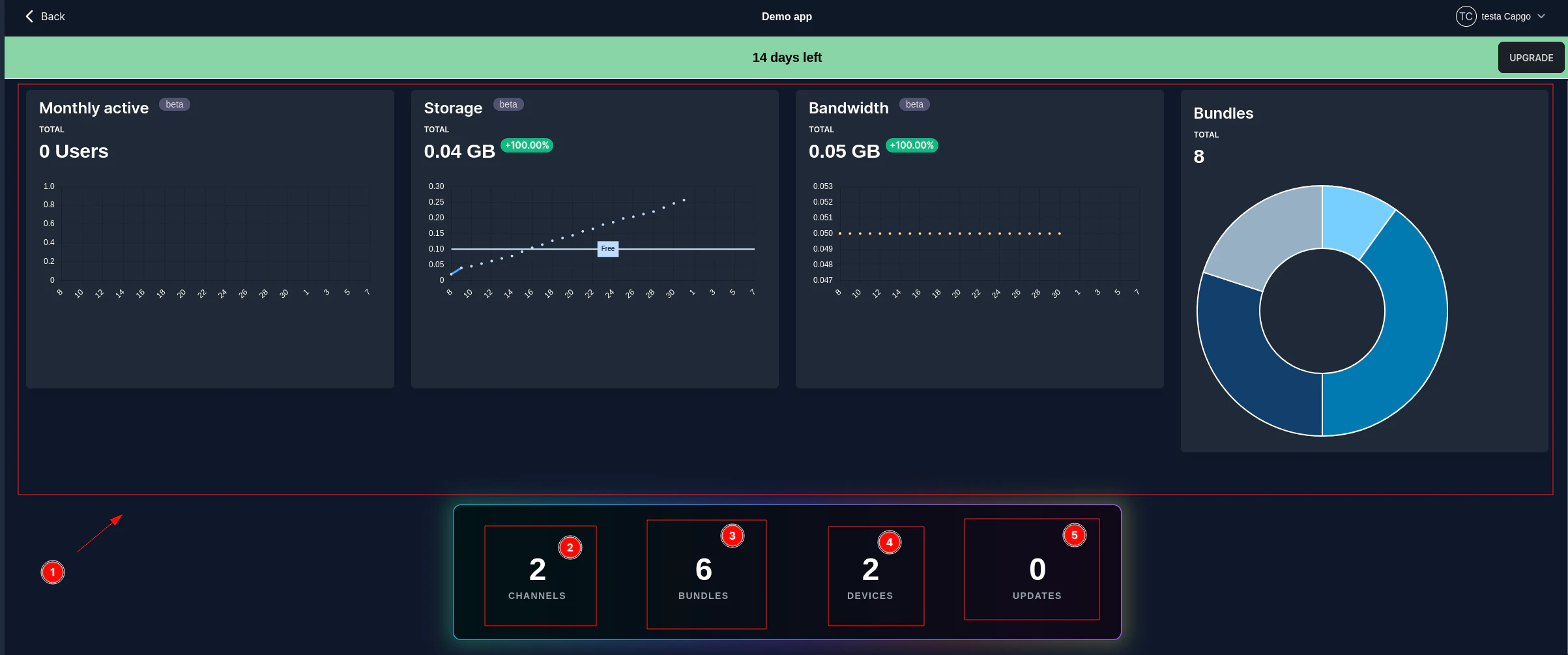
Examinons cela de plus près. La page principale de l'application est divisée en plusieurs zones clés :
-
Barre de navigation en haut : Fournit accès aux vues de gestion de l'application principale. Le screenshot est illustratif ; la console actuelle comprend :
- Tableau de bord : Indicateurs et résumés pour l'application.
- Observez (beta) : Lancement natif, WebView, signaux de problèmes et de santé de la mise à jour.
- Informations : Paramètres et détails de l'application principale (voir Information sur l'application).
- Ensembles: Versions et mises à jour.
- Canaux: context
- Canal d'actualisation et contrôles de déploiement progressif.: Appareils
- context: Log des événements et les journaux bruts.
- Builds : Gestion de build natif.
-
Affichage des statistiques : Affiche les principales métriques pour la dernière période facturée (les données reflètent l'utilisation de votre jour de facturation, et non du 1er du mois) :
- Utilisateurs actifs mensuels (8) : Suivi du nombre d'utilisateurs actifs uniques au fil du temps.
- Stockage (9) : Affiche la consommation de stockage actuelle.
- Bandwidth (10) : Affiche l'utilisation de la bande passante.
- Bundle Actif (11): Affiche la répartition des appareils actifs en fonction de différents lots d'applications.
-
Cartes de Résumé: Propose un aperçu rapide des principaux comptes :
- Téléchargements de Bundle (12): Nombre total de lots d'applications téléchargés.
- Statistiques des Mises à Jour (13): Nombre total de mises à jour effectuées, y compris les requêtes, les installations et les échecs.
- Statistiques des Déploiements (14): Nombre total de déploiements.
-
Options de Affichage (15-18): Contrôles pour filtrer et afficher les statistiques :
- Journalier (15): Afficher les statistiques sur une base journalière.
- Cumulatif (16): Afficher les statistiques cumulatives sur le temps.
- Période d'échéance (17): Afficher les statistiques pour la période d'échéance actuelle.
- Intervalle de dates (18): Sélectionnez un intervalle de dates personnalisé (par exemple, les 30 derniers jours).
Information de l'application
Section intitulée « Information de l'application »Cette section correspond à l'onglet « Information » (1) dans la barre de navigation supérieure. Vous pouvez y afficher et gérer les détails et les paramètres essentiels de votre application.
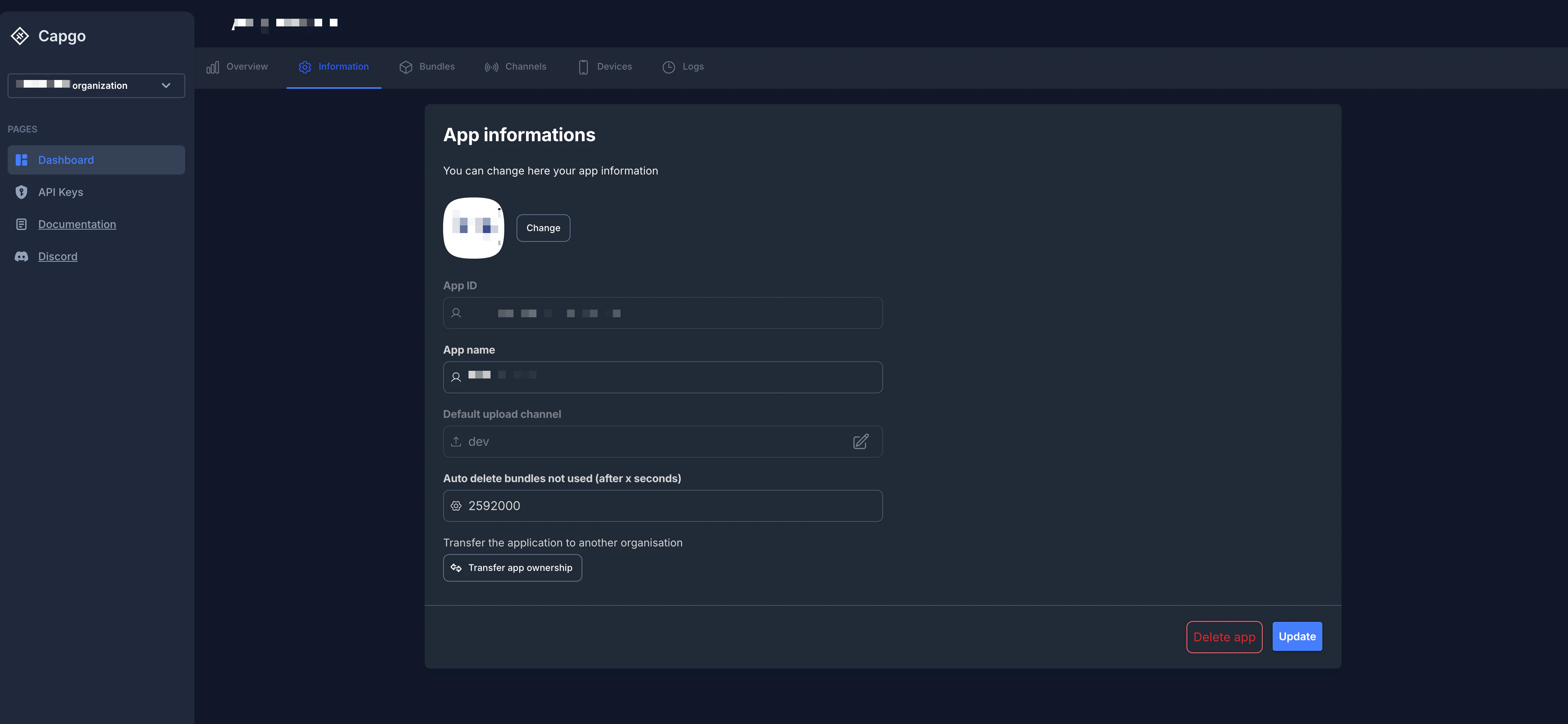
La capture d'écran est plus ancienne que la console actuelle et ne montre pas tous les paramètres actuels. Utilisez les descriptions des champs ci-dessous comme source de vérité.
Voici un aperçu des champs et actions disponibles :
- Appareil d'icône (2) : Affiche l'icône de votre application. Vous pouvez cliquer sur le bouton « Changer » pour télécharger une nouvelle icône.
- ID d'application (3) : Un identifiant unique pour votre application dans Capgo. Ce ID n'est pas éditable.
- Nom d'application (4) : Le nom affiché pour votre application. Vous pouvez le modifier si nécessaire.
- Canal de téléchargement par défaut (5) : Spécifie le canal par défaut vers lequel les nouvelles archives seront téléchargées. Vous pouvez cliquer sur l'icône de modification pour sélectionner un canal différent par défaut.
- Canal de téléchargement par défaut (6) : Spécifiez le canal par défaut à partir duquel les appareils téléchargeront les mises à jour. Vous pouvez cliquer sur l'icône de modification pour sélectionner un canal de défaut différent. La page du canal affiche si un canal est le canal de défaut, mais vous le changez ici, et non avec un commutateur sur le canal. Ouvrez un canal et cliquez Gérer les paramètres de l'application pour passer à ce champ. Consultez la Configuration du canal par défaut section ci-dessous pour obtenir des informations détaillées.
- Supprimer automatiquement les ensembles non utilisés (après x secondes) (7) : Cette option vous permet de supprimer automatiquement les ensembles anciens qui n'ont pas été utilisés pendant une durée spécifiée (en secondes). Définissez sur
0pour désactiver la suppression automatique. Cela aide à gérer l'espace de stockage et à garder votre liste d'ensembles propre. - Exposer les métadonnées de l'ensemble aux plugins (8) : Lorsque cette option est activée, les champs de lien et de commentaire de l'ensemble seront envoyés au plugin de mise à jour Capacitor. Cette fonctionnalité nécessite une version du plugin supérieure ou égale à 7.35.0.
- Empêcher les requêtes d'infrastructure de fournisseur : Lorsque cette option est activée, Capgo rejette les requêtes de mise à jour, de statistiques et de canal-self provenant des adresses IP de centres de données Google et Apple connus. Laissez-l’activée pour le trafic de production normal. Désactivez-la temporairement uniquement lorsque vous testez intentionnellement depuis l'infrastructure de fournisseur. Les nouvelles applications activent cette protection par défaut ; les applications existantes conservent leur paramétrage précédent désactivé jusqu'à ce que vous le modifiiez.
- Transfert de la propriété de l'application (9): Cette section fournit une option pour initier le transfert de votre application vers une organisation différente dont vous faites partie.
- Bouton de suppression de l'application : Supprime définitivement votre application de Capgo. Cette action est irréversible et supprimera toutes les données associées, les ensembles, les canaux et les appareils.
- Bouton de mise à jour : Enregistre toutes les modifications que vous avez apportées aux champs éditables de cette page (par exemple, le nom de l'application, le canal de téléchargement par défaut, la configuration d'auto-suppression des ensembles).
Configuration du canal par défaut
Sous-section intitulée « Configuration du canal par défaut »Le Canal de téléchargement par défaut est l'une des configurations les plus importantes pour votre application. Il détermine quel canal les nouveaux appareils recevront des mises à jour lorsqu'ils se connectent pour la première fois à Capgo.
Comment fonctionnent les canaux par défaut
Section intitulée « Comment fonctionnent les canaux par défaut »Lorsqu'un appareil demande une mise à jour à Capgo, le système détermine le canal à utiliser en fonction de la priorité suivante (priorité la plus élevée en premier) :
- Cartographie de l'appareil forcée: Si l'ID de l'appareil est explicitement forcé à un canal dans les paramètres du canal, ce canal gagne toujours.
- Surcharge Cloud: Si l'appareil a été affecté à un canal depuis le tableau de bord ou Public API, cette surcharge est utilisée.
- Plugin
setChannel(): Dans les versions actuelles de ce plugin, c'est une affectation locale et non une surcharge du tableau de bord. Voir Comment un appareil choisit un canal. - Capacitor config
defaultChannel: Si défini dans votrecapacitor.config.*fichier, cela est utilisé pour les builds de test/bêta. - Canal de Téléchargement Par Défaut: La configuration effectuée ici. C'est ce que ~99% de vos utilisateurs de production utiliseront.
Canaux Par Défaut Spécifiques à la Plateforme
Section intitulée “Canal Par Défaut Spécifique à la Plateforme”Vous pouvez configurer des canaux par défaut spécifiques à la plateforme — par exemple un pour iOS, un pour Android et un pour Electron. Cela est utile lorsque :
- Vous souhaitez mettre à jour une plateforme avant les autres
- Vous avez besoin de stratégies d'actualisation différentes par plateforme
- Vous testez une nouvelle version sur une plateforme tout en gardant l'autre stable
Pour configurer les défauts par défaut par plateforme :
- Créez des canaux séparés pour chaque plateforme (par exemple
production-ios,production-android, etproduction-electron) - Dans les paramètres de chaque canal, activez uniquement la plateforme pertinente (iOS, Android ou Electron)
- On Information sur l'application, définissez chaque de ces canaux comme le canal de téléchargement par défaut pour sa plateforme. Capgo permet d'avoir plus d'un canal par défaut lorsque les canaux ciblent différentes plateformes.
Lorsqu'un appareil demande une mise à jour :
- Les appareils iOS recevront des mises à jour du canal par défaut iOS activé
- Les appareils Android recevront des mises à jour du canal par défaut Android activé
Un Canal de Téléchargement Par Défaut Unique (Recommandé pour la plupart des Applications)
Sous-titre « Un Canal de Téléchargement Par Défaut Unique (Recommandé pour la plupart des Applications) »Pour la plupart des applications, une seule chaîne de téléchargement par défaut qui prend en charge les trois principaux plateformes est l'approche la plus simple :
- Créez un canal (par exemple,
production) - Assurez-vous que les boutons iOS, Android et Electron soient activés
- Définissez-le comme le canal de téléchargement par défaut sur Informations sur l'application
Cela garantit un comportement cohérent sur tous les plateformes et simplifie votre flux de publication.
Modification du canal par défaut
Section intitulée « Modification du canal par défaut »Lorsque vous modifiez le canal par défaut :
- Les nouveaux appareils recevront immédiatement des mises à jour à partir du nouveau canal par défaut
- Les appareils existants qui ont déjà une affectation de canal (via un décalage ou une force) NE seront PAS automatiquement mis à jour
- Pour déplacer les appareils existants, vous devez soit :
- Utiliser
setChannel()ouunsetChannel()) à partir de l'application. La suppression du registre du périphérique backend n'efface pas une affectation locale.setChannel()La suppression. - Forcer leur canal à l'écran de tableau de bord (console/API ; expire après 90 jours).
- Supprimer leur console/API pour qu'ils retombent dans l'ordre de priorité. Les appareils avec uniquement la valeur par défaut cloud reprennent ensuite la nouvelle valeur par défaut.
- Utiliser
Conseil.: Testez toujours votre nouveau canal par défaut avec un petit groupe d'appareils forcés avant de le rendre par défaut pour tous les utilisateurs.
Continuez depuis la page d'application.
Section intitulée « Continuez depuis la page d'application ».Si vous utilisez la page d'application pour planifier l'écran de tableau de bord et les opérations API , connectez-l’avec API Vue d'ensemble pour le détail d'implémentation dans API Vue d'ensemble Introduction pour le détail d'implémentation dans Introduction API Clés pour le détail d'implémentation dans API Clés Appareils pour le détail d'implémentation dans Appareils, et Bundles pour le détail d'implémentation dans Bundles.